
 @AstroBassDee
 17
@AstroBassDee
17
17
@AstroBassDee
17
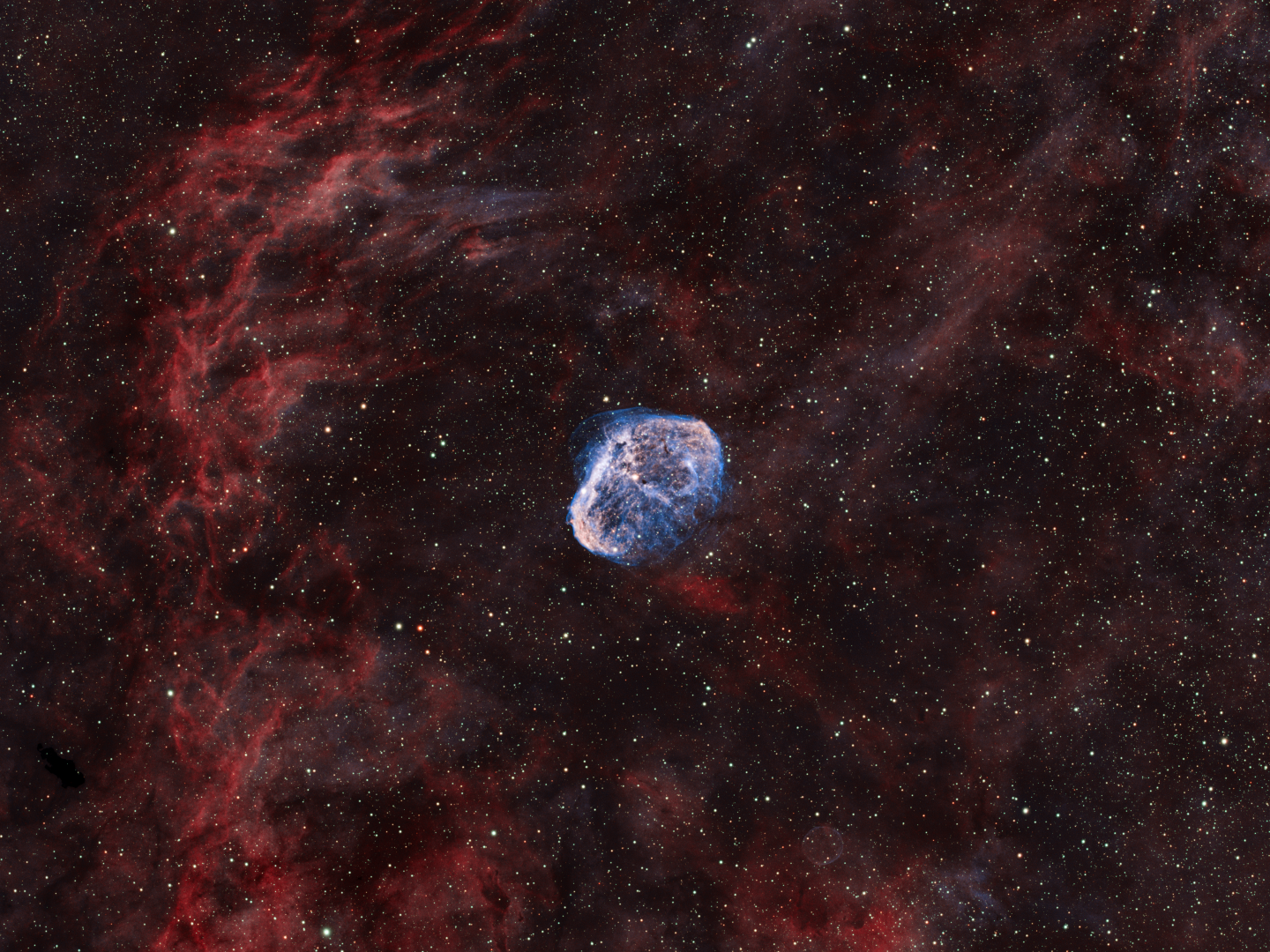
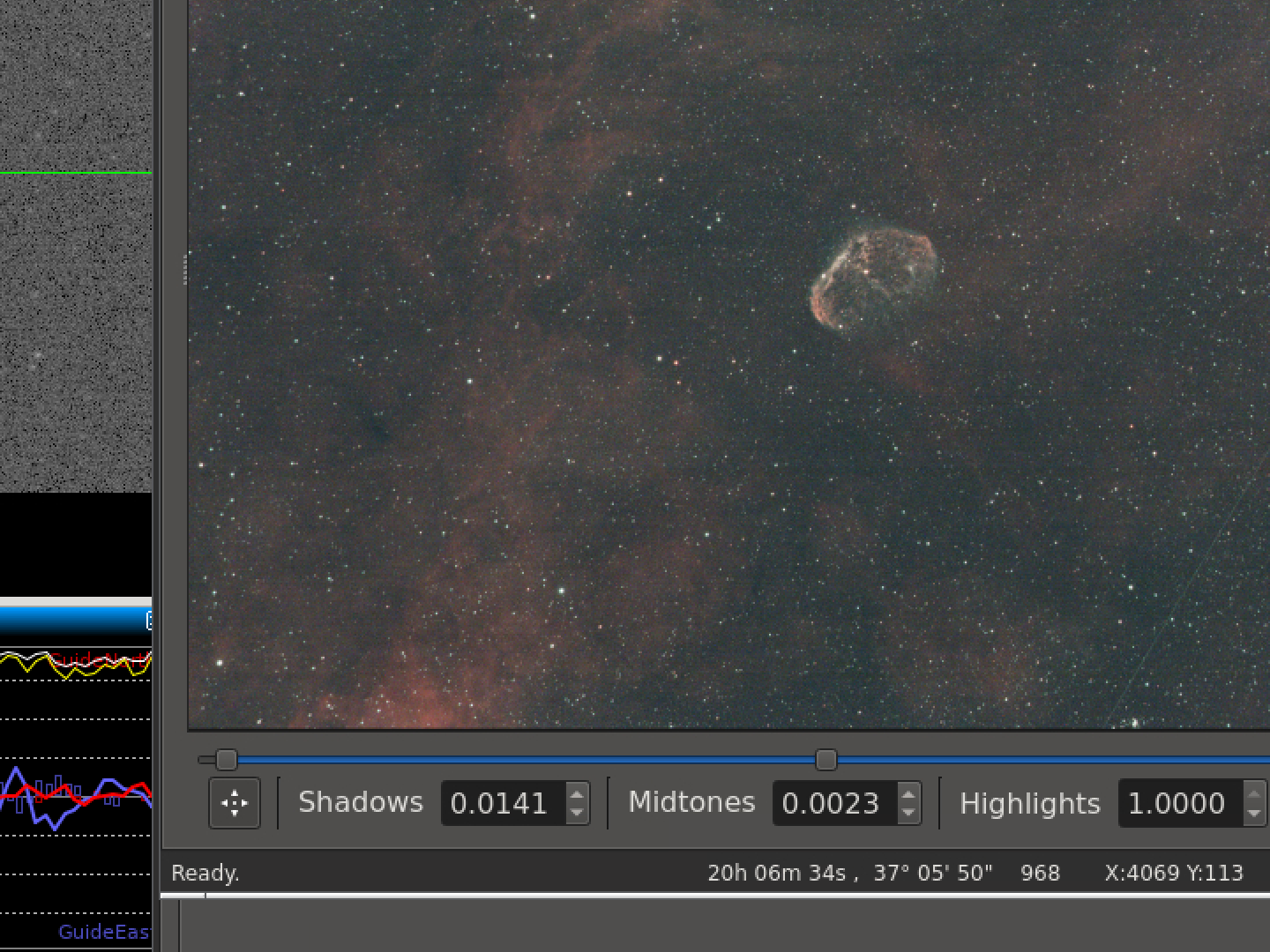
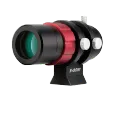
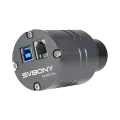
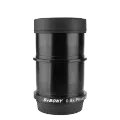
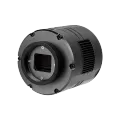
NGC 6888, the Crescent Nebula in HOO from a Backyard Refractor \n\nNGC 6888 is a Wolf-Rayet bubble in Cygnus, formed as the fast wind of the central star WR 136 collides with material shed in an earlier red supergiant phase. The shell shows a strong OIII component in its inner cavity and Ha dominated filaments in the outer arcs, which makes it an ideal subject for a dualband narrowband approach on a color sensor. This is a full technical writeup of how I captured and processed it from my backyard near Salzgitter in northern Germany. \n\nAcquisition \n\nThe optical train was the SVBONY SV550 80ED refractor with the 0.8x reducer, yielding 384mm focal length at f/4.8. On the IMX294 sensor of the cooled SVBONY SV405CC this gives a pixel scale of about 2.49 arcseconds per pixel, which matches the typical seeing at my site well and keeps the target critically sampled rather than oversampled. The filter was the SVBONY SV220 Ha OIII 3nm dualband, chosen so both emission lines are captured in a single pass on the one shot color chip. \n\nThe mount is an EXOS 2 with an OnStep controller, guided with PHD2 through an SV165 guide scope and SV305C Pro guide camera. Acquisition and control ran from a Raspberry Pi 5 in the field using EKOS and KStars. All exposures were 180 seconds. I chose this sub length after checking that the sky background stayed comfortably above the read noise floor with the 3nm filter at f/4.8, which it did, so the shorter subs gave me better rejection of satellites and guiding outliers without sacrificing depth. The data was collected across three nights around the August new moon. After discarding a handful of frames to guiding and passing clouds, 166 subframes made the final stack, for a total integration of 8.3 hours. \n\nCalibration and Stacking \n\nEach night was calibrated with its own darks, flats and dark flats. Bias frames were omitted, since the dark flats already carry the bias signal for the flat calibration and the darks are matched in exposure to the lights. Stacking was done in Siril with a two pass registration followed by drizzle integration, using sigma rejection at 3.0 low and 3.0 high to remove hot pixels, plane trails and the remaining outliers. Keeping the pipeline at 32 bit throughout preserves the faint OIII signal for the aggressive stretch it needs later. \n\nChannel Separation, the Key Step \n\nWith a dualband filter on a color camera, the stacked result is an RGB image where Ha sits almost entirely in the red channel and OIII spreads across green and blue. Treating this as a single RGB image and stretching it as a whole is where most Crescent images fail, because the strong Ha simply overwhelms the fainter OIII and the turquoise inner shell disappears. \n\nThe solution is to separate the channels and stretch them independently. After cropping, plate solving, background extraction with GraXpert and denoising, I removed the stars with Starnet on the starless linear image. On that starless image I then split the channels with the Siril command split HA OIII_G OIII_B. Since the green and blue OIII data are nearly identical, I averaged them into a single cleaner OIII channel using pixel math with the expression ($OIII_G$ + $OIII_B$) / 2. \n\nFrom there, Ha and OIII were stretched separately. The Ha was stretched moderately, while the OIII was pushed considerably harder to bring the inner shell up to a visible contrast. This is the entire point of the separation. Because the OIII is pulled up so aggressively, its noise rises with it, so I applied an additional targeted denoise to the OIII channel alone before recombining, which cleaned up the graininess without touching the sharper Ha data. \n\nRecombination and Finishing \n\nThe two stretched channels were recombined into an HOO palette with rgbcomp, mapping Ha to red and the OIII to both green and blue. A green cast is normal after this step because OIII feeds two channels, so I applied SCNR green to neutralize it. From there the image went through curve adjustments for the final color balance between the red filaments and the turquoise cavity, followed by nonstellar sharpening with Cosmic Clarity on the starless image. Finally the stars, separated earlier and stretched on their own with a gentle asinh and histogram transform, were added back over the finished nebula. \n\nThe result shows the characteristic structure of the Crescent, the bright inner OIII shell contained within the network of Ha filaments that make up the outer bubble. For anyone working from a light polluted backyard with a modest refractor, NGC 6888 is a strong demonstration of how far dualband narrowband combined with disciplined channel separation can go. \n\nIG: @AstroBassDee
My name is Sebastian, and online I go by @AstroBassDee. I've been doing deep-sky astrophotography for about a year now, imaging from Lower Saxony in Germany. I started out with a DSLR and a cheap achromat, and have since moved to a cooled, narrowband setup built around SVBONY gear. I shoot pretty much everything in the deep sky, from nebulae to galaxies, and the Veil had been on my list for a while.

 Google
 Amazon
No data Yet