


 Wellenberg
 5
Wellenberg
5
5
Wellenberg
5
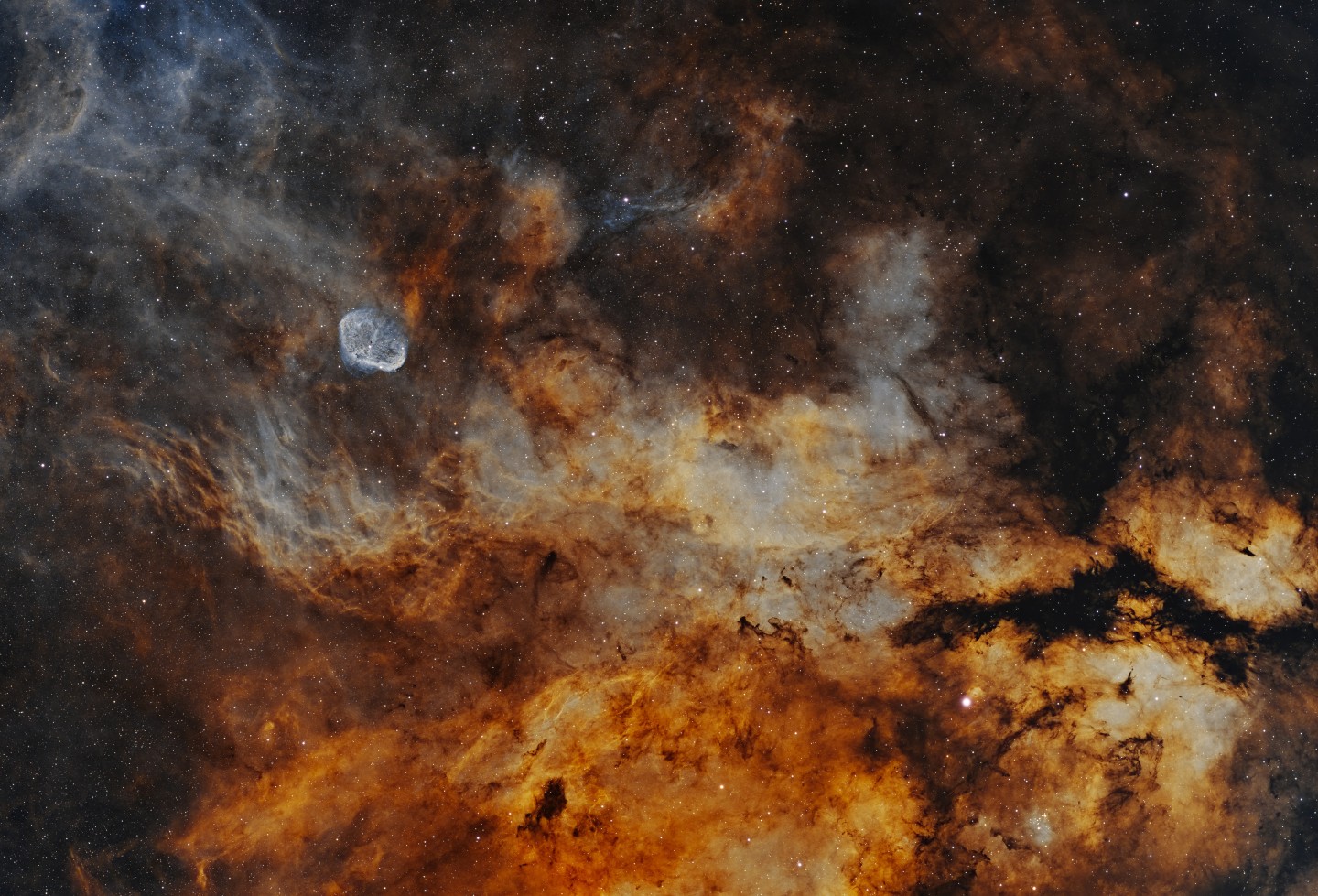
I spent a four-week vacation in Germany and had my lightweight travel gear with me. I was able to collect about 29 hours of HaOIII, SIIOIII, and RGB data from the Sadr region. This is the longest exposure I have ever captured, and I find the result impressive. Stacked in Siril, postprocessed in PixInsight and Gimp.
The Anchor Star (Sadr / \gamma Cygni): Sadr sits at the center of the region. It is a brilliant supergiant star roughly 12 times more massive and 33,000 times more luminous than our Sun. However, Sadr is a foreground star roughly 1,800 light-years away, while the nebula surrounding it lies much deeper in space at around 3,000 to 5,000 light-years. The Butterfly Structure: Dark interstellar dust lanes split the glowing gas clouds into distinct lobes, earning IC 1318 the nickname The Butterfly Nebula (not to be confused with planetary nebulae of the same name). Star-Forming Region: The complex glows red due to ionized hydrogen gas (\text{H II}) excited by nearby hot young stars embedded within dense dust clouds. Astrophotography Favorite: Located within the dense star fields of the Milky Way plane, it is surrounded by iconic deep-sky targets including the Crescent Nebula (NGC 6888) and the open cluster NGC 6910.
 Google
 Amazon
No data Yet