

 Giacomo76
 109
Giacomo76
109
109
Giacomo76
109

March 2026
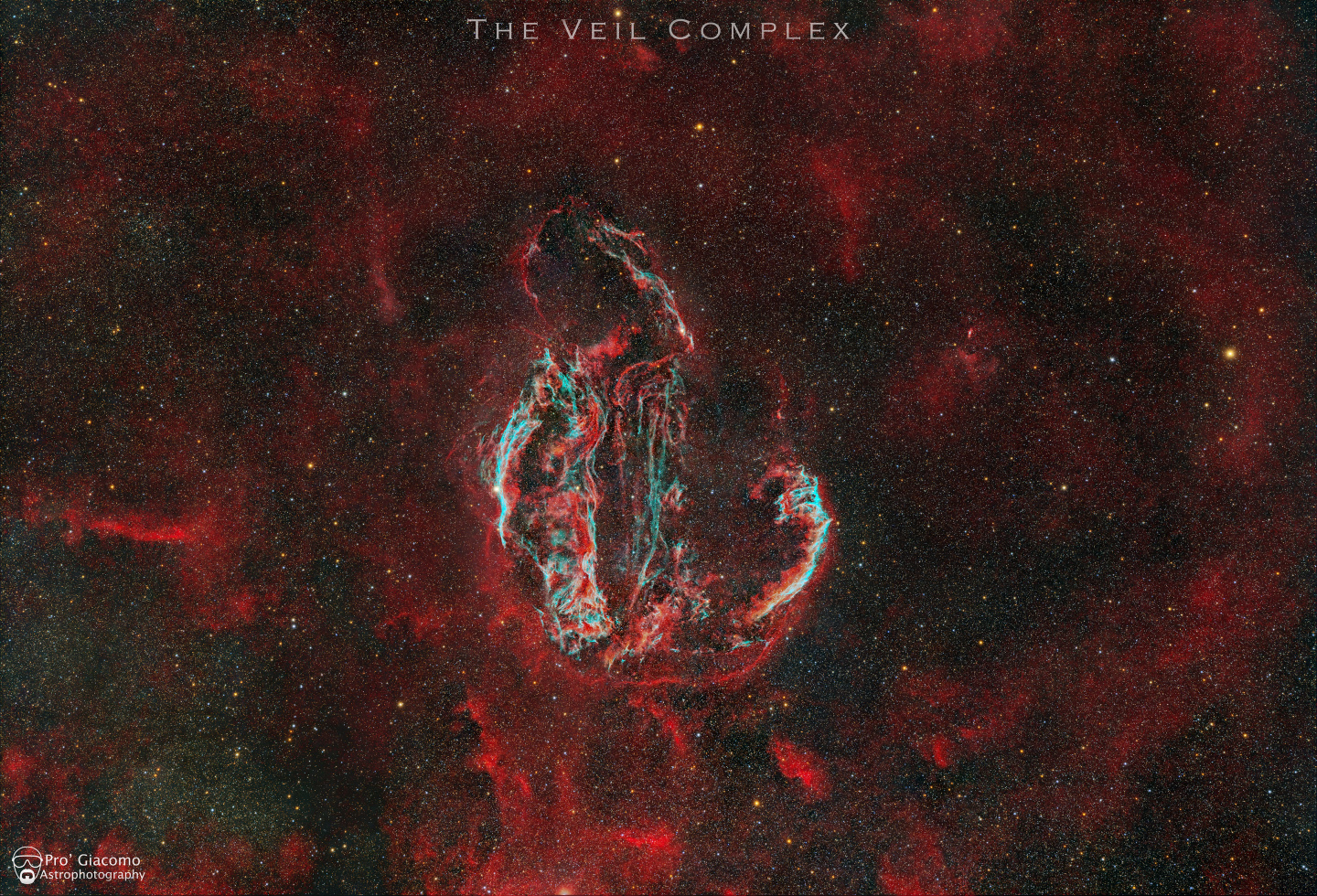
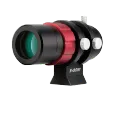
What we see in this image is the spectacular Cygnus Loop, also known as the Veil Nebula: the immense remnant of a supernova that exploded between 10,000 and 20,000 years ago, about 2,400 light-years from Earth in the constellation Cygnus. The wide-field view allows us to admire the entire nebular complex, revealing the extraordinary extent of this immense, expanding bubble of gas, almost 120 light-years across. On the right, the Eastern Veil stands out, composed primarily of the nebulae NGC 6992 and NGC 6995, where intricate filaments of hydrogen and oxygen intertwine like delicate cosmic lace. On the opposite side, the Western Veil emerges, identified as NGC 6960, famous for crossing the bright star 52 Cygni, creating one of the most fascinating contrasts in astrophotography. These filaments are not simple clouds of gas: they represent the shock wave of the supernova that continues to propagate through space today, compressing and heating the interstellar medium until it glows with the characteristic colors of ionized hydrogen and oxygen. Each subtle thread tells a story that began thousands of years ago, when a massive star ended its existence in an explosion of unimaginable energy. Today, that same energy continues to shape the cosmos, reminding us that in the Universe, every end is also a new beginning. Observing the Veil Complex means contemplating a moment in the ongoing transformation of the Universe: the last traces of a star that, in dying, left behind one of the most extraordinary works of art in the sky. Light: 172 x 300 seconds Filter: Optolong L-Extreme F2 Camera: Asi 294 mc pro Telescope: Svbony SV 535 APO f/2.8 Guide Scope: Svbony SV165 30/120 F4 Mount: Skywatcher Eq 6-r Pro Acquisition: Asiair Plus Software: DSS - Pixinsight – Photoshop Shots: 03-09-10-21/07/2026 Location: Torricella (TA) ITALY Sky Bortle: 6 Author: PRO’ GIACOMO.
Il primo aspetto che colpisce è senza dubbio la luminosità: un rapporto focale di f/2.8 su 105 mm consente di raccogliere una quantità di luce notevole in tempi relativamente contenuti. Una caratteristica che rende questo obiettivo particolarmente interessante per la ripresa di nebulose estese e campi stellari ricchi, come le regioni della Via Lattea. Dal punto di vista ottico, le prime impressioni sono positive: le stelle appaiono pulite e ben definite, con un leggero cromatismo comunque facilmente gestibile in fase di post-produzione. La puntiformità rimane buona fino ai bordi del sensore della ASI294MC Pro, senza evidenti segni di degrado. Anche la vignettatura si mantiene contenuta, risultando meno invasiva rispetto ad altri obiettivi con caratteristiche simili. Il montaggio dei filtri è semplice e immediato grazie alla filettatura frontale da 2”. Sul fronte pratico, uno dei punti di forza è sicuramente la portabilità: dimensioni compatte e peso contenuto lo rendono adatto anche a

 Google
 Amazon
No data Yet