

 Petr Vichr
 3
Petr Vichr
3
3
Petr Vichr
3
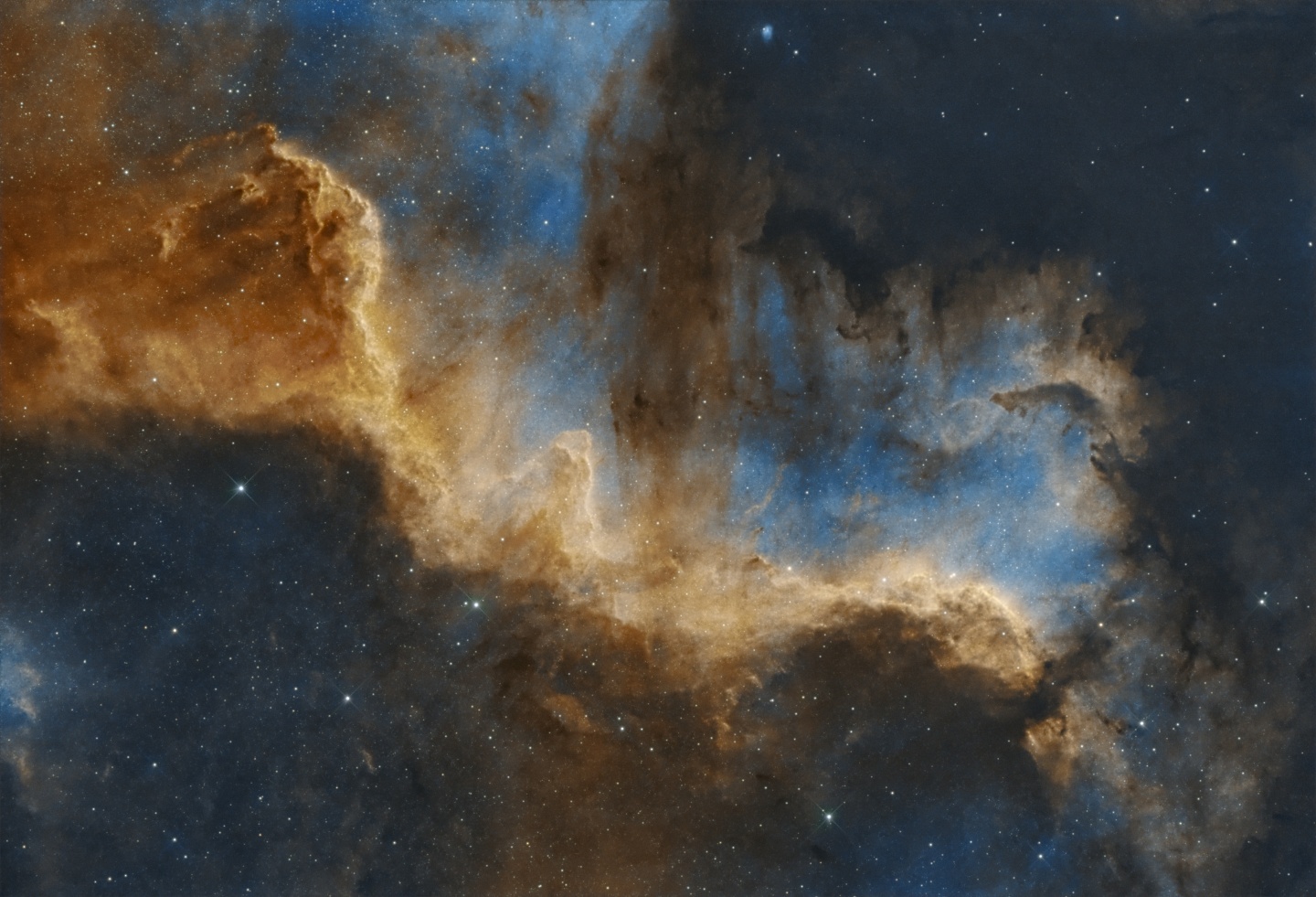
A detailed narrowband view of the Cygnus Wall, one of the most prominent structures within NGC 7000. The image was created from Hα, OIII and SII emission data captured with an OSC camera and two dual-band filters. Hα was used as the red channel, SII as green, and OIII as blue. The OIII signal was combined from both dual-band datasets. Natural-color stars were added from a separate broadband UV/IR-cut dataset. The final narrowband integration is approximately 29 h 46 min, collected during September over several nights with very different conditions, including short clear windows, high cloud and strong moonlight.
The Cygnus Wall is part of the North America Nebula, approximately 2,500 light-years away. The bright structures are clouds of ionized gas, while the dark lanes are dense interstellar dust obscuring the glowing nebula behind them. This project took almost the entire month of September to complete. Clear nights were scarce, so the data was collected whenever short gaps between clouds appeared. Some sessions were affected by high cloud or an extremely bright Moon, making the final dataset a combination of many nights of very different quality. What fascinates me most about this region is how, at this focal length, the nebula begins to look less like a single astronomical object and more like a landscape of light, gas and dust.

 Google
 Amazon
No data Yet