
Table of Contents
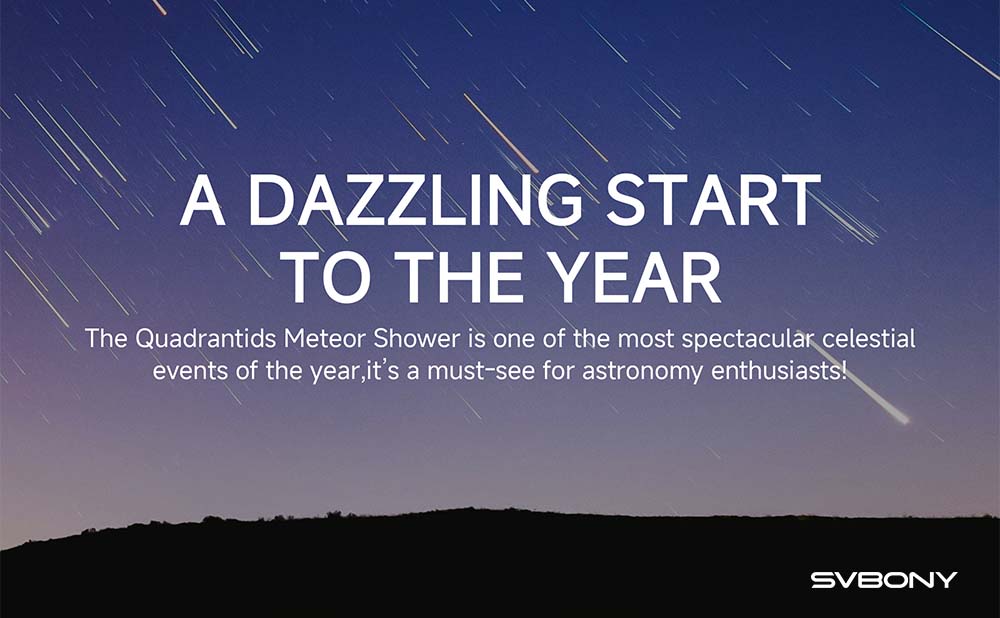
2026 Quadrantid Meteor Shower Observing Guide
The Quadrantid meteor shower is considered one of the three most intense meteor showers. Unfortunately, its peak in 2026 coincides with a full moon, at which time most meteors will be obscured by moonlight. However, if you concentrate, you might still be able to see some bright meteors!
What does the Quadrantid Meteor Shower Mean?
All meteor showers are named after the constellation where their radiant point is located. The Quadrantid meteor shower is an exception, however, because its radiant point is located in the constellation Boötes, near the Big Dipper. So, how did it get its name?
This January's main meteor shower is named after an ancient and now-obsolete constellation - Quadrans Muralis. This constellation was created in 1795 by the French astronomer Jérôme Lalande. In 1922, Quadrants, along with several other constellations, was removed from the modern list of constellations. Most of the stars in Quadrants eventually end up in Boötes, but the Quadrantid meteor shower retains the name, likely because a smaller meteor shower - the Bootids - is already present near Boötes in January.
The Origin of the Quadrantid Meteor Shower
The origin of the Quadrantid meteor shower remained unresolved until 2003, when astronomer Peter Jenniskens concluded that the shower's parent body was asteroid 2003 EH1. 2003 EH1 may be related to comet C/1490 Y1, which was observed 500 years earlier by astronomers in China, Japan, and South Korea. If 2003 EH1 is indeed the parent body of the Quadrantid meteor shower, it will become the second major meteor shower, after the Geminids, to originate from an asteroid rather than a comet.
When and where to see the Quadrantid Meteor Shower?
Visibility Forecast for the 2026 Quadrantid Meteor Shower
Theoretically, the zenithal hourly rate is about 80-120 meteors. However, if the peak coincides with a full moon (100% illumination), the actual number of meteors visible to the naked eye will be greatly reduced to about 10 or fewer per hour due to moonlight interference. If you can block the moonlight with buildings, trees, or hills, you might be able to see some bright fireballs.
When is the Quadrantid Meteor Shower in 2026?
Active period: December 28, 2025 - January 12, 2026.
Peak of activity:The estimated time is around 21:00 GMT on January 3.The peak lasted only about 6 hours.
Where can I see the Quadrantids?
- Best viewing area: Northern Hemisphere. The radiant point of the meteor shower is located in the northern celestial sphere, remaining above the horizon throughout the night and rising relatively high.
- Viewable but less ideal area: Southern Hemisphere. The radiant point remains low or below the horizon, resulting in a limited number of visible meteors.
| Area | Recommended Date | Observation Strategy |
| East Asia | January 3 - January 4 | Best Observation Window: January 4, 00:00 – before dawn (~06:00) • Reason: The radiant rises around midnight from the northeast and reaches its highest point in the second half of the night, increasing meteor rates. • Moonlight Strategy: The full moon (January 3) shines all night. The key is to find an observation spot with terrain or trees to the west in the latter half of the night (as the moon sets in the west) to place yourself in the moon's shadow. |
| Europe | January 3 - January 4 | Best Observation Window: January 3 after sunset – January 4 before dawn • Reason: The radiant is low in the early evening, but activity has begun. The peak time (UTC 21:00) corresponds to nighttime in Europe (e.g., 22:00 in London, 23:00 in Berlin), making it a prime viewing opportunity. • Moonlight Strategy: The nearly full moon is visible almost all night. In the early evening, the moon is in the southeast, requiring southeast-facing obstructions; later in the night, it moves to the southwest, requiring southwest-facing obstructions. |
| North America | January 2 - January 3 (The night before the peak) |
Only Viable Observation Window: January 2 after sunset – January 3 before sunrise • Reason: The predicted peak at UTC 21:00 on January 3 corresponds to daytime in North America (16:00 in New York, 13:00 in Los Angeles). Therefore, observation must occur the night before. • Moonlight Strategy: The moon phase will be a waxing gibbous moon (~98% illuminated), still extremely bright and disruptive. The strategy is the same as for Europe: find obstructions based on the moon's position. |
Conclusion
The first major meteor shower of 2026 - the Quadrantids - will peak around 21:00 GMT on January 3. While this shower will produce approximately 80 meteors per hour, the full moon will make most of them difficult to observe. It is recommended to observe before dawn on January 4 to capture some bright meteors.
 Google
 Amazon
There are no customer reviews yet . Leave a Reply !