
Table of Contents
Review of the SVbony SV220 3nm Dual band H-Alpha&OIII Filter
Narrowband filters are essential for capturing nebula details, yet for years, “performance” and “price” seemed an irreconcilable contradiction - top-tier brands offered exceptional 3nm filters at premium prices, while budget-friendly options often compromised performance, deterring enthusiasts. That balance was shattered with the arrival of the SVbony SV220 3nm filter. Jim Thompson (P.Eng) reveals the true capabilities of this filter through rigorous spectral analysis, real imaging tests, and multi-dimensional reviews.Below is the initial content of Jim Thompson's review:
Below is the Initial Content of Jim Thompson's SV220 3nm Filter Review
Introduction:
Last month SVbony released a new narrowband filter, the SV220 3nm H-Alpha & OIII Filter. There are already four existing commercially available filters in the 3nm multi-narrowband(MNB) class, making SVbony’s offering a latecomer to the filter market. In this review I put a sample of this new filter (pictured in Figure 1) to the test to see how it performs compared to the already established filters in the same class. I also provide a comparison between the SV220 7nm filter that came out last Fall to the new 3nm version.
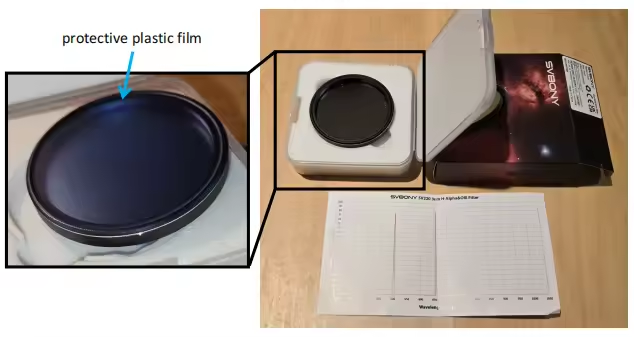
Figure 1 My Sample of the New SV220 3nm Filter
Objective:
Specifically, in this review I compare the filters listed below (quoted price in USD for 2” version):
-
Optolong L-uLtimate – $419
-
Askar Colour Magic Ultra E1 Duo Narrowband – $605
-
Player One Anti-Halo PRO Dual-Band – $499
-
Antlia ALP-T 3nm – $429
-
SVBony SV220 3nm – $290
-
SVBony SV220 7nm – $140
The Antlia ALP-T and SVbony SV220 7nm H-Alpha & OIII filter samples tested were purchased by me from various vendors, and the remaining filter samples were all provided to me for free by their respective manufacturers. Filter performance was evaluated based on the increase in contrast between the observed object and the background, which is a measurable quantity. It was evaluated quantitatively using the measured filter spectra combined with the spectra of several common deepsky objects, and by direct measurement from images captured using each filter and a one-shot colour (OSC) camera. The spectrometer data was also used to evaluate the relative signal-to-noise ratio (SNR) achievable using each filter.
Results – Spectrum Measurements:
The transmission spectrum for each filter, as measured on my bench spectrometer, is shown in Figure 2. The spectrum of the new SVBony 3nm filter compares well against its competitors, having pass bands that are very well centered on O-III and Hα, and peak transmission values higher than the other four 3nm filters tested.
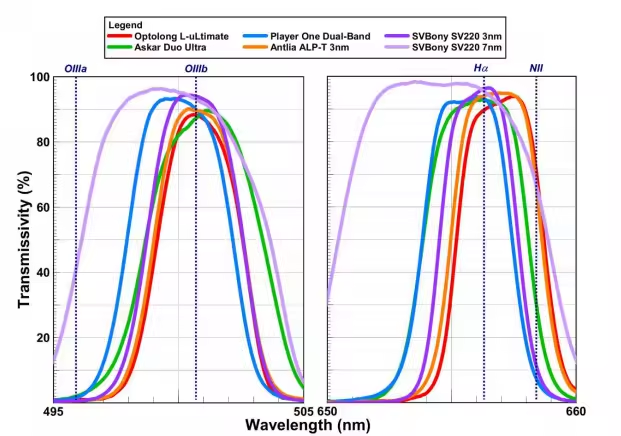 Figure 2 Measured Filter Spectra (f/∞) – 3nm Class MNB
My spectrometer testing included measurements over a range of filter angles to characterise the effect of operating on different speed optics. The resulting transmission rate of O-III and Hα versus optics f-ratio is plotted in Figure 3. Included on the figure is a summary table listing the full width half maximum (FWHM) band width calculated from my spectrum data, as well as a value of percent luminous transmissivity (%LT), a measure of generally how much light is getting through the filter.
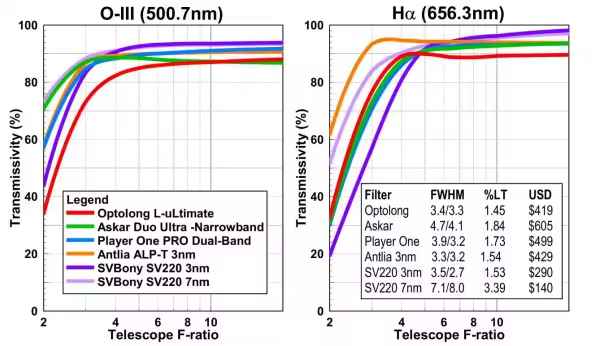 Figure 3 Measured Transmission vs. Optics F-ratio
Based on my measurements, the SVbony SV220 3nm Filter has similar f-ratio sensitivity in the O-III band to that observed for the other four brands, but higher sensitivity in the Hα band. If we assume a cut-off for useful transmissivity at 80%, then the SVbony 3nm filter is best used on optics slower than f/4, while most of the other brand filters can be used down to between f/3.2 and f/3.5. The stand-out is the Antlia filter which can be used down to around f/2.4. The reason for the increased sensitivity in the SVBony filter is that its pass bands are well centered on the O-III and Hα emission wavelengths, but it is better to have the pass band center wavelengths (CWL) shifted slightly to the right to compensate for band shift at faster f-ratios. Also, the effective refractive index of the filter coatings has an effect on the amount of band shift per unit filter angle, with a higher effective refractive index producing a lower f-ratio sensitivity.
The last piece of useful information to extract from the measured filter spectra is a prediction of the theoretical relative performance of each filter when imaging different types of objects. To do this I used the numerical method I developed back in 2012 which applies the spectral response of the filter and sensor combined with the spectral emission from the object and background light polluted sky to estimate the apparent luminance observed. Using this technique, I can predict both contrast increase and SNR relative to no filter, for a range of light pollution (LP) levels, which are expressed here in terms of naked eye limiting magnitude (NELM). The results of this prediction for the filters under test are provided in Figure 4.
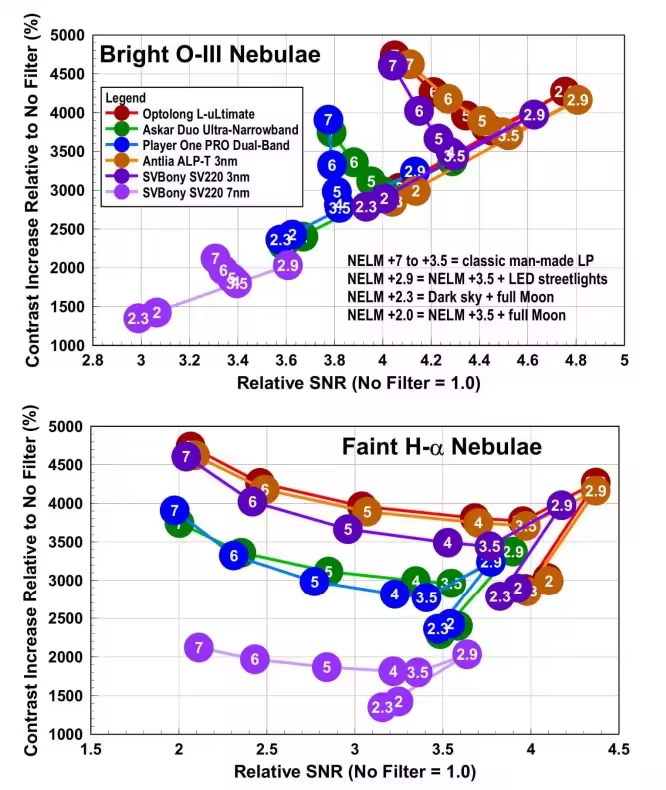 Figure 4 Predicted Filter Performance
Performance for a range of classic man-made LP levels are shown as well as three special cases: urban LP with LED streetlights (NELM +2.9), dark sky with a full Moon (NELM +2.3), and urban LP with a full Moon (NELM +2.0). Bortle equivalents for the stated NELM values are roughly as shown in Table 1.
Table 1 Approximate Conversion Between NELM and Bortle
|
NELM |
Approx. Bortle |
|
2.0 –2.9 |
9+ |
|
3.5 |
9 |
| 4.0 | 8 |
| 5.0 | 6 |
| 6.0 | 4 |
| 7.0 | 2 |
Note that the prediction of SNR assumes a fixed exposure time combined with a perfect sensor, i.e. there is no read noise or dark current noise, only shot noise. In the figures, a filter has better performance the higher up and more to the right it is on each plot. Finally, a Sony back-illuminated CMOS sensor with STARVIS (Gen 1) technology has been assumed for all of these predictions.
The new SV220 3nm dual band filter is predicted to be a strong performer, providing contrast and SNR increases only slightly less than the Optolong and Antlia brand filters, and significantly better than the Askar and Player One brand filters. Compared to the 7nm version of the SV220, the 3nm version provides roughly twice as much contrast increase.
Using my prediction of SNR it is also possible to put a number on each filter’s cost-benefit, in this case quantified in terms of $USD per unit of SNR. From the calculated values summarized in Table 2, the SVBony filter very cleary provides the lowest cost per unit of performance.
Table 2 Predicted Filter Cost-Performance Benefit
|
Filter |
$USD/Unit SNR |
|
Optolong L-uLtimate |
92 |
|
Askar Colour Magic Ultra E1 Duo Narrowband |
148 |
|
Player One Anti-Halo PRO Dual-Band |
126 |
|
Antlia ALP-T 3nm |
94 |
|
SVbony SV220 3nm |
66 |
|
SVbony SV220 7nm |
39 |
Results - Imaging:
Images of three different nebulae have been collected using each of the filters under test, including: NGC6960 “Western Veil”, IC1805 “Heart”, and M27 “Dumbbell”. These images were captured on two different evenings in late September – early October 2025, with all image collection on a particular target completed within a 75-minute window. All images were captured from my Bortle 9+ backyard (NELM +2.9), and are live stacks produced in Sharpcap with an ASI533 MC Pro camera and either a William Optics FLT-98 @ f/6.3, an Askar FMA180 @ f/4.5, or a Mallincam VRC-10” @ f/6. The same sub-exposure and total exposure time was used for all filters on a particular object.
Images of the three imaged objects taken with each filter are shown in Figures 5 to 7. A cursory review of the images suggests that there was very little difference between the performance of each filter. They all provide a very large increase in contrast and SNR over the no-filter case, as is clearly illustrated by the captured images. Also provided is a visual comparison between the 7nm and 3nm versions of the SV220 filter, shown in Figure 8. In this case the advantage of the narrower filter is evident in the increased visibility of faint nebulosity.
Differences in filter performance are more apparent after using the raw captured image data to directly measure the contrast increase delivered by each filter. This was accomplished by using AstroImageJ to measure the average luminance from common areas in the images: a dark background area, and a bright nebulous area. The resulting contrast increase measurements are plotted in Figure 9. Note that the letter inside each data marker denotes the deep-sky target that particular point corresponds to. For the most part, including the new 3nm SVBony filter, all the filters tested performed on average as predicted. The exceptions are as follows:
-
Optolong L-uLtimate slightly below predicted;
-
Player One Anti-Halo PRO Dual-Band slightly above predicted; and
-
SVbony SV220 7nm well above predicted, but data for only one target was collected.
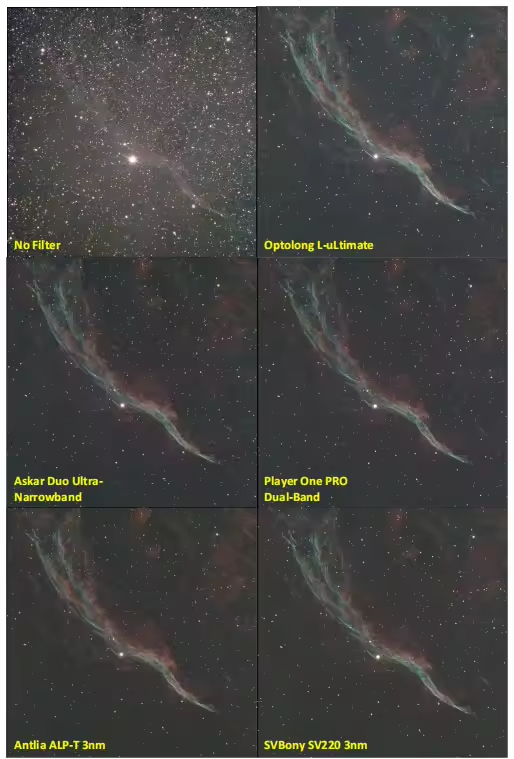 Figure 5 Sep. 20th Imaging Results – NGC6960 Western Veil Nebula
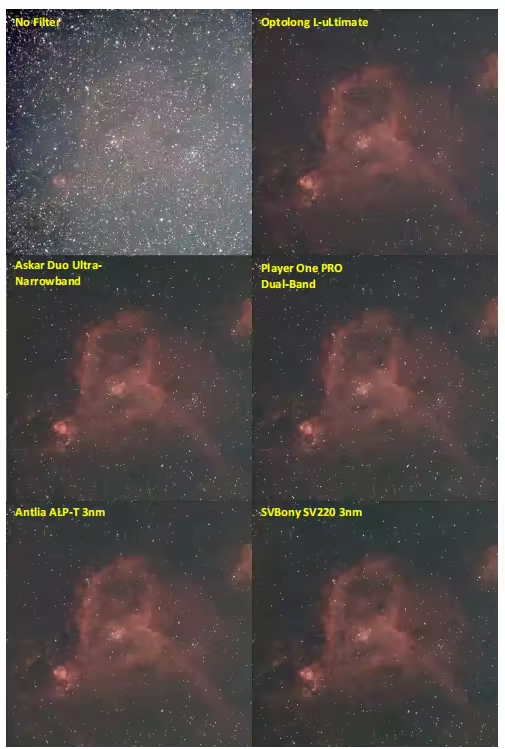
Figure 6 Sep. 20th Imaging Results – IC1805 Heart Nebula
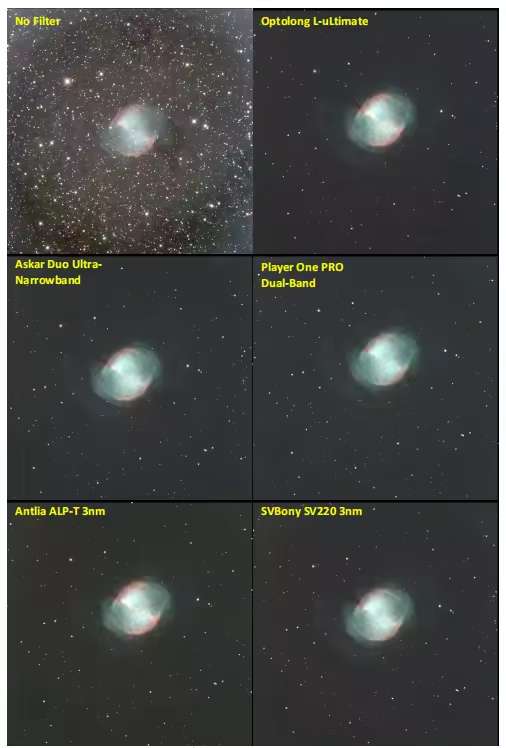 Figure 7 Oct. 5th Imaging Results – M27 Dumbbell Nebula
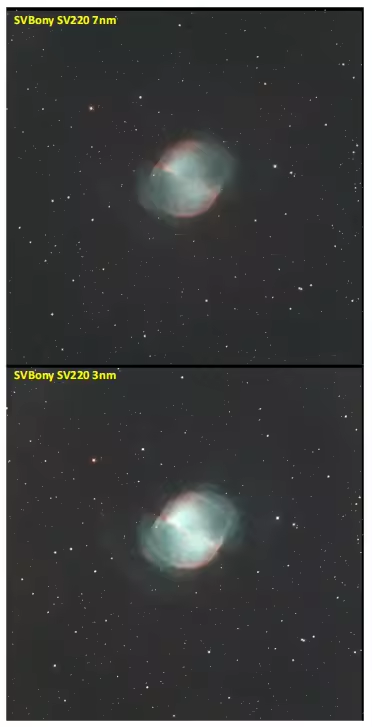
Figure 8 Oct. 5th Imaging Results – 7nm vs. 3nm SV220 Comparison
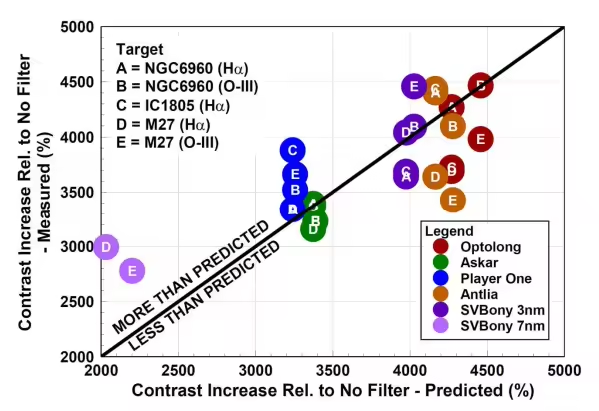 Figure 9 Measured Deepsky Object Contrast Increase vs. Predicted
The final observation to make from the image data is to compare each filter’s propensity for halos around bright stars. A blow-up of the area around Vega, captured on Sep. 19th and 20th, is shown in Figure 10. The Askar and Player One filters were found to have practically no evidence of halos. In the middle was the Antlia filter which showed evidence of a faint halo. The Optolong and SVBony filters presented the most evident halo of the filters tested.
Conclusions:
Based on the results of the testing described above, I have found the new 3nm SV220 filter to be a good value relative to the other filters in the 3nm MNB class:
-
predicted and measured contrast increase better than the Askar and Player One brand filters, and very similar to the Optolong and Antlia brand filters.
-
similar f-ratio sensitivity in the O-III band compared with all the other filters tested, but higher sensitivity in the Hα band;
-
halos around bright stars similar to the Optolong brand filter, where the Askar and Player One filters have none; and
-
the lowest price amongst available 3nm options, by a large margin.
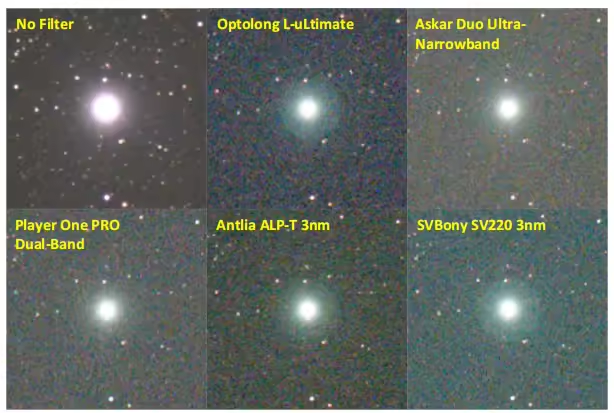 Figure 10 Examples of Halos Around Bright Stars – Vega (α Lyrae, +0.0, 9,000K)
If you have any questions, please feel free to contact me.
Cheers!
Jim Thompson
SV220 3nm Filter Brings Deep-sky Photography within Reach
Based on Jim Thompson's field testing, the SV220 3nm Filter precisely targets the O-III and Hα core bands within its spectral performance, with peak transmission rivaling top-tier industry brands. This ensures every intricate detail of nebulae is captured. In practical compatibility, the Hα band's higher f-ratio sensitivity allows it to fit most mainstream telescopes, meeting the equipment needs of different enthusiasts. Its advantage of offering the “lowest cost per unit SNR” is our solution for users working within budget constraints.
If you're seeking a 3nm narrowband filter that delivers “professional-grade performance at an entry-level price,” this authoritatively tested product may be the optimal solution for effortlessly launching your deep-sky photography journey.
We would also like to extend our special thanks to Mr. Jim Thompson (P.Eng) for his professional and rigorous evaluation! This assessment not only provides users with a clearer understanding of the product's capabilities but also offers valuable insights for our ongoing technical optimizations.
In the future, SVbony will continue to prioritize user needs, deepen its expertise in optical technology, and introduce more equipment that balances performance and affordability. This will empower more people to effortlessly explore the profound beauty of the night sky through their lenses!
 Google
 Amazon
There are no customer reviews yet . Leave a Reply !