


Table of Contents
Astronomical Events in February 2026
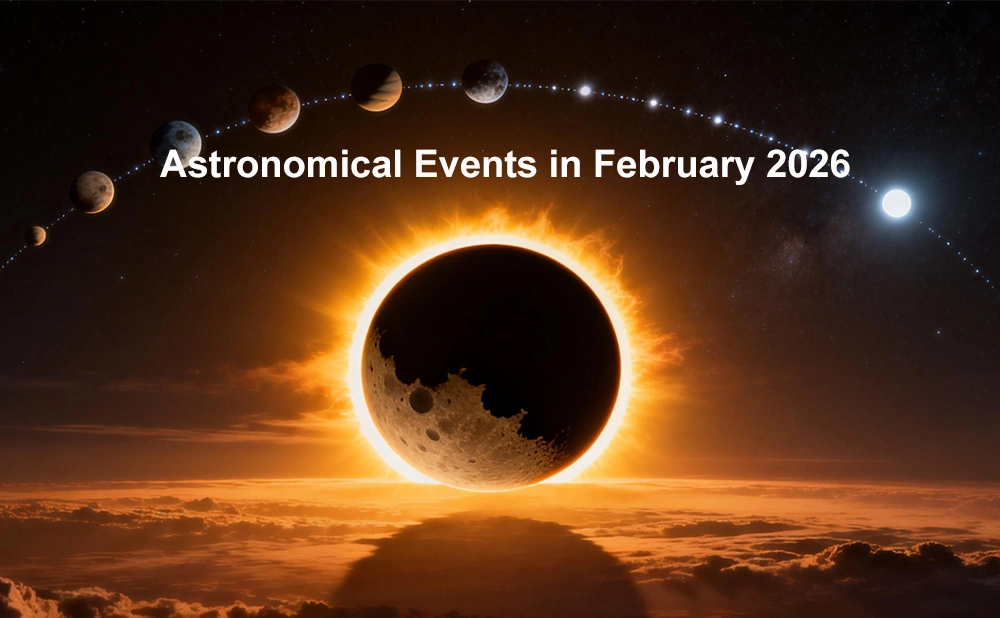
Though February is short, the night sky of February 2026 promises extraordinary sights. From a rare "six-planet alignment" to a "Ring of Fire" annular solar eclipse, from the prime viewing window for Mercury to a romantic encounter between the Pleiades and the Moon, this month's celestial calendar is packed. Whether you're an avid astronomer or a casual skywatcher, this guide will lead you through the cosmic wonders of February.
Top 5 Astronomical Events in February 2026
February 1st: Snow Moon (Full Moon)
Time: February 1, 22:09 GMT
What to see: Known as the "Snow Moon," February's full Moon will shine brightly in the constellation Cancer, close to the Beehive Star Cluster (M44). The sight of the brilliant Moon near a sparkling open cluster makes for a perfect night-time scene.
February 17th: Annular Solar Eclipse & New Moon
Time: New Moon occurs at February 17, 12:01 GMT
What to see: This New Moon coincides with an annular solar eclipse. Unfortunately, the path of annularity travels mostly over Antarctica and the Southern Ocean, making it a show primarily for penguins.
February 19th: Mercury at Greatest Western Elongation
Time: February 19, 16:59 GMT
What to see: This is one of the best opportunities to spot Mercury from the Northern Hemisphere in 2026. After sunset, look for Mercury low in the western sky, at its maximum angular distance (18°) from the Sun. Use the golden hour about 1 hour after sunset to find this elusive planet in the twilight.
February 24th: First Quarter Moon meets the Pleiades
Time: February 24, 02:43 GMT
What to see: The First Quarter Moon will pass very close (about 1 degree) to the famous Pleiades star cluster (M45, Seven Sisters). Observers in North America, Central America, and the Caribbean will even witness the Moon pass in front of the cluster - a beautiful lunar occultation.
February 28th: Six-Planet Alignment
Time: About 1 hour after sunset
What to see: The grand finale of the month! As dusk settles, look towards the western sky to see Jupiter, Uranus, Saturn, Neptune, Venus, and Mercury stretched out in a grand celestial arc. Jupiter, Saturn, Venus, and Mercury will be visible to the naked eye, and a nearly full Moon will join the scene near Jupiter, creating a breathtaking vista.
February Celestial Events Calendar
| Date | Event |
| Feb 1 | Full Moon (Snow Moon), Lunar occultation of the Beehive Cluster |
| Feb 3 | Lunar occultation of Regulus (Alpha Leonis) |
| Feb 8 | Alpha Centaurid meteor shower peak |
| Feb 9 | Last Quarter Moon |
| Feb 11 | Lunar occultation of Antares (Alpha Scorpii) |
| Feb 17 | New Moon, Annular Solar Eclipse, Comet C/2024 E1 at perigee |
| Feb 18 | Venus near the Moon |
| Feb 19 | Mercury at Greatest Elongation, Saturn & Neptune near the Moon |
| Feb 24 | First Quarter Moon, Moon near the Pleiades |
| Feb 25 | Mercury begins retrograde motion |
| Feb 27 | Jupiter near the Moon, Venus near Mercury |
| Feb 28 | Six-Planet Alignment, Lunar occultation of the Beehive Cluster |
Tip: All times are in Greenwich Mean Time (GMT). Please convert to your local time for accurate viewing.
Planet Viewing Guide
Northern Hemisphere (Mid-latitudes)
- Mercury & Venus: Low in the western sky after sunset. The period around Feb 19 is prime time for Mercury.
- Mars: Begins to appear low in the eastern sky before sunrise by month's end, with improving visibility.
- Jupiter: The undisputed "king" of the night, visible all evening with brilliant brightness.
- Saturn: Low in the southwest after sunset, with its viewing window closing this month.
- Uranus & Neptune: Require binoculars or a small telescope.
Southern Hemisphere
The overall trends are similar, but Mercury and Venus will appear lower after sunset, making them slightly harder to spot. Mars is better placed for viewing in the pre-dawn sky.
Deep-Sky Objects & Meteor Showers
- Meteor Showers: Only the minor Alpha Centaurid shower peaks this month (Feb 8, ZHR~6), with significant moonlight interference. Viewing is better from the Southern Hemisphere.
- Deep-Sky Objects: February is excellent for observing the Orion Nebula (M42), the Pleiades (M45), the Beehive Cluster (M44), and the Large Magellanic Cloud (Southern Hemisphere).
- Comets: Try spotting comets like C/2024 E1 (Wierzchos) and 24P/Schaumasse with a telescope.
Stargazing Tips
- Safety First: When observing a solar eclipse, you must use certified eclipse glasses or a proper solar filter for your telescope. Never look directly at the Sun with your eyes or regular sunglasses.
- Find Dark Skies: For planets and deep-sky objects, try to get away from city lights on clear, moonless nights.
- Use Tools: Astronomy apps are great for locating objects. A pair of binoculars will significantly enhance your experience.
- Patience & Warmth: Stargazing requires patience. February nights can be cold, so dress warmly.
The February sky offers both grand planetary processions and delicate cosmic encounters. Whether you're in the warmer south or the chilly north, don't miss the chance to step outside and look up.
May a dazzling expanse of stars light up your February 2026.
 Google
 Amazon
There are no customer reviews yet . Leave a Reply !