


Table of Contents
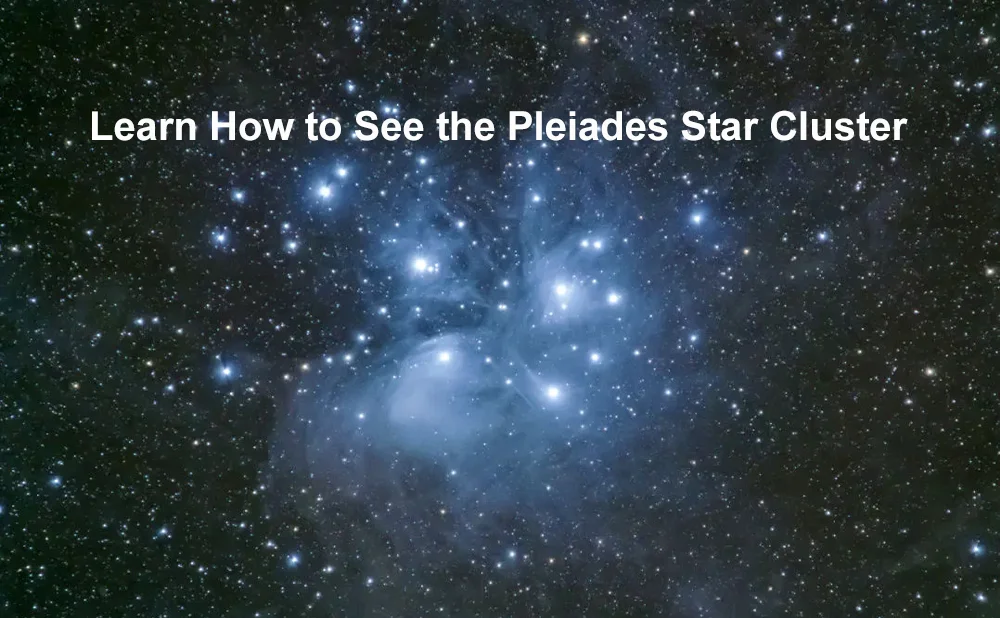
Learn How to See the Pleiades Star Cluster
The Pleiades, also known as the Seven Sisters, is an open star cluster - a group of stars born from the same giant cloud of gas and dust. Located in the constellation Taurus, the Pleiades cluster is approximately 440 light-years away from us.
Why is the Pleiades So Special?
- Extremely Bright and Easy to Observe: It is one of the few deep-sky objects clearly visible to the naked eye.
- Rich Cultural Significance: Known as the "Seven Sisters" in Greek mythology, it has left a profound mark on human culture.
- Photography-Friendly: Its bright stars and diffuse nebulae make it an excellent introductory target for astrophotography.
How to Find the Pleiades Star Cluster?
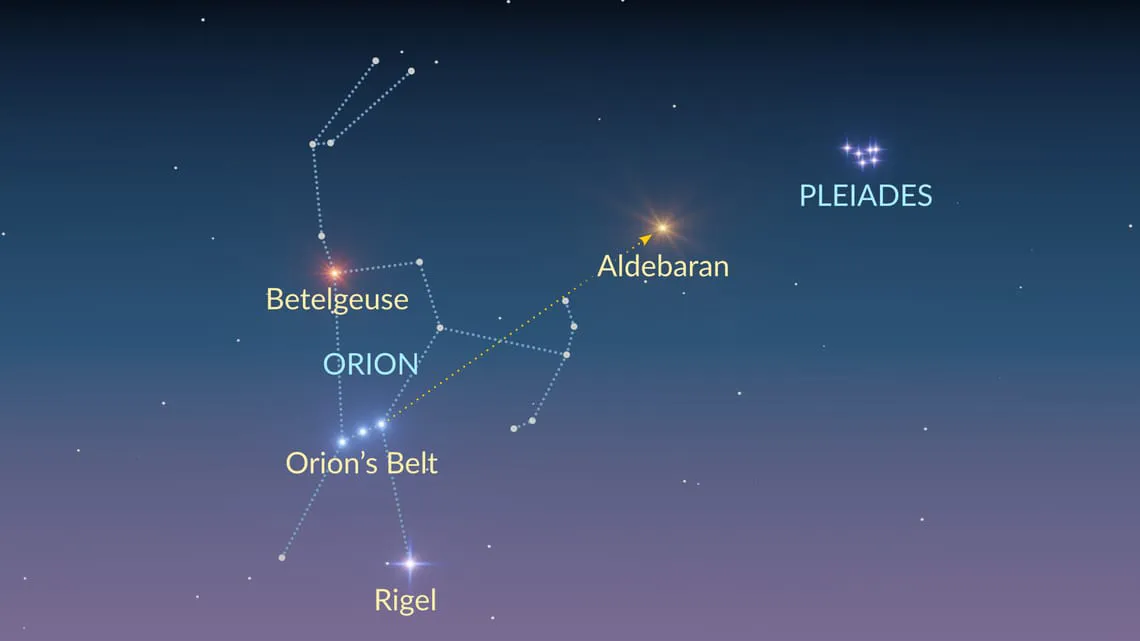
- Find the three bright stars of Orion's Belt.
- Imagine a line passing through them, extending towards Orion's bow.
- You will first encounter Aldebaran, the bright red star in Taurus, and then you will see a small cluster of blue-white stars - that is the Pleiades.
Special Celestial Events in 2026: Lunar Occultation of the Pleiades
In 2026, the Pleiades will have a series of close encounters and even occultations with the Moon, presenting excellent opportunities for observation and photography.
February 24, 2026: Pleiades Close to the Moon - Lunar Occultation
- Close Approach Time: 02:43 GMT
- Close Approach Distance: 1°12'
- Occultation Start Time: February 23, 23:37 GMT
- Occultation End Time: February 24, 05:14 GMT
On February 24, a Moon illuminated at 38% will meet and graze past the Pleiades in the sky. For observers in North America, Central America, and the Caribbean, this will be a lunar occultation of the Pleiades, where the Moon will first hide stars in the cluster and then reveal them again.
In northern North America, the occultation is most prominent, with the Moon covering nearly half of the cluster's stars, including Maya (Maia) and Taygeta. Farther south, the Moon's path will be farther from the cluster. For example, in Edmonton, Canada, only Sterope (Asterope) will be occulted.
These two objects are excellently positioned in the evening sky, reaching their highest point between evening and midnight. Since the Moon will only be a crescent, its light won't be too intense, making it a great opportunity to clearly observe this occultation. Binoculars can provide a better view of the cluster, while a small telescope can help you track the disappearance of individual stars behind the Moon.
March 23, 2026: Pleiades Close to the Moon - Lunar Occultation
- Close Approach Time: 08:41 GMT
- Close Approach Distance: 1°05'
- Occultation Start Time: 05:27 GMT
- Occultation End Time: 10:42 GMT
On March 23, a Moon at 23% illumination will pass close to the Pleiades. The Moon and the Pleiades will rise in the local evening and set around midnight. Since the Moon is in its waxing phase, it will not occult the Pleiades, so under clear skies, the crescent Moon and the Pleiades should be visible to the naked eye.
In some regions, the Moon will transit in front of, and occult, the Pleiades. This lunar occultation is visible in northeastern Asia and high northern latitudes, including Japan, South Korea, northern China, and Russia, as well as parts of the northern United States, Canada, and Greenland.
April 19, 2026: Pleiades Close to the Moon - Lunar Occultation
- Close Approach Time: 16:39 GMT
- Close Approach Distance: 0°58'
- Occultation Start Time: 13:23 GMT
- Occultation End Time: 18:39 GMT
On April 19, a slender crescent Moon (only 7% illuminated) will graze past the Pleiades. You can observe this pair from after sunset until before midnight. Since the crescent is very thin, its light won't overpower the Pleiades, making both easily visible to the naked eye under a clear sky.
In some regions, this celestial spectacle will be even more exciting: the Moon will pass in front of the Pleiades, briefly occulting some of its stars. This lunar occultation is observable across Europe, the Middle East, and North Africa.
In these events, the Moon's light will not completely drown out the cluster, creating ideal conditions for observation and photography.
Pleiades Photography Guide
Step 1:Equipment Setup and Balancing
- Connect the SV555 astrograph lens to the SC571CC color cooled camera via an M48 adapter ring.
- Assemble onto the equatorial mount, carefully adjusting front-back balance.
- Connect the power cable (requires stable 12V supply) and turn on camera cooling.
Step 2: Precise Focusing
- Aim the lens at the brightest star in the Pleiades.
- Zoom in on the live display in computer software.
- Fine-tune the SV555 focus ring until star points are smallest and sharpest.
- Lock the focus ring (can be temporarily secured with tape).
Step 3: Sequence Shooting Settings
- Set SC571CC parameters: ISO 800, 16-bit RAW.
- Plan to shoot 30-50 light frames, with single exposures of 60-90 seconds.
- Simultaneously prepare to shoot dark frames (same parameters, lens cap on), flat frames (shoot a uniformly lit surface).
Step 4: Post-Processing Techniques
- Calibration: Calibrate light, dark, flat, and bias frames in software like DeepSkyStacker or PixInsight.
- Stacking: Stack all light frames (typically can reduce noise by about 70%).
- Stretching: Use histogram stretching to reveal faint details.
- Color: Enhance the blue characteristics of the Pleiades.
- Sharpening: Apply moderate sharpening to highlight stellar details.
Advantages of Combining SV555 with SC571CC
- The excellent optical design of the SV555 reduces the need for post-processing chromatic aberration correction.
- The low-noise characteristics of the SC571CC make the stretching process smoother.
- The cooling system ensures image consistency, resulting in better stacking effects.
Frequently Asked Questions
Q1: Is the Pleiades a constellation?
A: No, the Pleiades is a star cluster - a group of stars bound by gravity and formed from the same molecular cloud. In contrast, a constellation is also a group of stars, but they are not physically related.
Q2: When is the Pleiades visible?
A: In the Northern Hemisphere, the best viewing period is roughly from October to February. In the Southern Hemisphere, it's best seen from about November to March.
Q3: How many stars can be seen in the Pleiades?
Naked-eye observers typically see six stars at a glance. However, with keen eyesight and a clear, dark sky free from light pollution, the longer you look, the more stars you may see. American astronomer Robert Burnham Jr. claimed to have seen 20 stars; most people can see up to 14 at most. Binoculars provide a better view of the cluster and its surrounding nebulosity. All the brightest stars are concentrated in a core area of about 1.5-2° (the entire cluster occupies a larger area in the sky); a high-power telescope can help observe fainter stars.
Q4: How was the Pleiades born?
Their story began with a vast cloud of gas and dust collapsing under its own gravity, its temperature rising continuously until nuclear fusion was triggered, giving birth to hundreds of young, bright stars, most of which are hot B-type stars. These stars illuminate nearby reflection nebulae - clouds of dust that scatter the starlight, producing the cluster's ethereal blue glow.
For a long time, astronomers believed this dust was a remnant from the cluster's formation. Today, it is thought that the Pleiades is simply passing through an unrelated interstellar dust cloud. This dust cloud is a reflection nebula: the dust scatters the blue light from the cluster's hot stars rather than emitting its own light.
Q5: How old is the Pleiades?
On the grand timeline of the universe, the Pleiades is relatively young, estimated to be about 100 to 125 million years old.
Wishing you pleasant stargazing and clear skies!
 Google
 Amazon
There are no customer reviews yet . Leave a Reply !