
Table of Contents
Maksutov-Cassegrain Collimation Guide
For the Maksutov-Cassegrain telescope, its iconic meniscus corrector lens and central secondary mirror form an extremely precise optical system. This design offers excellent focal ratio and portability, but it also means that the optical axis (the line connecting the centers of all optical elements) must maintain extremely high accuracy. Transportation vibrations, temperature changes, and even prolonged effects of gravity can cause the optical axis to shift by microns. Such shifts become immediately apparent during high-magnification observations: star points stretch into comet-like shapes, and planetary details become blurry.
Optical axis collimation is the process of fine-tuning to realign all optical elements back to the same straight line. This tutorial will use the MK127 Mak-Cass Telescope as an example to detail a precise collimation process based on an artificial star point and high-magnification viewing with a DSLR camera.
Explanation of Equipment List
DSLR Camera Canon EOS-700D
Function: Serves as the primary imaging device, replacing the eyepiece, used for capturing images and for high-precision observation of the star's diffraction rings. Its high resolution and live view magnification capabilities are crucial for calibration.
Analogy: It is the "eyes" of the calibration process.
M420 Canon EOS Camera Mount
Function: An adapter ring used to securely and firmly connect the Canon camera to the telescope's eyepiece interface.
Alt-Azimuth Mount + Tripod
Function: The telescope's base. The alt-azimuth mount allows the telescope to tilt (up/down) and pan (left/right). The tripod supports the entire system, providing a stable platform.
Desktop Tripod
Function: Likely used to secure the artificial star generator, aligning its height with the telescope's optical axis.
Artificial Star Generator
Function: Simulates a point light source (a star) at infinity. Since calibration needs to be performed in a stable environment and cannot always rely on real stars, this device creates a tiny, bright, and stable light point to serve as the benchmark target for calibration.
Key Point: It replaces real stars.
M2 Hex Key (Allen Wrench)
Function: Used to turn the adjustment screws on the telescope's secondary mirror (corrector lens). It is the sole tool for performing the physical adjustment of the optical axis. M2 refers to the screw specification; it is very small and requires a dedicated tool.
Environmental Requirements
Operate indoors or in a stable environment without wind or turbulence.
Reason: Air movement causes light to shimmer, making the observed star image (Airy disk) flicker and distort, which makes fine calibration impossible. A stable environment is a prerequisite for obtaining clear and stable diffraction rings.
Detailed Calibration Procedure
Step 1: Setting Up the Calibration Target
Action: Place the artificial star (simulated star) at a considerable distance directly in front of the telescope (recommended >25 meters).
Purpose:
- Simulate Infinity: Telescopes are designed to focus at infinity (e.g., stars). For a telescope with a 1500mm focal length, a distance greater than 25 meters can be approximately considered "infinity," where the image formed is closest to the ideal state.
- Provide a Collimation Reference:This fixed point light source becomes the reference object for judging whether the optical axis is perfectly straight.
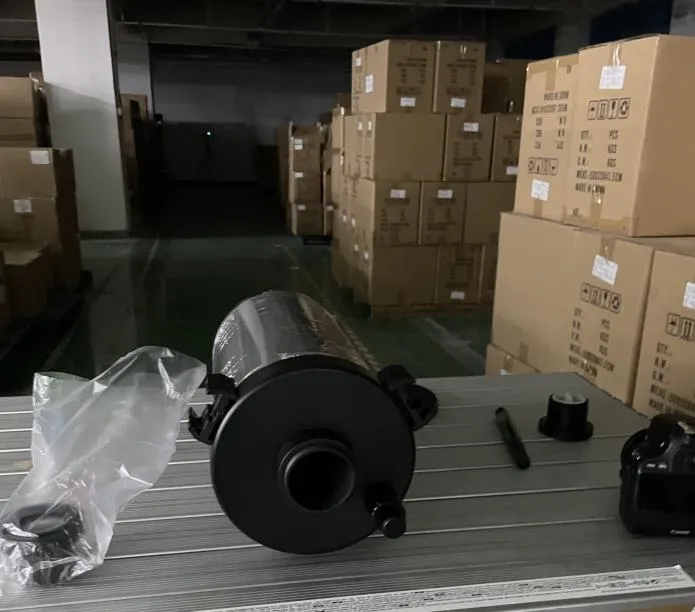 Step 2: Rough Alignment
Action: First, use a low-power eyepiece (wide field of view) to find the star point and move it to the center of the field of view.
Purpose: Ensure the target is already within the camera's capture range to avoid completely losing the target after attaching the camera.
Step 3: Camera Observation
Action: Replace the eyepiece with the camera. Utilize the camera's "Live View" function and activate digital zoom (5x or 10x).
Purpose: The camera's sensor and high magnification can extremely clearly reveal the fine structure of the star point - the Airy disk and diffraction rings - which is difficult to see clearly with the naked eye through an eyepiece. This is the foundation for high-precision calibration.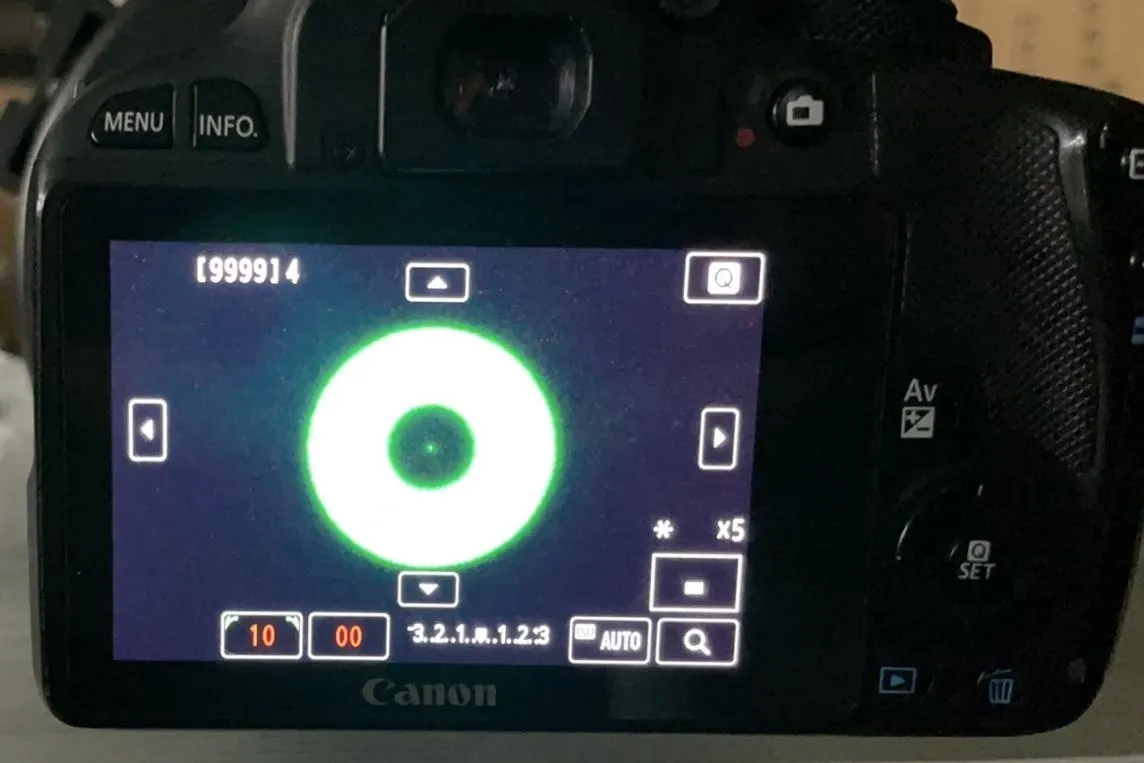
Step 4: Fine Focusing
What to do: Slowly rotate the focus wheel until the star on the screen becomes a very small bright spot, surrounded by one or more clear, darker concentric rings. This structure is the Airy disk.
Why: Only at the optimal focal plane will deviations in the optical axis be most clearly revealed through the asymmetry of the Airy disk. If out of focus, the star is just a blurry spot, making it impossible to determine the optical axis problem.
Step 5: Determining the Optical Axis Status
Ideal Optical Axis Collimation: The central bright spot of the Airy disk is located in the exact center of the entire pattern, and all diffraction rings are perfectly concentric circles.
Misalignment (Needs Adjustment):
- The entire diffraction ring pattern (central bright spot + rings) is offset to one side in the field of view.
- A more typical characteristic is that the diffraction rings are not concentric circles of equal width, but rather look like a comet: one side of the rings are crowded together (bright), while the other side spreads out (dark), which is called "coma."
Step 6: Fine-tuning (Core Step)
This is the most patient and skill-intensive part of the entire calibration process.
Exposing the Adjustment Mechanism: Unscrew the metal cap at the front of the telescope counterclockwise to expose the internal secondary mirror (correction mirror) and its three pairs of adjustment screws.
- White Screw (Pull Screw): Normally, tightening it will "pull" the mirror towards the screw.
- Black Screw (Push Screw): Normally, it holds the mirror in place; tightening it will "push" the mirror in the opposite direction.
Working Principle: These three pairs of screws are arranged at 120-degree angles. By loosening one and tightening the opposite one, the angle of the secondary mirror can be precisely tilted, thus correcting the optical axis.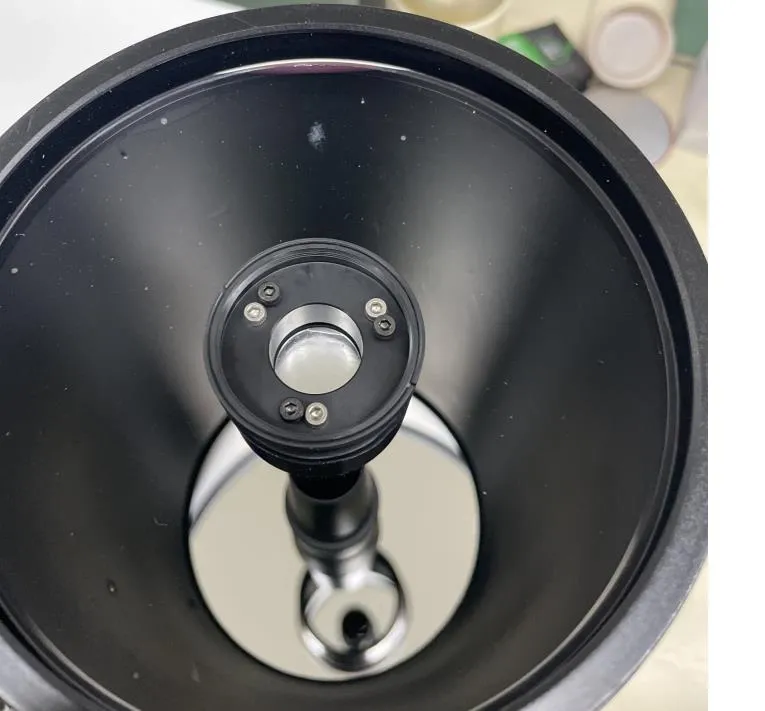
Adjustment Logic:
- Observe the Notch Direction: If the diffraction rings have a notch or brighten on one side (like a comet's head), it indicates that the optical axis is biased to that side.
- Reverse Adjustment: You need to tilt the secondary mirror in the opposite direction of the notch/tail. For example, if the comet's tail is pointing downwards to the right, you need to adjust the screws to tilt the secondary mirror upwards to the left.
- How to Operate: Locate the pair of screws that can push the secondary lens in the desired direction. Slightly loosen the "push" screw (approximately 30 degrees) while simultaneously slightly tightening the opposite "pull" screw (approximately 30 degrees). This is a minor "prying" process.
Key Techniques:
- Fine-tuning: Turn the screws only about 30 degrees (possibly less) each time, then stop and observe the image change. Optical adjustments are very sensitive.
- Alternating Adjustment: Do not adjust only one pair of screws. Alternate and coordinate adjustments between these three pairs of screws, gradually approaching the center.
- Avoid Stress: Excessive force or tightening without loosening will cause uneven stress on the lens, introducing aberrations and even damaging the equipment.
This process is like tuning a very precise machine. The artificial star points are the reference pitch, the Airy disk magnified by the camera is the display on the tuner, and those tiny hex screws are the tuning knobs. By observing the "image feedback" (the shape of the diffraction rings) and then operating the "adjustment mechanism" (the screws) in reverse, the optical system ultimately produces a "perfect harmony" (perfect concentric diffraction rings), ensuring that the star points are sharp, symmetrical, and reveal the necessary details during telescope observation.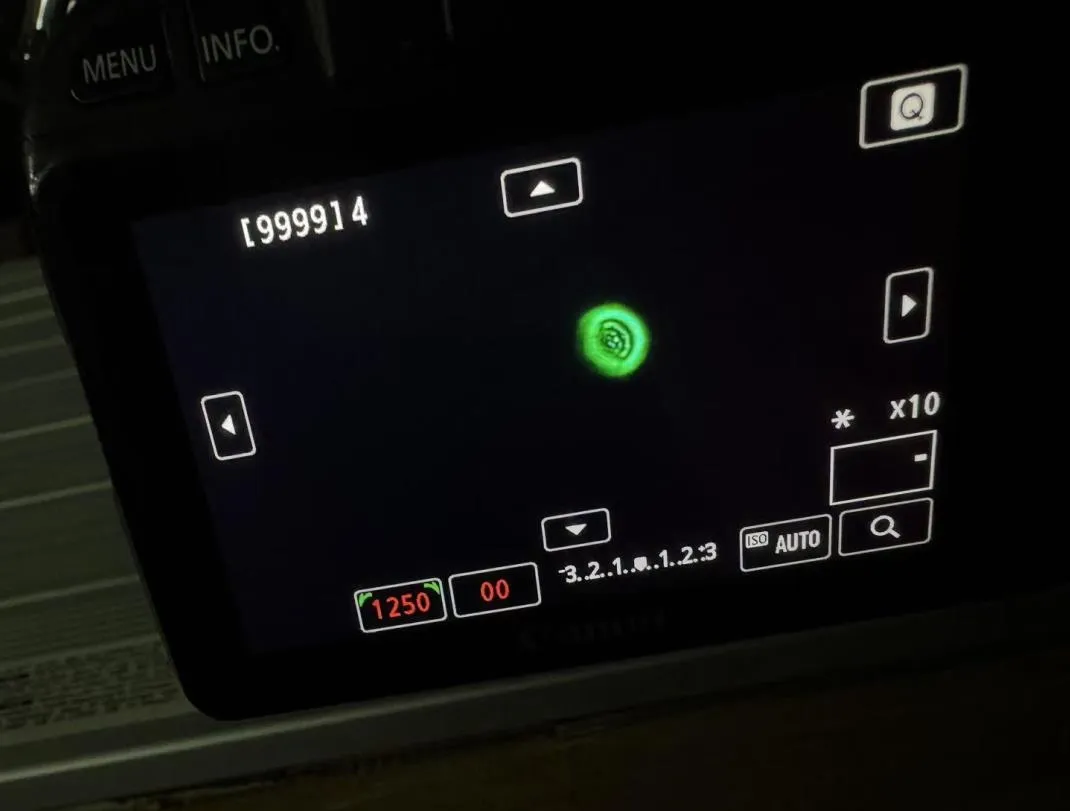 Summary
 Google
 Amazon
There are no customer reviews yet . Leave a Reply !