
Table of Contents
Mastering F-Numbers and F-Stops Ranges to Improve Astrophotography
In the worlds of photography and astronomy, light is everything. Whether capturing faint nebulae in the night sky or breathtaking landscapes on Earth, controlling the amount of light entering your lens or telescope is key to achieving the perfect image. This all revolves around a core concept: the F-Number, often called the F-Stop.
What is an F-Number?
Simply put, the F-Number is the ratio of a lens or telescope'sfocal lengthto the diameter of itsentrance pupil (effective aperture). It's typically expressed as "f/number," such as f/2.8, f/8, or f/16.
Key Insight: The F-Number is actually afraction. f/8 means 1/8, and f/2 means 1/2. Therefore,an aperture of f/2 is significantly larger than f/8, just as 1/2 cup of sugar is more than 1/8 cup.
How Does the F-Number Affect Your Shot?
Exposure Control: The Gateway of Light
- Low F-Number (e.g., f/1.4, f/2.8): Indicates a wide aperture, allowing a large amount of light to enter quickly. This is called a "fast" system, ideal for low-light conditions like deep-sky astrophotography.
- High F-Number (e.g., f/8, f/16): Indicates a narrow aperture, restricting light entry. This is a "slow" system, suitable for bright scenes or specific effects requiring longer exposures.
Calculation Example: Taking the Svbony SV555 Astrograph Lens as an example, with a focal length of 54mm and an adjustable aperture from f/4.5 to f/22, its effective aperture diameter varies from approximately 12mm to 2.45mm.
The Magic of Depth of Field: The Art of Sharpness and Blur
- Shallow Depth of Field (Low F-Number): A wide aperture creates a narrow plane of focus, making the subject stand out against a blurred background. This is the classic effect for portrait and wildlife photography.
- Deep Depth of Field (High F-Number): A narrow aperture keeps a larger range from foreground to background in sharp focus. This is ideal for landscape and architectural photography.
F-Number Strategies in Astrophotography
In astrophotography, your choice of F-Number depends on your target:
Capturing Faint Deep-Sky Objects (Nebulae, Galaxies)
- Use a Low F-Number System: Opt for telescopes or lenses with F-Numbers from f/4 to f/6.3 to gather more photons in less time. For instance, the Svbony SV555 at f/4.5 lets in about 24 times more light than at f/22, significantly reducing exposure time for deep-sky targets.
- Pro Tip: Adding a Focal Reducer to your telescope lowers the system's F-Number, making it faster and widening the field of view. For example, an f/10 system with a 0.63x reducer becomes f/6.3, increasing brightness by about 4 times.
Capturing Bright Lunar and Planetary Subjects
Use a High F-Number System: Choose configurations around f/15 to f/20 for higher magnification and detail.
Pro Tip: Adding a Barlow Lens to your telescope increases the system's F-Number, extending focal length and magnification. For example, an f/10 system with a 2x Barlow becomes f/20. While the image dims, it's better suited for small, bright targets.
Flexible Control with Camera Lenses and F-Stops
Unlike telescopes with fixed F-Numbers, camera lenses allow you to adjust the aperture dynamically:
- Maximum Aperture (e.g., f/1.8): The largest F-Number marked on a lens determines its maximum capability in low light. Professional lenses often feature wider maximum apertures.
- Sweet Spot Aperture: Most lenses deliver optimal sharpness at medium F-Numbers (e.g., f/5.6 to f/8), balancing aberrations and diffraction.
- Astrophotography Tip: Even with a fast f/1.4 lens, stopping down slightly to f/2.8 or f/4 for astro shots often yields sharper stars and reduces edge aberrations. For a lens like the SV555 with a variable aperture from f/4.5 to f/22, you can choose flexibly: use f/4.5 to capture the faintest nebulae, or stop down to f/8 for sharper star points across the frame.
The F-Number Sequence and Exposure Law
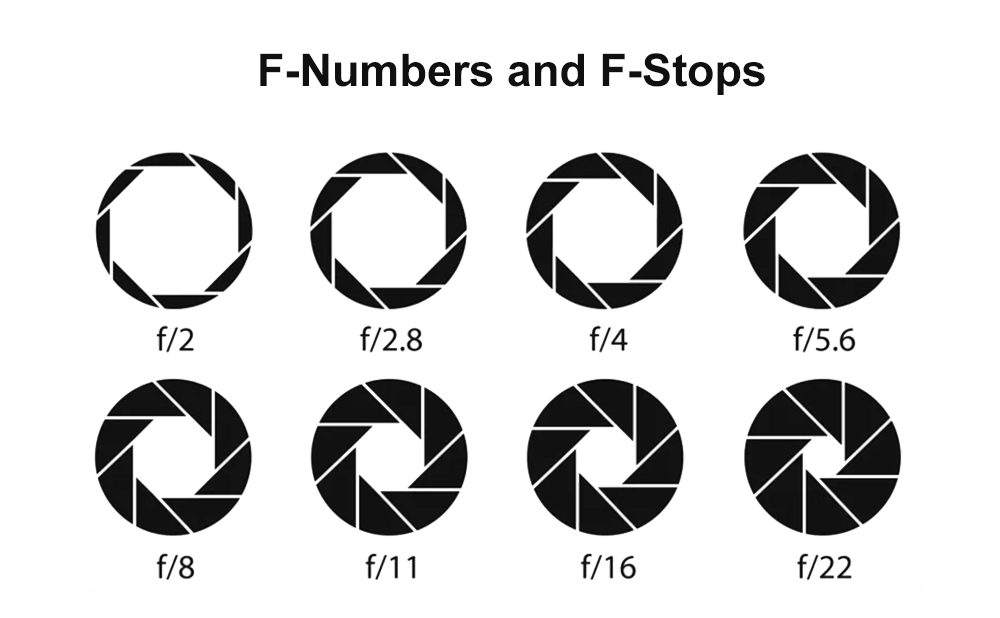
The standard F-stop sequence follows a geometric progression:f/1.4, f/2, f/2.8, f/4, f/5.6, f/8, f/11, f/16, f/22...
Important Rule: Each full stop increase (e.g., from f/2.8 to f/4) halves the amount of light entering. Conversely, each full stop decrease doubles the light.
From Theory to Practice: Your Action Guide
- Know Your Gear: Check the F-Number range of your lens or telescope. For telescopes, remember you can alter the system's F-Number with Barlow lenses or focal reducers.
- Choose Your Strategy Based on the Target:
- Deep-Sky Objects - Aim for a low F-Number to maximize light gathering.
- Moon & Planets - Can use a higher F-Number for higher magnification.
- Nightscape/Landscape - Balance F-Number with exposure time; consider medium F-Numbers for optimal image quality.
- Experiment and Adjust: There are no absolute rules. Try different F-Numbers under various conditions and observe their effects on exposure time, image brightness, and depth of field.
- Consider Post-Processing: Remember, your F-Number choice affects the quality of the raw image. Lower F-Numbers may introduce more aberrations, while higher ones can cause diffraction. This may require corresponding adjustments in post-processing.
Inspiration from the Human Eye
Interestingly, our own eyes operate on a similar principle. In dim light, pupils dilate to about f/2.1, letting in more light. In bright environments, they constrict to about f/8.3, protecting the retina and increasing depth of field. After 30 minutes of dark adaptation, the eye's sensitivity can improve by an amount equivalent to about 20 F-stops!
Conclusion: Mastering the Language of Light
The F-Number is more than just a digit on your camera or telescope; it's the bridge of light connecting you to your subject. By understanding and mastering the principles of F-Numbers and F-Stops, you will be able to:
- Capture more faint details in the dark night sky.
- Preserve more texture and dimension in bright scenes.
- Create images that are sharp from the foreground to infinity.
- Or make your subject pop against a dreamy, blurred background.
Whether you're a stargazing astronomy enthusiast or a photographer capturing earthly beauty, the F-Number is an indispensable tool in your creative kit. Now, pick up your gear and start experimenting - each adjustment is a new chapter in your conversation with light.
Clear skies and happy shooting!
 Google
 Amazon
There are no customer reviews yet . Leave a Reply !