


Table of Contents
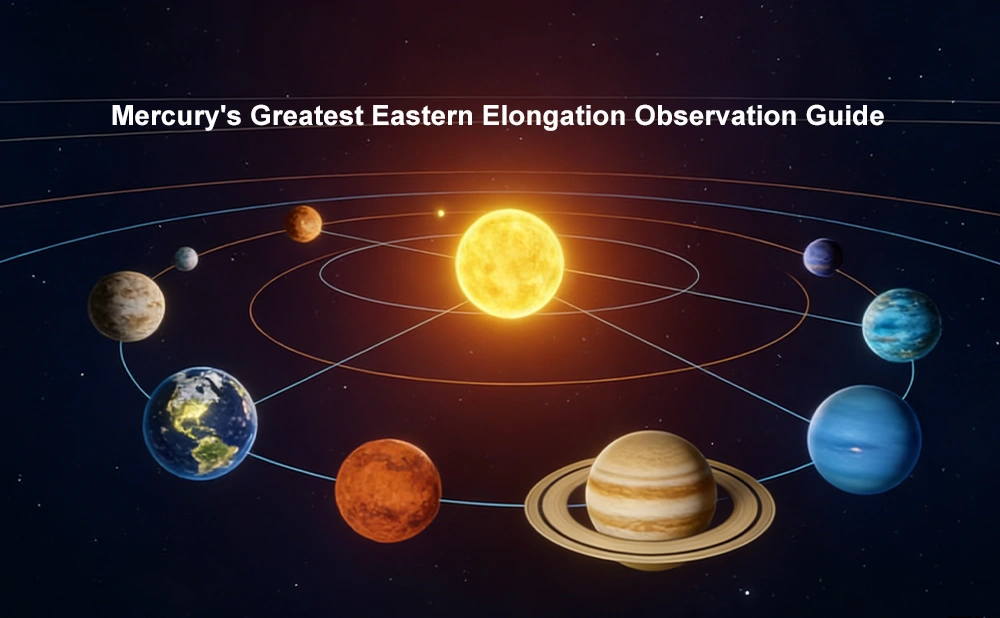
Mercury's Greatest Eastern Elongation Observation Guide 2026
The early spring sky of 2026 will host an unmissable planetary performance. On February 19 at 16:59 (Greenwich Mean Time), Mercury, the innermost planet of our solar system, will reach the special position of its second greatest elongation of the year. This is an eastern elongation, meaning Mercury will hang high in the western sky after sunset, providing an excellent opportunity to observe this elusive planet.
What is Greatest Eastern Elongation?
Precise Astronomical Definition
From an Earth observer's perspective, the inner planets (Mercury and Venus) always appear to move around the Sun. Their angular distance from the Sun determines their visibility. Greatest Eastern Elongation occurs when Mercury is at its farthest point east of the Sun on the ecliptic, forming its maximum angular separation
. For this 2026 event, the elongation angle will be approximately 18 degrees and 07 arcminutes— while not the theoretical maximum (which can reach 28 degrees), the favorable angle of the ecliptic relative to the horizon at dusk during spring in the Northern Hemisphere creates excellent viewing conditions.
The Cycle of the "Morning and Evening Star"
As the "messenger of dawn and dusk," Mercury's visibility follows an interesting pattern
- Short Orbital Period: It orbits the Sun in just 88 Earth days, causing its relative position to Earth to change rapidly.
- Frequent Elongations: Greatest elongations occur on average every 3-4 months, alternating between Eastern (visible at dusk) and Western (visible at dawn).
- Changing Brightness: During this elongation, its apparent magnitude will be -0.4. While not as bright as its peak (which can reach around -2.0), it will still outshine most visible stars.
What Makes the 2026 Greatest Eastern Elongation of Mercury Special
- Multi-Planet Dance: Venus (magnitude -3.9) and Saturn (magnitude 1.1) will appear near Mercury simultaneously.
- Crescent Moon Adds Charm: A slender crescent Moon, only about 5% illuminated, will join this celestial gathering.
- Golden Timing: The angle of the ecliptic during spring evenings is most favorable for Northern Hemisphere observations.
Observational Guide for the Greatest Eastern Elongation of Mercury in 2026
Key Timings:
- Best Viewing Window: Within 30 to 60 minutes after sunset.
- Duration: Mercury will be visible for about 40 to 60 minutes after sunset before it sets.
- Location: Low in the western sky, in the direction of the constellation Aquarius.
Step-by-Step Finding Method:
- About 20 minutes after sunset: Face the western sky.
- Locate Venus: Look for the brightest "evening star" (Venus).
- Scan Down and Left: Look for Saturn, about 10 degrees down and to the left of Venus.
- Pinpoint Mercury: Find the pearl-gray point of light that is Mercury, positioned slightly lower and to the left of Venus.
Important Notes:
- Choose an Open Location: Ensure an unobstructed view of the western horizon.
- Watch the Weather: Clear, atmospherically stable nights are best.
- Prepare in Advance: If using equipment like the MK127 telescope, set it up about 30 minutes early to let it acclimate to the outdoor temperature.
Observing the Greatest Eastern Elongation of Mercury with Professional Equipment
For observers wishing to see planetary details or capture the full celestial alignment, a telescope like the MK127 Maksutov-Cassegrain can be a powerful ally.
Core Advantages:
- 127mm Aperture: Strong light-gathering ability, clearly showing Mercury's tiny disk (about 7 arcseconds in diameter) in the twilight.
- Three-element Maksutov Design: Effectively corrects optical aberrations for sharp planetary images.
- Dual-Speed Focuser: Allows for quick initial location and then fine, precise focusing.
- Optional 0.65x Reducer/Corrector: Shortens the focal length from 1500mm to about 975mm (f/11.8 to f/7.8), making it more suitable for capturing wide-field shots of Mercury, Venus, and Saturn together.
Observing Tips with the MK127:
- Quick Location: After sunset, first find bright Venus with the naked eye or finderscope, then use the telescope to locate Mercury down and to its left.
- Magnification Suggestions:
- Mercury details: 150-200x.
- Venus phase: 100-150x.
- Saturn's rings: 200-250x.
- Multi-planet frame: Use the 0.65x reducer with a 2-inch eyepiece or camera to capture all objects at once.
- Photography Suggestion: Pair with a planetary camera or DSLR, using short exposures (0.5-2 seconds) to record this precious event.
For observers without professional equipment, binoculars can still allow you to enjoy this beautiful scene, but equipment like the MK127 offers richer detail and a more complete view.
Extended Knowledge: Mercury's Phases
Through a telescope, you can observe Mercury's phases, similar to the Moon's
- February 19: Approximately 48% illuminated (similar to a first-quarter Moon).
- Following week: The illuminated portion gradually decreases, shifting towards a crescent shape.
- Early March: It moves into inferior conjunction, disappearing from Earth's view.
Summary
The Greatest Eastern Elongation of Mercury on February 19, 2026, is a rare opportunity to observe a multi-planet gathering. Whether you are a beginner with binoculars or an advanced enthusiast using professional equipment like the MK127, you can gain a unique experience from this astronomical event. May you share an unforgettable stargazing evening with these interstellar visitors spanning billions of kilometers in the early spring twilight of 2026.
 Google
 Amazon
There are no customer reviews yet . Leave a Reply !