
Table of Contents
Planetary Opposition: The Best Time to Observe Outer Planets
Have you ever noticed an exceptionally bright star in the night sky, shining all night long, even dazzlingly so? It might very well be a planet in "opposition." Planetary opposition is not only an annual event eagerly anticipated by astronomy enthusiasts but also an excellent opportunity to observe the outer planets.
What Is Planetary Opposition?
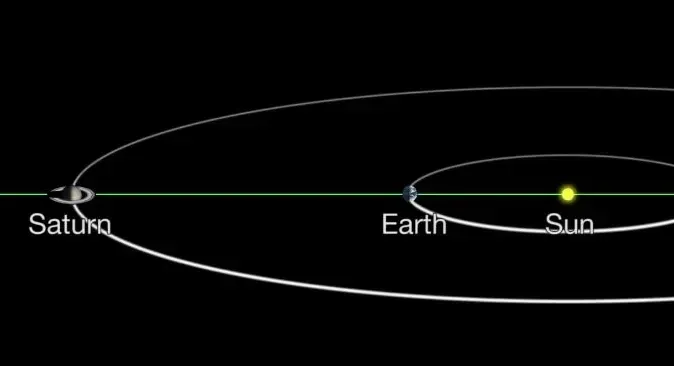
In simple terms, planetary opposition occurs when Earth aligns almost perfectly between the Sun and another planet. From Earth's perspective, the planet appears directly opposite the Sun in the sky - it rises in the east as the Sun sets in the west and sets in the west as the Sun rises in the east. This phenomenon is similar to the familiar principle of a full moon.
 Why Is Opposition So Special?
Brightest Moment
During opposition, the planet is fully illuminated by the Sun, reflecting the maximum amount of light to Earth, making it appear at its brightest. Mars is particularly remarkable - the usually dim red planet can brighten severalfold during opposition, even rivaling Jupiter in brilliance.
Closest Distance
At this time, the planet is at its closest distance to Earth, making it appear larger through a telescope. Mars shows the most significant change in apparent diameter, allowing surface details to be more easily observed.
Visible All Night
A planet in opposition rises after sunset and remains visible until just before sunrise, providing an entire night of observation. At midnight, it reaches its highest point in the sky, where atmospheric interference is minimal, offering optimal viewing conditions.
Start of Retrograde Motion
Interestingly, planets begin their "retrograde" motion around the time of opposition - moving briefly westward against the backdrop of stars. This peculiar phenomenon puzzled ancient astronomers until the heliocentric model provided an explanation.
Which Planets Experience Opposition?
Only planets with orbits outside Earth's (the outer planets) can experience opposition:
- Mars: The most spectacular opposition, occurring approximately every 26 months.
- Jupiter: Once a year, reaching a brightness of -2.7 magnitude.
- Saturn: Once a year, with its ring system clearly visible.
- Uranus and Neptune: Require telescopic observation.
Mercury and Venus, with orbits inside Earth's, never experience opposition - they always appear near the Sun and are only visible at dawn or dusk.
Upcoming Significant Opposition Events
2026 will be an exciting year for opposition observations:
January 10: Jupiter in Opposition
On January 10, 2026, at 08:34 GMT, Jupiter will be in opposition to the Sun. It will shine at a brightness of -2.7 magnitude, located in the constellation Gemini. Jupiter will rise in the east at sunset, remain visible all night, and reach its highest point around local midnight.
Even without optical aids, Jupiter is awe-inspiring. With binoculars or a telescope, you can observe its four largest moons - Io, Europa, Ganymede, and Callisto - appearing as tiny points of light near the planet. A telescope also reveals Jupiter’s striped cloud bands.
In 2026, Jupiter will be closest to Earth during opposition, at approximately 4.23 astronomical units (AU). Its apparent diameter will reach 45.6 arcseconds, making it exceptionally large and ideal for detailed observation.
September 26: Neptune in Opposition
Neptune will reach opposition on September 26, 2026, at 01:28 GMT (21:28 ET on September 25, 2026). While this giant planet will be at its brightest (7.8 magnitude), it remains too dim for naked-eye observation. However, you can try spotting it with binoculars or a small telescope. Neptune will be in the constellation Pisces, rising in the east at sunset and visible for most of the night, reaching its highest point around local midnight.
In 2026, Neptune will be closest to Earth during opposition (28.9 AU), providing the best viewing conditions of the year. Still, its apparent diameter is small - only about 2.4 arcseconds - requiring precise focusing and dark skies for optimal observation.
October 4: Saturn in Opposition
Saturn will reach opposition on October 4, 2026, at 12:21 GMT (08:21 ET). It will shine at about 0.3 magnitude, easily visible to the naked eye. This ringed planet will be in the constellation Cetus, rising in the east at sunset and visible for most of the night, reaching its highest point around local midnight.
With a telescope, you can observe Saturn’s iconic ring system - even a modest telescope can clearly show the separation between the rings and the planet’s disk. Under good conditions, a telescope can also reveal Saturn’s largest moon, Titan, along with several fainter moons.
During Saturn’s opposition in 2026, it will be closest to Earth (8.43 AU), with an apparent diameter of 19.7 arcseconds, offering excellent conditions for observing the planet and its rings.
Future Mars Oppositions (approximately 780-day intervals):
- February 19, 2027
- March 25, 2029
- May 4, 2031
Scientific Significance of Opposition
Historically, planetary oppositions helped astronomers measure distances beyond Earth. In 1672, by observing Mars in opposition, Cassini made the first relatively accurate calculation of the distance between Earth and Mars. Today, opposition remains a valuable window for studying planetary atmospheres and surface features.
Observation Tips
- Flexible Timing: Planets remain in good observational condition for weeks around opposition, so you don’t need to stick to the exact date.
- Weather First: Choose a clear, stable night over the exact opposition date.
- Dark Adaptation: Allow your eyes 15-20 minutes to adjust to the dark to see more details.
- Record Changes: Try documenting variations in brightness and color, especially for Mars during different oppositions.
Conclusion
Mark your calendars, prepare your telescopes, and when the next opposition arrives, step outside for a celestial rendezvous with these distant worlds!
 Google
 Amazon
There are no customer reviews yet . Leave a Reply !