


Table of Contents
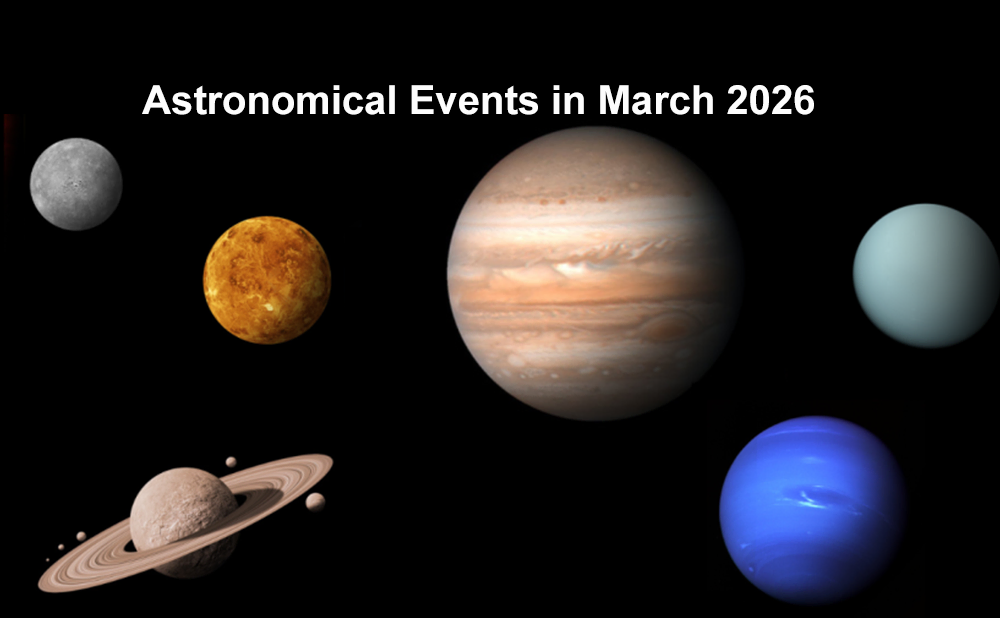
Astronomical Events in March 2026
Following the "six-planet alignment" in February, the night sky in March will also present a series of celestial wonders!
Key Astronomical Events in March 2026
March 3: Worm Full Moon
Sometimes called the "Blood Worm Moon," the full moon in March 2026 will be a true visual feast – a complete total lunar eclipse.
- Visibility: The entire eclipse will be visible in most parts of Europe, Asia, Australia, North and South America, and parts of the Arctic and Antarctic Circles. The eclipse will last from the partial eclipse phase to the maximum eclipse and then to the end of the eclipse. During this time, the moon will appear a rare reddish-brown hue in the Earth's shadow (the origin of the "blood moon" term).
- Observation Recommendations: No special equipment is required; it can be safely viewed with the naked eye. Using binoculars or a small telescope will allow you to appreciate more details of the planets above the horizon and the color gradations as they pass through the shadow.
March 8: Venus Conjunction with Saturn
After sunset on this day, bright Venus (magnitude -3.9) will slowly approach Saturn (magnitude 1.0) low in the western sky, appearing only about a finger's width apart (approximately 1°).
- Observation Conditions: Venus is easily spotted with the naked eye due to its exceptional brightness, while Saturn appears slightly softer but is still clearly visible. It is recommended to search near the western horizon within approximately 60 minutes after sunset.
- Visible Area: Visible in the southwestern quadrant after sunset in almost all parts of the world, with the best viewing locations being in the mid-latitudes and subtropical regions of the Northern Hemisphere. It can also be observed in the Southern Hemisphere, but the location may be further west and lower.
March 18: The Moon will be close to Mars and Mercury
In the pre-dawn stillness, a spectacular "morning sky triple performance" will suddenly appear – a crescent moon (approximately 2% brightness) will form a close angle with Mars (magnitude 1.1) and Mercury (magnitude 1.6) low in the southeastern sky, the three points separated by only 1-2 degrees.
- Observation Conditions: Mercury and Mars will be faint, but bright enough to be distinguished with the naked eye – provided the view is excellent, the air is very clear, and light pollution is near zero. The best observation window for this event is only about 60 minutes before sunrise.
- Location Preference: This event is particularly favorable for viewers in the Southern Hemisphere, as these three celestial bodies rise higher before sunrise, giving observers more time to observe. It's not hopeless in the Northern Hemisphere either; focus on an open-air location in the southeast with no obstructions before the astronomical dawn begins.
March 20th: Vernal Equinox
This year's March equinox marks the official start of astronomical spring in the Northern Hemisphere and autumn in the Southern Hemisphere. Globally, day and night are almost equal on this day, and the precise geometry of the Sun and Earth triggers another shift in the Plutonian celestial wheel.
- Observation Method: No need to look up at the sky; observe the sunrise and sunset times – both the Northern and Southern Hemispheres experience nearly equal day and night on this day. Note that sunrise is almost due east and sunset is due west; you can take photos or perform simple time measurements.
More Celestial Events in March 2026
Besides the bright, exclusive celestial events mentioned above, March also features several other star-level celestial events. Take a few minutes in the evening to glance at the night sky:
- March 2nd: The near-full moon is very close to Regulus in Leo, and a lunar occultation will be visible in parts of East Asia.
- March 3rd: The full moon, traditionally known as the "Bloodworm Moon," occurs in Leo and coincides with a total lunar eclipse (also known as the "Bloodworm Moon").
- March 3rd: The total lunar eclipse will turn the moon red, visible in Europe, Asia, Australia, the Americas, and polar regions.
- March 6th: The waning moon approaches Spica, a bright star in Virgo.
- March 8th: Bright Venus approaches Saturn in the evening sky, located in Pisces.
- March 10th: The waning moon approaches Antares, a red star in Scorpius, and a lunar occultation will be visible in parts of the Southern Ocean and islands.
- March 15: Mars approaches the elusive Mercury in Aquarius.
- March 17: A very thin crescent moon appears in the early morning sky near Aquarius, close to Mercury.
- March 17: On the same morning, a thin crescent moon also approaches Mars in Aquarius.
- March 18: Comet 88P/Howell reaches perihelion; people in the Southern Hemisphere may be able to observe it with a telescope before dawn.
- March 18: A slender crescent moon meets Mercury and Mars in Aquarius before sunrise; best viewed near the equator and in the Southern Hemisphere.
- March 20: After sunset, a slender crescent moon appears near bright Venus in Pisces.
- March 20: The vernal equinox marks the beginning of astronomical spring in the Northern Hemisphere and astronomical autumn in the Southern Hemisphere.
- March 23: The first quarter moon approaches Uranus (telescope required) and the Pleiades star cluster in Taurus. March 26: The waxing gibbous moon approaches Jupiter in Gemini.
- March 27: The waxing gibbous moon passes near Castor in Gemini.
- March 28: The waxing gibbous moon approaches the Beehive cluster in Cancer.
- March 29: The waxing gibbous moon again comes very close to Regulus in Leo; a lunar occultation is visible in parts of Asia, Africa, Europe, and western Russia.
Stargazing Preparation Tips for March 2026
- Location Selection: Ensure your observation location is in the darkest area with the widest field of view and minimal light pollution.
- Outdoor Comfort: March nights are still cold, especially if you're spending several hours outdoors watching a total lunar eclipse or observing distant planets. Be sure to dress warmly and bring hot drinks, a chair, and a light blanket.
- Auxiliary Tools:
- Basic Equipment: Your eyes are the smallest and most powerful astronomical telescope.
- Advanced Options: Binoculars (10×50 or 8×42) are excellent for observing planets; for total lunar eclipses and occultations, a small astronomical telescope (at least 70mm aperture) can provide more detail.
- Photography Enthusiasts: Set up your tripod, long shutter speed, and astronomical recording settings, especially suitable for recording color changes during a total lunar eclipse.
Enjoy your viewing, and stay warm!
 Google
 Amazon
There are no customer reviews yet . Leave a Reply !