
Table of Contents
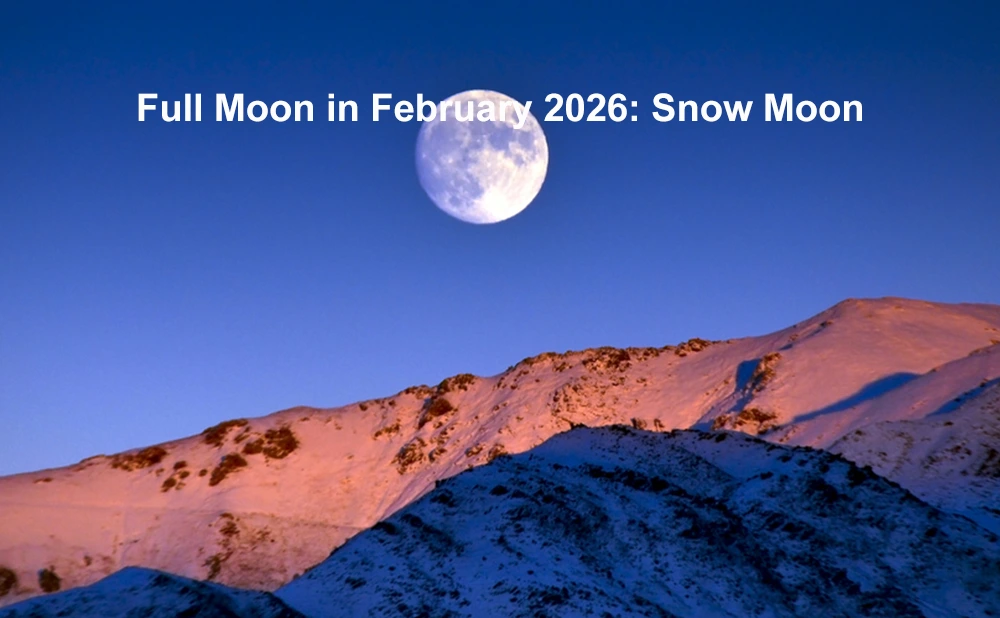
Full Moon in February 2026: Snow Moon
The first Full Moon of 2026 will bring us the winter-white Snow Moon. More than just a bright orb in the sky, it will travel through the constellation Cancer and pass close to the famous Beehive Star Cluster. For observers in North America, there’s even a chance to witness the rare event of the Moon “covering” the cluster.
What is the “Snow Moon”?
The Snow Moon is the traditional Native American name for February’s Full Moon, reflecting the heavy snowfalls typical across North America at this time of year. Some tribes also called it the Hunger Moon due to the difficulty of hunting in harsh winter conditions.
Other cultural names for February’s Full Moon:
- Chinese: Budding Moon
- Celtic: Ice Moon
- Cherokee (Southeastern US): Bony Moon
- Southern Hemisphere: Grain Moon, Barley Moon
Observing Highlights of This Snow Moon
Encounter with the Beehive Cluster (M44)
The most captivating aspect of this Full Moon is its close approach to the famous Beehive Cluster in Cancer.
- Closest Approach: February 1, 13:19 GMT (21:19 Beijing Time)
- What to Expect: A brilliant Full Moon next to a dense “cloud” of stars - a fantastic opportunity for astrophotography. However, the Moon’s glare will make the cluster difficult to see with the naked eye alone.
Lunar Occultation of the Beehive Cluster (North America Only)
For observers in the United States, Canada, and Greenland, an even rarer event may occur - a lunar occultation of the cluster.
- Starts: 11:21 UTC (19:21 Beijing Time, 06:21 ET)
- Ends: 15:00 UTC (23:00 Beijing Time, 10:00 ET)
- What Happens: The Moon will gradually move in front of the cluster, covering its stars before revealing them again one by one.
Observing Tip: Use binoculars or a small telescope for a better view.
Snow Moon Observation Plan Selection
High-Detail Lunar Surface Observation
MK127 Maksutov-Cassegrain Telescope(Native 1500mm f/11.8)
- 2× Barlow Lens
- 6mm Eyepiece
= 500× Magnification
Field of View: Approximately 0.06°
Suitable for: Study of large crater interiors.
Lunar Surface Panoramic Scanning
MK127 + 0.65× Reducer (975mm f/7.8)
- 32mm Wide-Angle Eyepiece
= 30× Magnification
Field of View: Approximately 1.7°
Suitable for: Quick positioning and locating areas of interest.
Photography-Optimized Configuration
MK127 (Reducer Mode)
- SC571CC Color Cooled Camera
- UV/IR Cut Filter
Resolution: 6244×4168 Pixels
Lunar Surface Coverage: Approximately 1/4 of the lunar surface (single frame)
Frequently Asked Questions
Q: Is the 2026 Snow Moon a Supermoon?
A: No. The next Supermoon will be the Beaver Supermoon on November 24, 2026.
Q: When is the next Full Moon?
A: The next Full Moon is the Worm Moon on March 3, 2026, which will also feature a total lunar eclipse visible from the Americas, Australia, and Asia.
Q: What time does the Moon rise?
A: The Full Moon generally rises around sunset. The exact time depends on your location - use an astronomy app to check moonrise for your city.
The Snow Moon of 2026 is the first grand gift from the winter sky. Whether you plan to photograph its meeting with the Beehive Cluster or simply stand under the cold, clear night to feel the Full Moon’s serene brilliance, it promises to be a night worth remembering.
May this Snow Moon light the way for your year ahead.
 Google
 Amazon
There are no customer reviews yet . Leave a Reply !