
Table of Contents
The Guide to the Annular Solar Eclipse on February 17,2026
On February 17, 2026, the Moon will pass in front of the Sun, creating a spectacular "Ring of Fire" annular solar eclipse. However, astronomical observation is no easy feat. This article will explain what makes this eclipse truly special - even though it remains almost entirely out of reach for 99.9999% of humanity.
What Type of Eclipse is this?
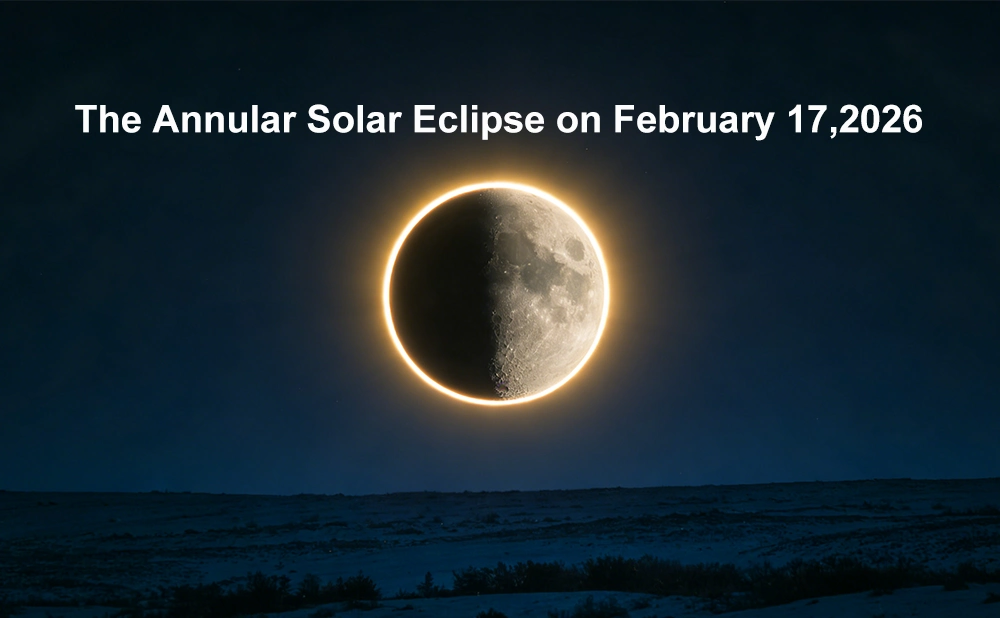
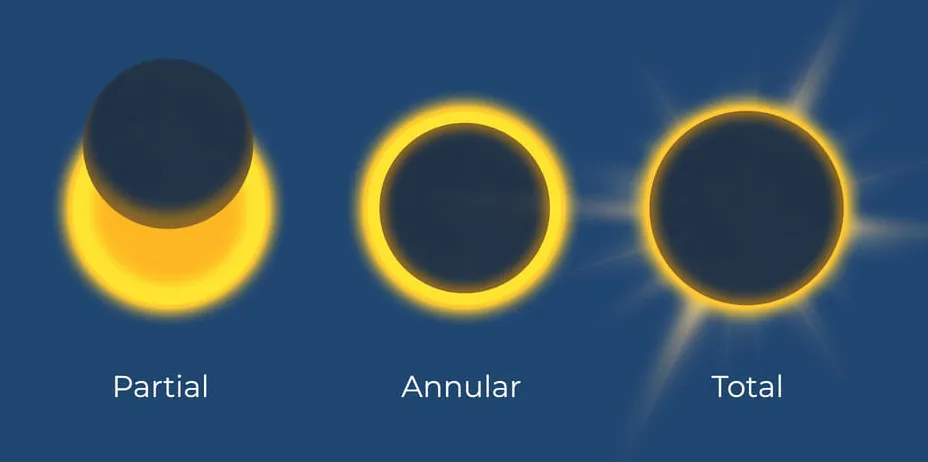
There are three main kinds of solar eclipses: total solar eclipse, partial solar eclipse and annular solar eclipse.This is an annular solar eclipse - sometimes referred to as a "Ring of Fire" eclipse - because the Moon will cover the center of the Sun (blocking about 96% of its visible surface), while leaving a bright ring of sunlight around its edges. However, only observers located within the narrow path of annularity will be able to see this phenomenon.
When is the Solar Eclipse in February 2026?
Global Timeline (GMT):
Partial Eclipse Begins: 09:56 GMT
Annularity Begins ("Ring" appears): 11:42 GMT
Maximum Eclipse: 12:12 GMT
Annularity Ends: 12:41 GMT
Partial Eclipse Ends: 14:27 GMT
Where will the February 2026 Solar Eclipse be Visible?
Visibility of the Ring of Fire (Annular Eclipse)
The annular phase of the eclipse will only be visible in remote Antarctica and nearby waters - this path is so remote that only a few observers in Antarctica and surrounding waters will be able to witness the eclipse.
Best Places to View the Annular Eclipse in February 2026:
If you can travel to Antarctica and stand within the path of the annular eclipse, you can see the sun transform into a thin ring within minutes. Here are some locations where the "ring of fire" will be visible during the annular solar eclipse on February 17, 2026:
Mirnyi Station (Antarctica):
- Duration of annular activity: 1 minute 52 seconds
- Time: 12:07 GMT
- Solar altitude: Approximately 10° above the horizon
Concordia Research Station (Antarctica):
- Duration of annular activity: 2 minutes 1 second
- Time: 11:46 GMT
- Solar altitude: Approximately 5° above the horizon
As you can see, even at the "best" viewing locations, the sun is low on the horizon - therefore weather, haze, and local topography are key factors affecting eclipse visibility.
Partial Eclipse Visibility
Observers outside the annular eclipse path will see a partial eclipse - the sun will appear as if it has been "bitten". This phenomenon will be visible in:
- Most of Antarctica
- Southern tip of South America
- Parts of Southern Africa
- And surrounding ocean areas
Why is the Solar Eclipse in February 2026 so Special?
The Audience Is Penguins, Not Crowds
The path of the "Ring of Fire" crosses remote Antarctica, meaning the best on-site viewing locations are largely limited to a handful of research stations.
It’s a Deep Annular Eclipse
At maximum coverage, the Moon will block about 96% of the Sun, leaving a slender, striking ring of sunlight. This is one of the most spectacular annular eclipses you could see… if you could actually see it.
It Kicks Off a "Ring of Fire" Triple Feature
This is the first solar eclipse of 2026 and the start of three consecutive years with annular eclipses:February 17, 2026 - Antarctica (a quiet opening act)February 6, 2027 - a path across the Atlantic to AfricaJanuary 26, 2028 - Galápagos Islands + Spain
A Rare Eclipse in a Rare Place
This eclipse may not be easy or convenient to observe, but its geographical setting makes it unique. An annular eclipse over Antarctica offers views that other eclipses can’t match: dramatic polar landscapes, a low-angle Sun, and the sheer rarity of an eclipse in such an environment.
For professional photographers, expeditions, or researchers already working in polar regions, this could be a once-in-a-lifetime opportunity to photograph an eclipse from one of Earth’s most remote settings.
Solar eclipse:Frequently Asked Questions
Q1:What is the difference between annular and total solar eclipses?
A:During a total solar eclipse, the moon completely blocks the sun, briefly revealing the corona. During an annular solar eclipse, the moon is farther from the sun and appears slightly smaller, unable to completely block it, thus leaving a bright ring of sunlight around the moon ("ring of fire").
Q2:When is the next solar eclipse after February 2026?
A:The next solar eclipse after February 17, 2026 is a total solar eclipse on August 12, 2026. At that time, the eclipse will be visible in parts of Russia, Greenland, Iceland, and Spain, with the total eclipse phase lasting 2 minutes and 18 seconds.
Q3:Can I view a solar eclipse with my phone, binoculars or a astronomy telescope?
A:Only with a solar filter specifically designed for that device (especially filters for binoculars and telescopes). Without a filter, it may cause permanent damage to your eyes and/or the device.
Q4:Will it get dark during this eclipse?
A:Unlike a total solar eclipse. Because this is an annular solar eclipse, the sun will not be completely blocked, so daytime light will dim, but it will not turn into night.
Solar Eclipse on February 17, 2026: Conclusion
On February 17, 2026, an annular solar eclipse will occur, forming a "ring of fire" - but this "ring of fire" will only be visible from distant Antarctica. A partial solar eclipse will be visible in southern South America, southern Africa, and most of Antarctica. This eclipse also marks the beginning of a three-year streak of annular solar eclipses from 2026 to 2028.
Related posts:
https://www.svbony.com/blog/what-about-a-solar-eclipse-types-causes-facts-and-future-events
https://www.svbony.com/blog/2027-solar-eclipses-two-stunning-celestial-events
 Google
 Amazon
There are no customer reviews yet . Leave a Reply !