
Table of Contents
What is the Spring Equinox?
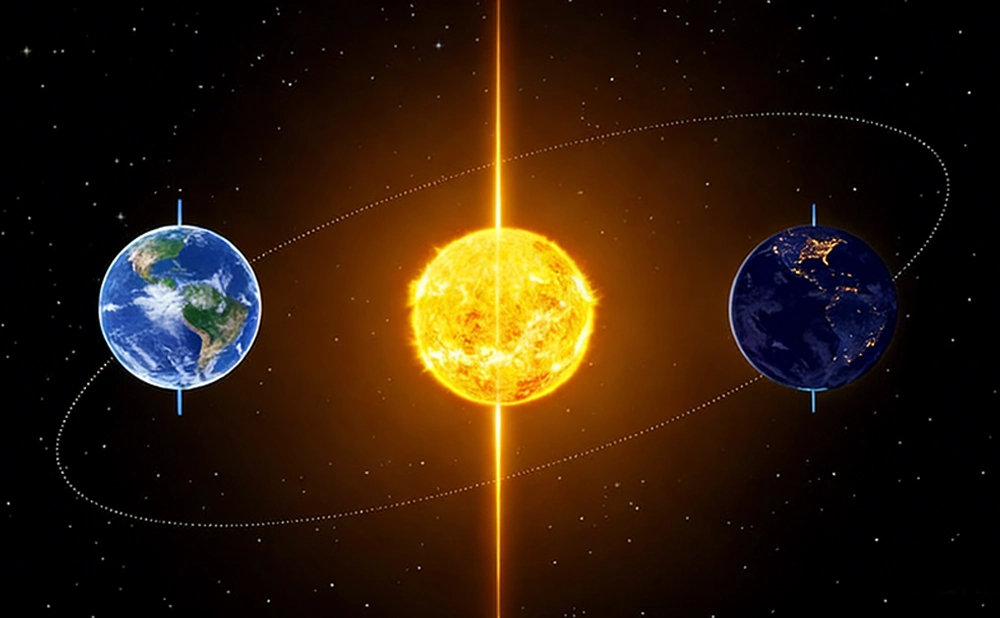
The March equinox is when the Sun shines directly on the equator. It’s not just a date, but a seasonal turning point. For the Northern Hemisphere, it marks the start of spring; for the Southern, the beginning of autumn.Because the Earth's orbital period (approximately 365.2422 days) does not perfectly match the Gregorian calendar year, the exact date of the spring equinox varies slightly each year, generally fluctuating between March 19th and 21st. For example, the March equinox is coming up on March 20, 2026.
What is an Equinox?
The word “equinox” comes from the Latin “aequus” (equal) and “nox” (night). True to its name, the equinox represents a unique pause in Earth's tilted dance.
- The Scientific Definition: Astronomically, the March equinox (also called the vernal equinox) is the precise moment when the Sun, in its annual apparent journey, crosses the celestial equator moving from south to north. The celestial equator is the projection of Earth's equator onto the imaginary celestial sphere. At this instant, Earth's rotational axis is tilted neither toward nor away from the Sun, causing sunlight to fall almost equally on both hemispheres.
- The Principle Behind It: This phenomenon exists because Earth does not orbit upright but is perpetually tilted at about 23.5 degrees. This tilt is responsible for the seasons we depend on. The equinoxes (spring and autumn) are the two points in Earth's orbit where this tilt is effectively "neutral" relative to the Sun.
Are Day and Night Actually Equal During the Spring Equinox?
It is widely believed that day and night are exactly equal on the equinox. While this beautiful notion is not perfectly accurate, it holds profound truth.
- The Truth of "Equal": From a geometric standpoint, theoretical day and night lengths are closest to 12 hours everywhere on Earth during the equinox. However, two factors make the actual experienced daytime slightly longer:
- Atmospheric Refraction: Earth's atmosphere acts like a lens, bending sunlight. At sunrise, we see the Sun before its geometric center has cleared the horizon; at sunset, we see it after it has technically set. This "gifts" us roughly 6-8 extra minutes of daylight each day.
- Definitional Difference: Sunrise and sunset are officially defined as the moment the Sun's upper edge meets the horizon, not its center. The Sun's "disk" itself takes time to rise and set.
- The "Equilux": Therefore, the true day of equal day and night (called the Equilux) usually occurs a few days before or after the vernal equinox, depending on your latitude.
Cultural Celebrations and Human Connections Related to the Spring Equinox
As such a clear demarcation in the natural world, the equinox has been deeply engraved into human civilizations, giving rise to diverse traditions.
- Persian New Year - Nowruz: One of the most famous equinox celebrations, marking the start of the Persian New Year, with over 3,000 years of history. People perform a major spring cleaning (symbolizing renewal) and set the Haft-Sin table, displaying seven items starting with the Persian letter 'S' (Sin), each symbolizing concepts like life, love, and health.
- Slavic and European Traditions: Many cultures historically celebrated fertility and rebirth goddesses at this time, such as the Germanic Ostara. Symbols like eggs and hares - representing fertility and new life - originated from these ancient rites and influenced later Easter customs.
- The "Descent of the Feathered Serpent" at Chichen Itza: At the Mayan pyramid of Kukulcán in Mexico, a spectacular play of light occurs at sunset on the equinox. Shadows create a pattern of undulating light down the pyramid's stairs, resembling a giant serpent slithering downward, symbolizing the return of the feathered serpent god and the start of the rainy season.
Astronomical and Observational Aspects of the Equinox
The equinox is not just a theoretical point; it offers unique opportunities for skywatchers.
- Sunrise Due East, Sunset Due West: On the equinox day (except at the poles), no matter where you are on Earth, you can observe the Sun rising exactly due east and setting exactly due west. It's the best time of year to accurately locate these cardinal directions.
- Fastest Sunrises and Sunsets: During the equinoxes, the Sun rises and sets at a nearly perpendicular angle to the horizon, making the time for the entire solar disk to appear or disappear the shortest of the year.
- Enhanced Aurora Activity: Due to seasonal patterns in the interaction between Earth's magnetic field and the solar wind, the periods around the equinoxes (both March and September) are often prime windows for observing auroras (Northern and Southern Lights).
Signs of Spring After the Equinox
The equinox is nature's signal to hit the "switch."
- Northern Hemisphere: Spring arrives. Longer days drive the reawakening of life. Plants bud and bloom, migratory birds begin their journey north, and insects emerge from dormancy. Snow melts, temperatures rise, and the landscape greens.
- Southern Hemisphere: Autumn begins. Shorter days bring cooler air. Leaves change color and fall, animals start preparing for winter or migrate to warmer regions, and nature enters a season of harvest and settling.
Conclusion: Balance Within and Without
The March equinox is a globally synchronized astronomical event. It is not only a change of seasons in the external world but also an invitation to reflect on balance in our own lives - between work and rest, giving and receiving, ending and beginning. On this equinox, step outside, feel the shift in the Sun's angle, observe the stirrings of plants and animals around you, and reconnect with the natural pulse of our planet.
 Google
 Amazon
There are no customer reviews yet . Leave a Reply !