

Table of Contents
How to Get Focus with Your Telescope for Beginners?
Unlike the human eye, which automatically adjusts its focus, an astronomical telescope has a fixed-focus primary lens or mirror. To achieve a sharp image, we must manually adjust the telescope's focuser, which moves the eyepiece to the precise position where the light rays converge.
Understanding Your Telescope: It’s All About the Optics
Before we start twisting knobs, let’s take a quick peek at how your telescope works. Think of it as a complex light-gathering tube. Its job is to collect light from a distant object and deliver it to your eye in a perfectly sharp point. The focusing mechanism is the final, critical step in that journey, fine-tuning the light path to match your unique eyesight.
Basic Parts of a Telescope Involved in Focusing
To use a telescope effectively, you need to be best friends with a few key components:
- Eyepiece: This is the part you look through. Different eyepieces have different magnification powers (e.g., 10mm, 25mm). You’ll always start with the one with the highest number (lowest power).
- Focuser: This is the knob or rack-and-pinion system that moves the eyepiece holder in and out. This movement is what changes the focus.
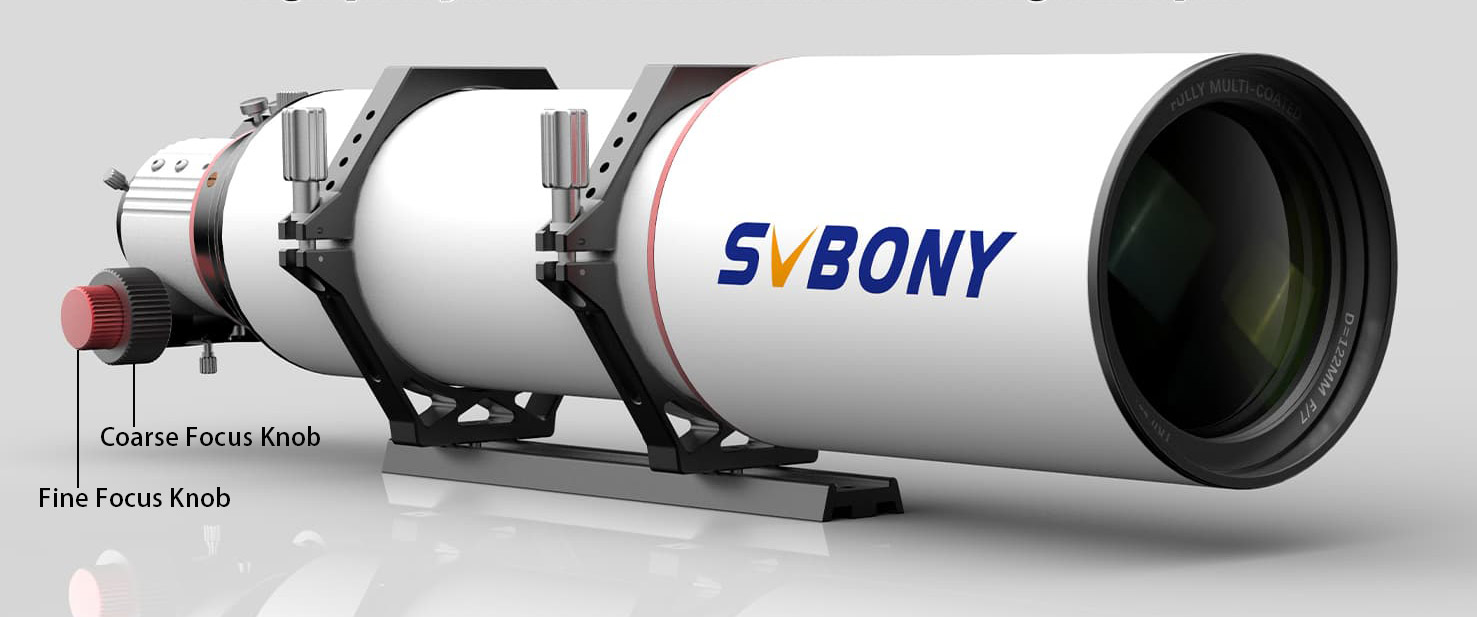
- Focus Knobs: Most focusers have two knobs - a larger one for coarse focus (big movements) and a smaller one for fine focus (tiny, precise adjustments).For example, here is the focus knob location on the SV550 refractor telescope.
How to Focus a Telescope for the First Time: A Step-by-Step Walkthrough
Alright, theory time is over. Let’s get our hands (virtually) dirty.
Step 1: Choose the Right Environment and Target
Never try to learn how to focus a telescope by pointing at a star. They’re tiny points of light that are hard to judge. Instead, do this during the day! Choose a bright, sunny day and find a distant, stationary object like a power line insulator, a treetop, or a street sign far away. This gives you a clear, high-contrast target to work with.
Step 2: Start with the Lowest Power Eyepiece
Set your eyepiece to the longest focal length (e.g., 25mm instead of 10mm). This provides the lowest magnification, offering the widest and brightest field of view. This makes it easier to locate targets and achieve initial focus, and is also more forgiving of slight focus errors.
Step 3: The Coarse and Fine Focus Dance
Aim at Your Target: Point your telescope at the distant object you chose. Look through the eyepiece. It will almost certainly be a complete blur.
Slowly Turn the Coarse Focus Knob: Pick a direction (e.g., counter-clockwise) and turn the main focus knob slowly. Watch the blurry image. Does it start to get any better or worse?
Find the "Sweet Spot": If it gets worse, reverse direction. If it starts to get sharper, keep going until the image is as clear as you can get it with the big knob.
Switch to the Fine Focus Knob: Now, use the smaller knob to make tiny adjustments back and forth. You’ll quickly find the point of perfect, razor-sharp focus. Congratulations, you’ve done it!
Pro Tips and Common Mistakes to Avoid When You Set Up a Telescope
Getting a one-time focus is great, but ensuring the stability of the focus is also important. Here’s how to truly set up a telescope for success.
Stability is Key: Managing Your Tripod and Mount
A wobbly tripod is the enemy of focus. Any vibration will make the image shimmy, making fine focus impossible. Ensure all leg locks and mount bolts are fully tightened. If possible, hang a weight from the center of the tripod to dampen vibrations. Avoid touching the telescope while you are looking through it.
Don’t Rush: Let the Telescope Adjust to Temperature
If you’re moving from a warm house to a cold night outside, your telescope needs time to reach "thermal equilibrium." The mirrors or lenses will warp slightly from the temperature change, ruining your focus. Let your scope sit outside for 20-30 minutes before you expect pinpoint accuracy.
Keeping Your Optics Clean for Consistent Performance
Dust and smudges on your eyepiece will degrade your view and make focusing frustrating. Always use a rocket blower to remove dust before considering a gentle wipe with lens-specific cleaning fluid and microfiber cloth. And never, ever touch the glass with your fingers!
Troubleshooting: When Focus Just Won’t Happen
sometimes, despite your best efforts, things don’t work. If you can’t achieve focus:
- Check Your Target: Are you pointed at something too close? Most telescopes have a minimum focus distance.
- Extension Tubes: Did your telescope come with a 2x Barlow lens? If it’s inserted, it changes the focal length. Remove it and try again.
- Mirror Alignment (Collimation): For reflector telescopes, if the mirrors are misaligned, you will never achieve a sharp focus. Learning to collimate is your next step.
Conclusion
For beginners, learning to how to focus a telescope is as crucial as selecting an entry level telescope. It forms the fundamental skill for astronomical observation. Remember to enjoy the process and be patient. With experience, you will become more proficient in focusing the telescope and obtain clear images.
Share your success story in the comments below - we’d love to celebrate with you! Clear skies!
There are no customer reviews yet . Leave a Reply !