


Table of Contents
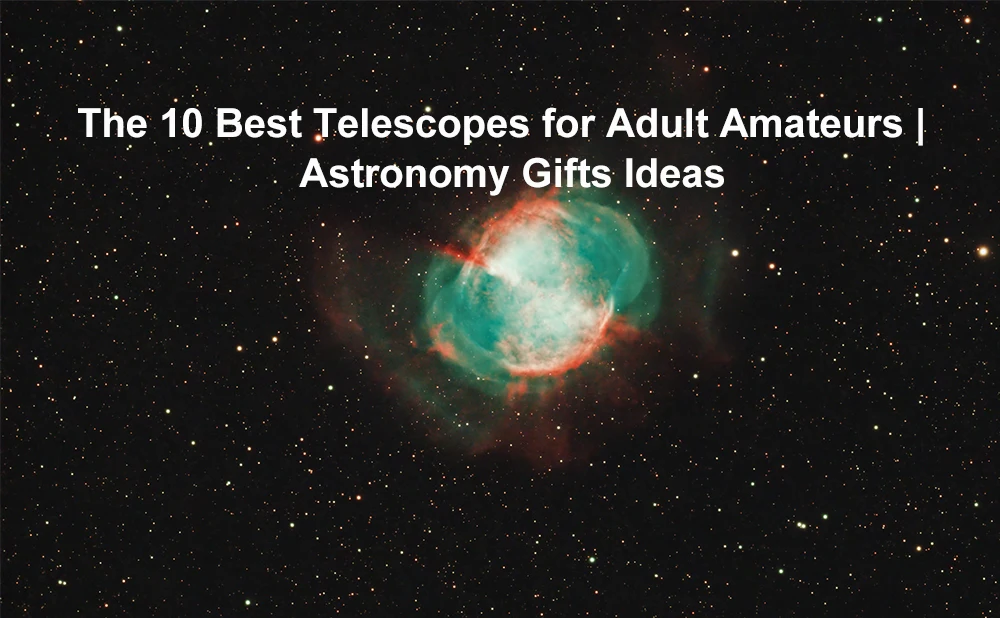
The 10 Best Telescopes for Adult Amateurs | Astronomy Gifts Ideas
Remember that childhood awe of seeing Saturn's rings for the first time through a telescope? In fact, starting your cosmic journey as an adult can be even more rewarding.
Whether for yourself or as astronomy gifts, choosing a first telescope for adults can feel overwhelming. Don't worry, we'll explore everything from the best starter telescope for adults to dedicated astronomer telescope options, and even some alternatives like binoculars for adults.
But first, let's tackle the big question.
What to Know Before You Buy
What to Look for When Buying a Telescope for Adults?
Choosing telescopes for adults isn't just about "magnification". You need to consider your lifestyle, your viewing spot, and what cosmic sights spark your imagination.
Aperture:It's All About the Light
Think of a telescope as a light-collecting bucket. The diameter of its main lens or mirror - the aperture - is the width of that bucket. A bigger aperture gathers more light. More light means you can see fainter, more distant nebulae, galaxies, and finer details on planets. For any serious amateur astronomy telescope, a larger aperture is usually more valuable than extreme magnification. A good telescope for adults should start at a minimum of 70mm (for refractors) or 114mm (for reflectors).
The Optical: Refractor, Reflector, or Catadioptric?
- Refractor Telescopes: Use lenses. They're typically low-maintenance, offer sharp images, and are excellent for the Moon, planets (a great telescope for adults to see planets), and double stars. A classic choice for the best starter telescope for adults.
- Reflector Telescopes: Use curved mirrors. They give you a large aperture for your money, making them a deep-sky favorite for exploring faint galaxies and nebulae - a true telescope for amateur astronomer.
- Catadioptric Telescopes (like Maksutov-Cassegrain): Combine lenses and mirrors in a compact package. They're powerful and portable, a fantastic "all-rounder."
The Mount
This is the most overlooked component! Even with the best optical tube, a shaky mount can ruin your stargazing experience. A stable equatorial or altazimuth mount, paired with smooth tracking, is key to a great stargazing session.
What Will You Really See?
With a good starter telescope, you'll see lunar craters in stunning detail, the phases of Venus and Saturn's glorious rings. Star clusters will be dazzling, and some bright nebulae (like Orion's) will show a beautiful, fuzzy glow. Don't expect Hubble-like color images - our eyes see in muted grays and greens in the dark, but the "realness" of the live view is magical.
10 Top Telescopes for Adult Beginners
Best Starter Telescope for Adults
The SV503 70mm f/6.78 refractor telescope is an entry-level flat-field telescope optimized for astrophotography. It features a built-in field flattener and a two-element lens group containing ED (FPL51) glass, effectively eliminating field curvature and chromatic aberration. Combined with an f/6.78 focal ratio and a dual-speed focusing system, it delivers high-quality astronomical images with sharp edges.
This is a SV550 80mm F6 APO triplet refractor telescope, specifically optimized for deep-sky astrophotography and visual observation. Its core features include a triplet APO optical design incorporating one piece of S-FPL51 extra-low dispersion glass to effectively eliminate chromatic aberration, a 2.5-inch 1:10 dual-speed focuser to reduce vignetting with full-frame cameras, and a fast f/6 focal ratio combined with internal light baffles to enhance image contrast.
The SV48P is a 90mm f/5.5 achromatic refractor telescope, positioned as a cost-effective option for deep-sky astrophotography and visual astronomy. Its key features include a large 90mm aperture and a fast f/5.5 focal ratio for bright field of view, along with a 2-inch dual-speed focuser featuring a 1:10 reduction ratio for precise focusing. The product comes standard with a dovetail plate for easy mounting on an equatorial mount, and its optical lenses are multi-layer green coated.
Telescope for Adults to See Planets
This is a MK127 Maksutov-Cassegrain telescope with a 127mm aperture and an f/11.8 focal ratio, specifically designed for high-magnification observation of planetary and lunar details. Its core features include a three-element Maksutov optical design, a built-in field flattener, and 99% high-reflectivity dielectric coatings to correct aberrations and enhance image quality. It is equipped with a dual-speed focuser for precise focusing and is compatible with both 2-inch and 1.25-inch accessories. The included 0.65x focal reducer lowers the focal ratio to f/7.8, facilitating the photography of deep-sky objects.
The MK105 is a 105mm aperture, 1365mm focal length (f/13) Maksutov-Cassegrain telescope, emphasizing portability and planetary observation and photography. It features a metal tube and a convex meniscus lens design that requires no periodic collimation, and is equipped with a 160mm long dovetail plate and dual finder scope bases to enhance stability and expandability. It is compatible with 1.25-inch accessories and is positioned as a planetary observation telescope suitable for astronomy beginners and outdoor use.
Astronomy Telescope for Nebulae
This is a SV550 122mm f/7 APO triplet apochromatic refractor telescope, designed for large-aperture deep-sky astrophotography and visual observation. Its core features a triplet APO structure containing one piece of FPL-51 ED glass, combined with an 854mm focal length and a 300mm long dovetail plate to enhance optical performance and mounting balance. The tube body is crafted from CNC-machined aluminum alloy and comes standard with a 2.5-inch 1:10 dual-speed focuser and a carrying case. It is compatible with M63 threaded interfaces and various photographic accessories.
The SV503 is a 102mm f/7 ED doublet achromatic refractor telescope, optimized for deep-sky astrophotography and visual observation. Its core features a doublet air-spaced design with S-FPL51 ED glass to reduce chromatic aberration, combined with a large 102mm aperture and f/7 focal ratio to deliver a bright, wide field of view. The telescope body comes standard with a dual-speed rack and pinion focuser offering 90mm of back focus, a retractable lens hood, and is compatible with both 1.25-inch and 2-inch accessories, including a dedicated field flattener/reducer.
The SV555 is an APO Petzval astrograph lens specifically designed for deep-sky photography. Its core optical design features a 3-group, 5-element Petzval structure that includes two ED glass elements, covering a 44mm full-frame image circle and offering a continuously variable aperture from F4.5 to F22. The lens body is lightweight and comes with an upgraded lens hood, a lockable 360-degree rotating mechanism, and adjustable focus travel. It is compatible with EAF electronic focusers and M72 front filter threads. The product is positioned as a versatile travel astrograph lens.
The Portable Telescopes
The SV535 is a 35mm f/2.8 APO astro camera lens, emphasizing ultra-portability and a super-large aperture design. Its core features an apochromatic (APO) optical structure incorporating ED glass, offering an extremely bright F2.8 aperture ideal for wide-field deep-sky and nightscape astrophotography. The lens body is compatible with a standard T-mount, allowing it to be adapted to various camera mounts (such as Z, RF, and E mounts), and it comes with dual dovetail plates. The product is positioned as a portable astrograph lens.
The SV545 is a 45mm f/4.5 Petzval refractor astrograph lens. Its core features include a 3-group, 5-element (3G5E) Petzval APO apochromatic design incorporating ED glass, along with a built-in native field flattener. This combination is designed to deliver flat, sharp star images from the center to the edges across a full-frame sensor. The lens body integrates a focuser system pre-installed with an EAF (electronic auto-focuser) gear, offering broad compatibility. It is positioned as a robust, high-end astrophotography lens.
Binoculars: The Underrated Workhorse
Want a more awesome experience watching a meteor shower? You need a pair of binoculars. They instantly turn blurry dots in the sky into sharp, clear stars, allowing you to see even the faint smoke trails left behind by meteors in detail. More importantly, they also let you glimpse the star clusters and nebulae in the meteor shower's backdrop that are usually invisible to the naked eye, instantly doubling your stargazing experience. Portable and easy to use, they're an essential piece of basic gear for any stargazing enthusiast.
In Summary
Choosing telescopes for amateurs and adults boils down to balancing interest, budget, and practicality. Remember, the best telescope for adults is the one you'll use most often.
Have you spotted a scope on this list that calls to you, or will you start with a pair of binoculars? Maybe share this guide with someone looking for the perfect gift for you.Welcome to explore our telescopes for beginners page for more beginner-friendly guidance.
Step outside tonight and look up.
Comments (2 )

fsdfsd
fsdf
Leave a Reply
 Google
 Amazon
gdfgdf