

 @AstroBassDee
 41
@AstroBassDee
41
41
@AstroBassDee
41

March 2026
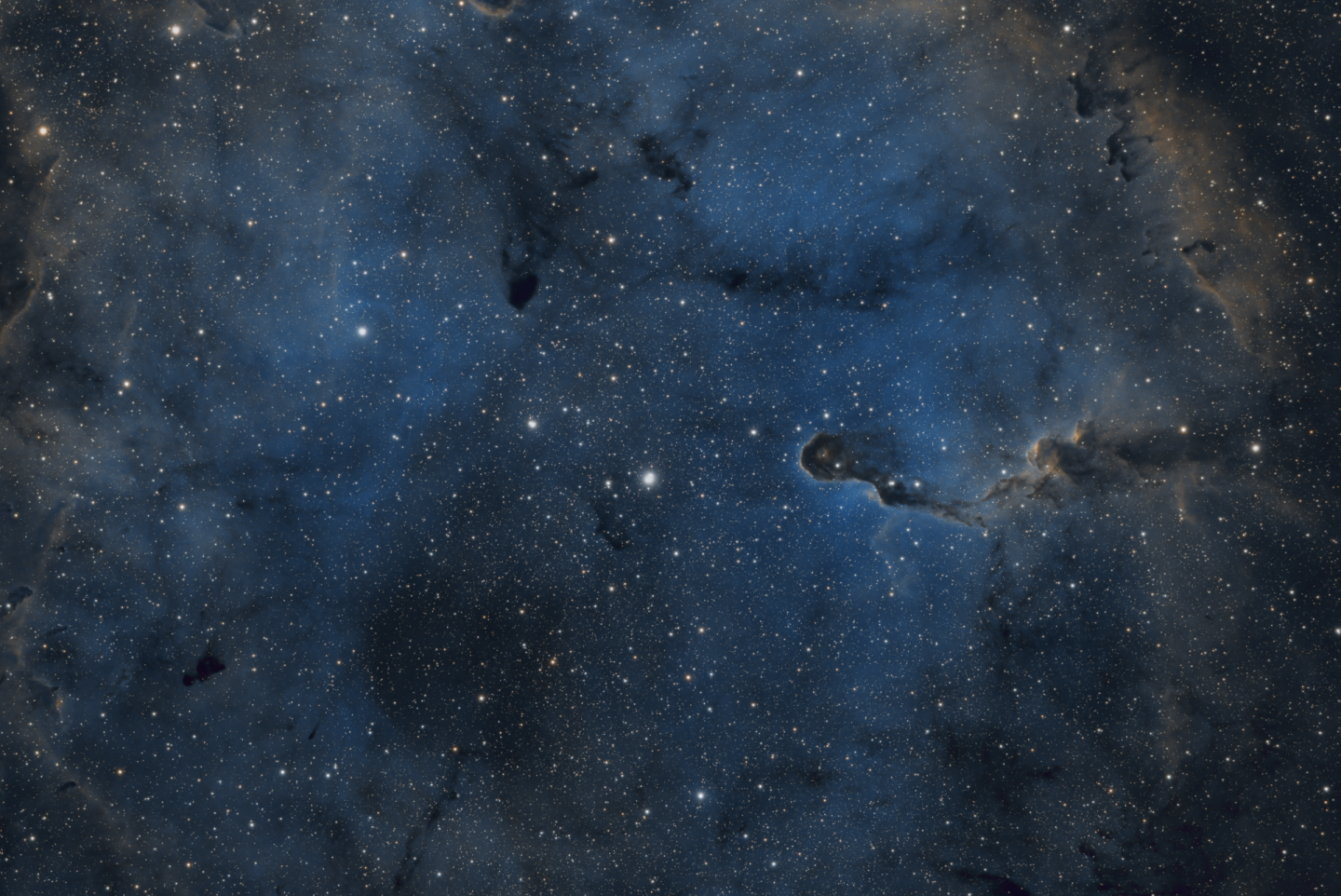
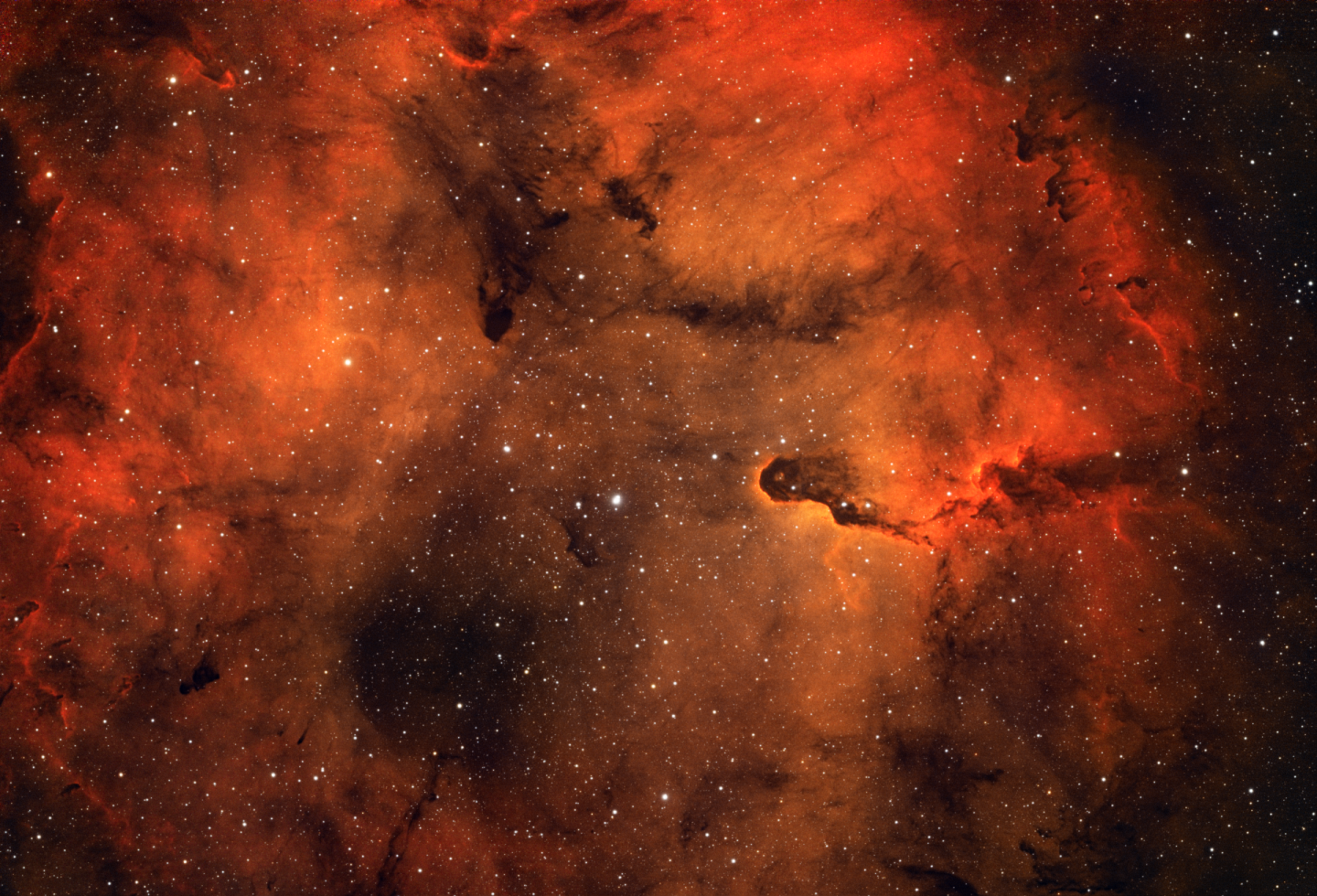
This one came down to the wire. When the SVBONY August Challenge landed on the Elephant's Trunk, I already had the Ha/OIII data in the bag, but I wanted to do something a little different and go for a full SHO palette. The problem: my SII filter hadn't arrived yet. It turned up only a few days before the deadline, which left me a very narrow window to gather the third channel and still have time to process. So I did the sensible thing and built in a safety net, finishing a complete HOO version first, then going for the SHO once the SII frames were in. Both versions are here: the cooler HOO image as the backup, and the warm SHO as the one I'm submitting. My setup Telescope: SVBONY SV550 80ED (80/480 apo triplet, f/6). I shot the Ha/OIII pass at the native 480 mm f/6 with the 1.0× flattener, and the later SII/OIII pass at 384 mm f/4.8 with the 0.8× reducer. Camera: SVBONY SV405CC (Sony IMX294 OSC), cooled to -10 °C Filters: SVBONY SV220 3 nm Ha/OIII and SVBONY SV220 SII/OIII dual narrowband Mount: Bresser EXOS-2 with OnStep kit Guiding: SVBONY SV165 guide scope with SV305C Pro Focuser: Gemini autofocuser Control: Raspberry Pi 5 running EKOS / KStars Acquisition IC 1396A sits inside a huge emission complex in Cepheus, sculpted by the winds of the hot stars nearby. The dense pillar itself hides active star formation deep inside, and it's a rewarding target in narrowband because the mix of Ha, OIII and SII across the region gives you a lot to work with. Because I'm imaging with an OSC camera, an SHO palette means two separate dual-narrowband passes: one through the 3 nm Ha/OIII, one through the SII/OIII, and then extracting and recombining the three channels in Siril afterwards. I shot everything at 180-second subs, gain 120, with the sensor cooled to -10 °C, and gave the weak SII the most weight it could get in the time I had, since it's by far the faintest of the three lines on this target. Every session was calibrated with its own darks, flats and dark-flats, and because I switched optical configurations between the two passes, each pass got its own flats in its own configuration. To finish it off I shot a short RGB set through a plain UV/IR-cut filter, just for the star colours. I kept these deliberately short, 30-second subs, so the bright stars wouldn't clip and would keep their true colours, above all the Garnet Star (Mu Cephei) at the northern edge, which I really wanted to come through as the deep red it is. Frame counts: Ha/OIII 3 nm (1.0× flattener): 191 lights across 2 nights (89 + 102), 9 h 33 min SII/OIII 7 nm (0.8× reducer): 120 lights, 6 h 00 min RGB stars (UV/IR-cut): 60 × 30 s, 30 min That comes to 371 subs in total, just over 16 hours across the project. The late SII channel, and why there are two versions When I planned this, I genuinely wasn't sure the SII would make it in time. I had the Ha/OIII in the bag from early August, but the SII/OIII filter only arrived with a handful of nights left before the deadline, and Lower Saxony in August is a weather lottery. So I treated the HOO version as a finished, submittable image in its own right, and the SHO as the stretch goal. In the end the clear nights cooperated just enough, and I gathered a solid 6 hours of SII in a single push. Not as deep as I'd have liked, but enough for the palette to hold together. Working with two different focal lengths did add a wrinkle. The Ha/OIII pass is at 480 mm and the SII/OIII pass at 384 mm, so the two datasets don't share a scale. Siril handled it cleanly, though: registering all the extracted channels together with a homography transform scaled the reducer frames up onto the flattener frames, and the common field ends up being the tighter framing I wanted anyway. Processing Base stacking in Siril 1.4.4: each pass calibrated and registered separately (global star alignment, two passes), then stacked with sigma clipping (3.0 / 3.0) in 32-bit. Channel extraction and registration: since the OSC stacks come out already debayered, I split each master into its RGB planes and pulled Ha and SII from the red channel, OIII from the green, then registered all channels together with homography so everything lined up in a single pixel grid despite the two focal lengths. Per channel, still linear: GraXpert background extraction, then GraXpert AI denoise, tuned per channel (gentle on the detailed Ha, harder on the faint SII). Then each channel stretched individually with the histogram transform, keeping the backgrounds matched so the colour balance would hold. StarNet++ per channel for the starless versions. SHO composite (SII to red, Ha to green, OIII to blue), then SCNR to remove the green cast, and VeraLux Curves to build contrast and lift the colour. A light pass with the Cosmic Clarity sharpening tool on the starless image to bring out the trunk and the dust lanes. Stars: the separate UV/IR-cut RGB set, stretched moderately to keep the bright stars from clipping, then registered onto the SHO frame (via the Ha channel, since the starless nebula has no stars to align to) and screened back in at the end. That's where Mu Cephei gets its colour. IG: @AstroBassDee
My name is Sebastian, and online I go by @AstroBassDee. I've been doing deep-sky astrophotography for about a year now, imaging from Lower Saxony in Germany. I started out with a DSLR and a cheap achromat and have since moved to a cooled, narrowband setup built around SVBONY gear. This was my first proper SHO project on an OSC camera, and getting there against a deadline made it all the more satisfying.





 Google
 Amazon
No data Yet