


Table of Contents
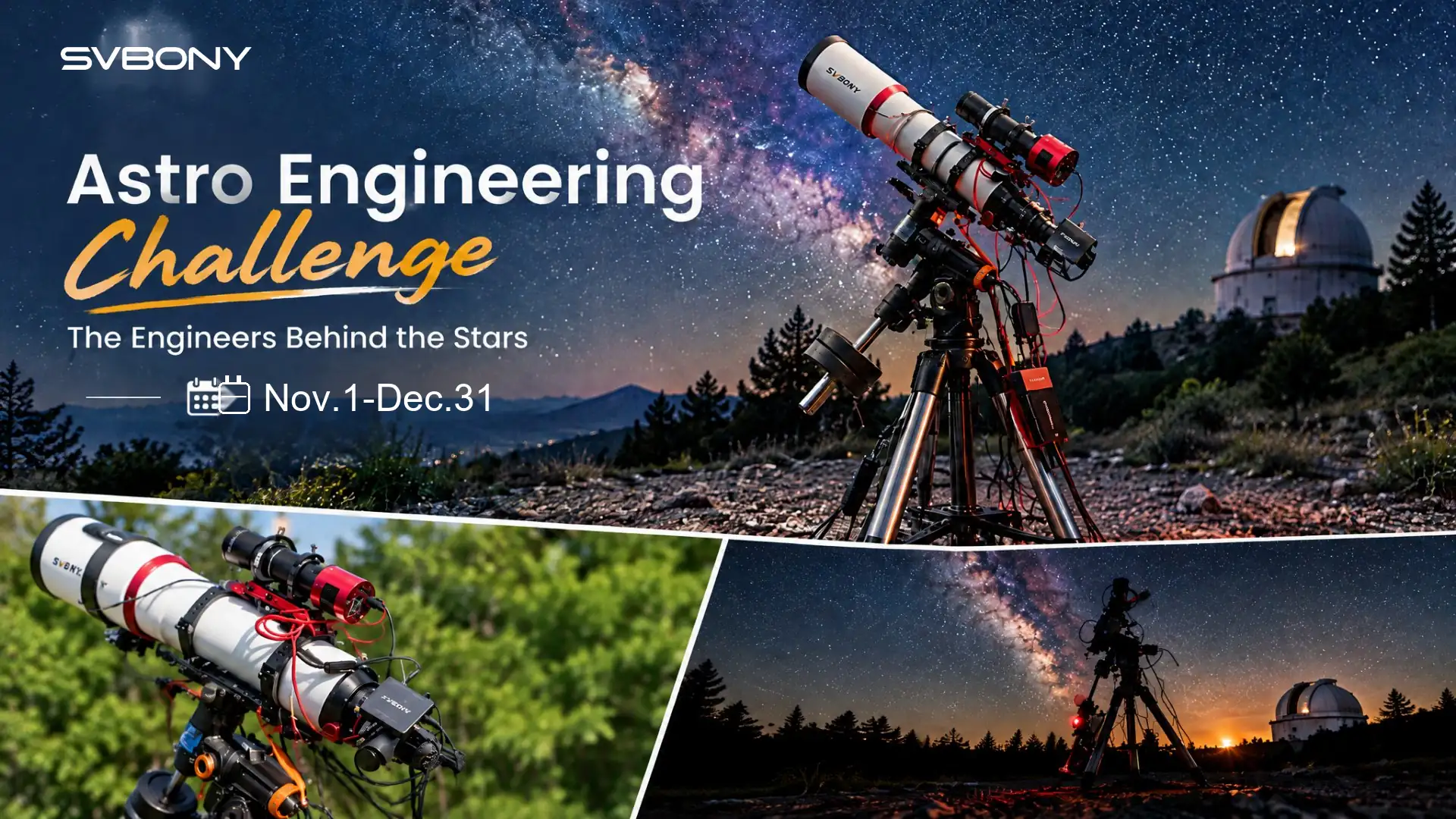
Astro Engineering Challenge 2026: The Engineers Behind the Stars
November 1 – December 31, 2026
What makes a great astronomy setup?
Is it the telescope with the largest aperture? The camera with the highest resolution? Or the most expensive equipment on the market?
Not necessarily.
A great astronomy setup is one that works for you. It's about choosing the right equipment, making smart connections, balancing performance and budget, and finding practical solutions to real-world challenges.
Some astronomers build lightweight rigs for traveling under dark skies. Others carefully balance their budgets to get the best deep-sky imaging performance. Some optimize their optical systems for full-frame cameras, while others create clever DIY modifications to make their equipment work better.
Every setup has a story. And behind every well-designed setup is an astronomer who knows how to make the most of their equipment.
That's why SVBONY is launching the Astro Engineering Challenge 2026: The Engineers Behind the Stars.
Over two months, we're inviting astronomy enthusiasts, astrophotographers, and hands-on problem solvers to share their equipment configurations, design ideas, and real-world experiences.
This isn't a competition to see who owns the most expensive gear or captures the prettiest image.
It's an opportunity to share what you've built, explain why you've built it that way, and help other astronomers discover smarter ways to enjoy the night sky.
Four Challenges. Four Ways to Build Your Perfect Setup.
From portability to performance, from budget planning to DIY creativity, each challenge explores a different aspect of astronomy equipment design.
Challenge 1: Best Portable Setup
November 1 – November 14
The Art of Traveling Light
A great night under the stars sometimes starts with a simple question: How much equipment do you really need?
Whether you're heading to a dark-sky location, traveling with your telescope, or setting up in your backyard, portability can make a big difference.
For this challenge, show us how you build a practical, travel-friendly astronomy setup.
We'd love to see:
-
Your complete portable astronomy rig.
-
Your telescope, mount, camera, and essential accessories.
-
How you organize and transport your equipment.
-
Why you chose this particular combination.
-
What you decided to leave behind to make your setup lighter or easier to use.
Think about: How do you balance portability, performance, and convenience?
Challenge 2: Best Value Deep-Sky Setup
November 15 – November 30
Smart Choices, Better Imaging
You don't always need the most expensive equipment to enjoy deep-sky astrophotography.
A carefully planned system can deliver impressive results without stretching your budget.
For this challenge, share how you allocate your budget and build a deep-sky imaging system that offers the best value.
We'd love to see:
-
Your complete deep-sky imaging setup.
-
Your telescope, camera, mount, guiding system, and accessories.
-
Your approximate total equipment budget.
-
Which components you decided to invest in and why.
-
Which upgrades you think are worth the money.
-
What you would change if you were building the system again.
Think about: Where should you spend more, and where can you save without sacrificing too much performance?
Challenge 3: Best Full-Frame Setup
December 1 – December 14
Go Wide. Think Bigger.
A full-frame sensor offers a wider field of view, but it also places greater demands on your optical system.
Choosing a suitable telescope is only part of the equation. Image circle coverage, field correction, filters, adapters, and back-focus spacing all contribute to the final result.
For this challenge, show us how you design and optimize a full-frame astrophotography system.
We'd love to see:
-
Your full-frame camera and telescope combination.
-
Your complete imaging train and connection setup.
-
Your telescope's image circle specifications, if available.
-
Your filter and adapter configuration.
-
How you handle vignetting and edge star performance.
-
Actual images captured with your setup.
Think about: How do you make sure your entire imaging system works together to take full advantage of a full-frame sensor?
Challenge 4: Best DIY Setup Upgrade
December 15 – December 28
One Modification. One Real Problem Solved.
Sometimes, the most useful upgrade isn't something you buy. It's something you make yourself.
A custom adapter, a 3D-printed bracket, improved cable management, or a homemade dew heater can make a real difference to your astronomy workflow.
For our final challenge, we want to see your creativity and practical engineering skills.
We'd love to see:
-
Your original setup and the problem you wanted to solve.
-
Your DIY modification or upgrade.
-
The materials and tools you used.
-
Photos showing the modification process.
-
Before-and-after comparisons.
-
How the modification improved your actual observing or imaging experience.
Think about: What small change made your astronomy setup work significantly better?
How to Participate
You don't need a professional observatory or an expensive equipment collection to join.
Whether you're a beginner building your first astronomy rig or an experienced astrophotographer with years of equipment knowledge, your experience can help someone else.
To participate, simply share your setup in the SVBONY community during the corresponding challenge period.
Here's what we'd like you to include:
1. Give Your Setup a Name
Create a name that describes your equipment combination or its purpose.
2. Show Us Your Setup
Upload clear photos of your complete equipment configuration. Close-up photos of important connections and accessories are welcome.
3. Share Your Equipment List
List your telescope, camera, mount, filters, adapters, and other relevant equipment.
4. Explain Your Choices
Tell us why you selected these components and how they work together.
5. Share Your Real-World Experience
What works well? What challenges have you encountered? What would you improve?
6. Tell Us About Your Trade-Offs
Every setup involves compromises. Maybe you chose a smaller telescope for portability, saved money on certain accessories, or modified your equipment to solve a specific problem.
We want to hear the reasoning behind your decisions.
7.Don't Forget Your Challenge Hashtag!
When sharing your setup, please include the corresponding challenge hashtag so we can easily find and feature your submissions.
Portable Setup: #SVBONYPortableSetup
Value Deep-Sky Setup: #SVBONYValueDeepSky
Full-Frame Setup: #SVBONYFullFrameSetup
DIY Setup Upgrade: #SVBONYDIYUpgrade
Please also include our main event hashtag #AstroEngineeringChallenge and #SVBONY in your post.
Let's share our ideas and inspire the astronomy community!
What Makes a Great Entry?
We're not looking for the most expensive equipment or the most impressive photography.
We value setups that offer useful ideas and real experiences to the community.
Here are some things we'll be paying attention to:
-
Practicality: Does the configuration serve its intended purpose?
-
Equipment Matching: Do the components work well together?
-
Real-World Experience: Does the user explain how the setup performs in actual use?
-
Problem-Solving: Are there clever ways to overcome equipment limitations?
-
Knowledge Sharing: Can other astronomers learn something from this setup?
A simple setup with a thoughtful explanation can be just as inspiring as a sophisticated imaging system.
Community Highlights & Recognition
Throughout the challenge, we'll highlight selected submissions and interesting equipment combinations in the SVBONY community.
At the end of the two-month event, we'll bring together some of the most inspiring setups across all four challenges.
Our planned recognition categories include:
-
Best Portable Setup
-
Best Value Deep-Sky Setup
-
Best Full-Frame Setup
-
Best DIY Setup Upgrade
-
Community Favorite Award
The goal is to recognize creativity, practical thinking, and the willingness to share knowledge with fellow astronomers.
Selected setups may also be featured in future SVBONY community content, subject to contributor permission.
Let's Build a Smarter Astronomy Community
Astronomy is more than pointing a telescope at the sky.
It's experimenting, learning, solving problems, and constantly improving the way we observe and capture the universe.
A beginner might learn how to build their first portable rig from your experience. An experienced astrophotographer might discover a clever DIY solution they hadn't considered. And someone planning their next upgrade might find exactly the equipment combination they've been looking for.
That's the value of sharing.
Whether your setup is simple or advanced, commercially built or DIY-modified, we want to see the thinking behind it.
Your equipment. Your ideas. Your engineering.
Join the SVBONY Astro Engineering Challenge 2026: The Engineers Behind the Stars, and show us how you build your perfect astronomy setup.
Let's make every setup a learning opportunity.
Clear skies and happy building!
— The SVBONY Team
Comments (0 )
Leave a Reply
 Google
 Amazon

There are no customer reviews yet . Leave a Reply !