


Table of Contents
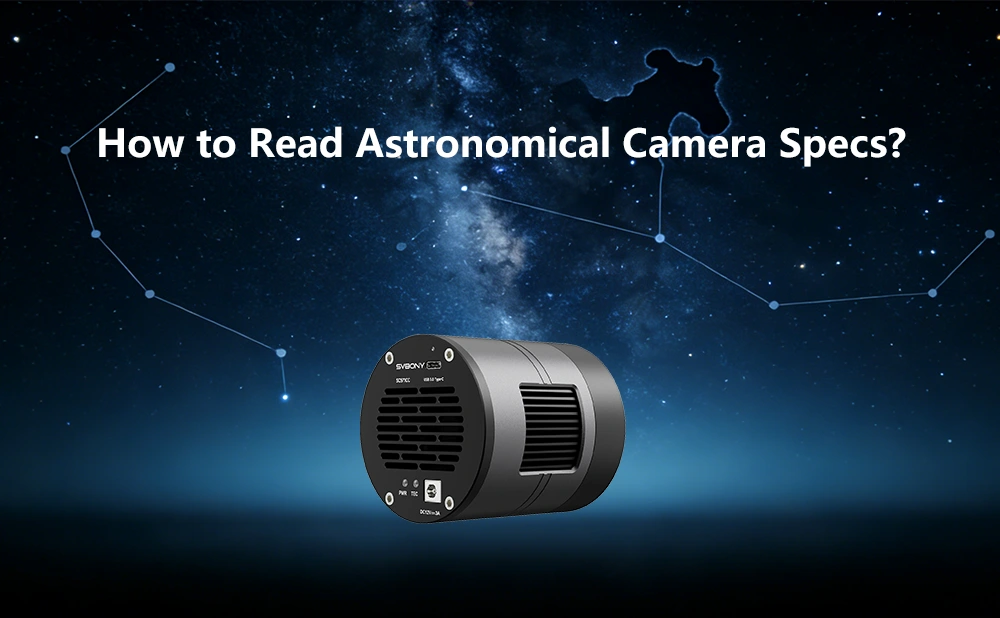
How to Read Astronomical Camera Specs?
For beginners just entering the field of deep-sky photography, the parameter tables of astronomical cameras often seem like a foreign language: 3.76μm pixels, >80% QE, 1.14e⁻ readout noise... What do these numbers actually mean? How do they affect the final image? Today, we'll provide a thorough explanation of these parameters to help you truly understand astronomical cameras.
Why Do We Need to Understand Camera Parameters?
The biggest difference between deep-sky photography and everyday photography is that we're photographing extremely faint objects. The surface brightness of a nebula is often only one millionth the brightness of a sheet of paper under moonlight. Under such extreme conditions, every technical specification of the camera directly affects the final image.
Understanding these parameters will not only help you choose the most suitable camera for you, but also allow you to make more reasonable settings during shooting, fully utilizing the potential of your equipment.
Detailed Explanation of Core Parameters
1. Pixel Size
What is Pixel Size?
Pixel size refers to the physical dimensions of each individual photosensitive unit on the sensor, typically measured in micrometers (μm). The SC571CC cooled camera has a pixel size of 3.76μm × 3.76μm.
Impact on Imaging:
- Large Pixels (>5μm):Each pixel collects more photons, offering higher sensitivity and greater dynamic range, but at the cost of lower resolution
- Small Pixels (<3μm):Higher resolution captures more detail, but each pixel collects fewer photons, potentially resulting in lower signal-to-noise ratio
- Medium Pixels (3-5μm):Like the SC571CC's 3.76μm, this range balances detail and sensitivity
Matching with Your Telescope:
Pixel size needs to work in harmony with your telescope's focal ratio. A commonly used empirical formula is the image scale("/pixel):Image scale = 206.3 × pixel size (μm) / focal length (mm)
The ideal image scale typically falls between 1-2 arcseconds per pixel. For common telescope focal ratios, 3.76μm represents a "golden size":
- f/5 telescope with 3.76μm pixels: image scale ≈1.5"/pixel (ideal)
- f/8 telescope with 3.76μm pixels: image scale ≈0.94"/pixel (slightly oversampled, but manageable in post-processing)
2. Quantum Efficiency: The Ability to Capture Photons
What is Quantum Efficiency?
Quantum Efficiency (QE) is the efficiency with which a sensor converts incident photons into electrons, expressed as a percentage. The SC571CC boasts a peak QE >80%.
Why Does It Matter?
Simply put: The higher the QE, the more "sensitive" your camera is.
- 80% QE means that out of every 100 photons, 80 are successfully recorded
- 50% QE means half of those photons are wasted
In deep-sky photography, many celestial objects emit extremely faint light. High QE means you can achieve the same signal-to-noise ratio with shorter exposures, or obtain clearer images with the same exposure time.
The Significance of QE Curves:
QE varies at different wavelengths. The SC571CC's QE curve shows:
- Blue light (around 450nm): approximately 70%
- Green light (around 550nm): >80% (peak)
- Red light (around 650nm): approximately 75%
- Hα line (656nm): still maintains high response
This means that the SC571CC is not only suitable for shooting regular colored deep-space targets, but also has a good response to Hα red light commonly found in emission nebulae.
3. Read Noise
What is Read Noise?
Read noise is the electronic noise generated when the camera reads the signal from the sensor, measured in electrons (e⁻). The SC571CC's read noise ranges from 2.6 to 1.14e⁻ (varying with gain).
Why Is It Important?
Read noise determines the darkest details a camera can capture. In extremely dark signals (such as the edges of dark nebulae), if the signal strength is lower than the readout noise, the details will be drowned out by the noise.
Relationship with Gain:
Modern CMOS cameras typically feature dual-gain designs (HCG/LCG modes):
- Low Gain:High full-well capacity, wide dynamic range, but higher read noise
- High Gain:Reduced full-well capacity, but significantly lower read noise
The SC571CC automatically switches operating modes through gain settings, providing optimal performance without user intervention.
4. Full Well Capacity and Dynamic Range
Full Well Capacity:The maximum number of electrons each pixel can hold, measured in e⁻. Larger is better, allowing recording of a wider brightness range.
Dynamic Range:The ratio between the brightest and darkest signals a camera can simultaneously record, typically expressed in stops or dB. The SC571CC offers over 14 stops of dynamic range.
The Relationship:Dynamic Range = 20 × log(Full Well Capacity / Read Noise)
Higher dynamic range means:
- Details in both brighter nebula centers and fainter outskirts can be preserved simultaneously
- Greater adjustment latitude in post-processing
- The necessity of advanced techniques such as HDR compositing has decreased.
5. ADC Bit Depth: The Smoothness of Color Transitions
What is ADC Bit Depth?
The bit depth of an analog-to-digital converter (ADC) determines the quantization accuracy when an analog signal is converted into a digital signal. The SC571CC uses a native 16-bit ADC.
Comparison:
- 12-bit:4096 grayscale levels
- 14-bit:16384 grayscale levels
- 16-bit:65536 grayscale levels
Advantages of 16-bit output:
- Smoother color transitions without banding.
- When stretching dark areas, it is less likely to produce stripe artifacts.
- Greater post-processing latitude.
6. Cooling Capability: The Guarantee for Long Exposures
Why Is Cooling Necessary?
All electronic sensors generate thermal noise (dark current). The higher the temperature, the greater the dark current. The SC571CC employs two-stage TEC cooling, capable of reaching 35°C below ambient temperature.
Practical Significance:
- Dark current approximately halves for every 6°C temperature drop
- A 35°C reduction means dark current decreases to less than 1/30 of its original level
- Enables confident single exposures of 10 minutes, 20 minutes, or even longer
Comprehensive Parameter Interpretation
Now, let's synthesize all these parameters to see how the SC571CC performs overall:
| Parameter | SC571CC Value | What It Means |
| Pixel Size | 3.76μm | Golden size, matches most astronomical telescopes |
| Resolution | 26 megapixels | Sufficient for large prints, allows cropping |
| Peak QE | >80% | Efficiently captures faint celestial signals |
| Read Noise | 1.14e⁻ (high gain) | Dark details are clearly visible |
| Dynamic Range | >14 stops | Preserve details in both highlights and shadows. |
| ADC Bit Depth | 16-bit | Smooth color transitions, ample post-processing room |
| Cooling Capability | ΔT 35°C | Stress-free long exposures, extremely low dark current |
| Amp Glow | Native zero amp glow | No corner brightening, simplified post-processing |
Overall Assessment:The SC571CC's parameters are balanced and excellent, with no obvious weak points. In core imaging performance, it reaches the first-tier level of current deep-sky photography cameras.
FAQ
Q1:Are more pixels always better?
A:For the same sensor size, higher pixel count means smaller pixel size, which may decrease sensitivity. 26 megapixels is an ideal balance point for APS-C sensors.
Q2:Is lower read noise always better?
A:Read noise is indeed important, but it must be considered alongside full-well capacity. What truly matters is dynamic range – the ratio between the two.
Q3:Is lower cooling temperature always better?
A:Lowering the temperature below -20°C can further reduce dark current, but with diminishing returns. ΔT 35°C is already sufficient for the vast majority of needs; excessively pursuing lower temperatures increases power consumption and condensation risk.
Q4:Are color cameras inferior to monochrome cameras?
A:While monochrome cameras with filters do offer advantages in narrow-band shooting, color cameras are convenient and easy to use, making them suitable for beginners and users seeking efficiency. High-QE color cameras like the SC571CC perform exceptionally well in everyday deep-sky photography.
Conclusion
Understanding astronomical camera parameters is like learning the "grammar" of the night sky. When you truly grasp the meaning behind these numbers, you can make more informed choices and, during shooting, better understand: why am I setting this parameter this way? How can I optimize image quality?
The SC571CC, as a high-performance cooled camera based on the IMX571 sensor, delivers excellent results across all core parameters. Whether you're just starting out or seeking an upgrade, it deserves your serious consideration.
Comments (0 )
Leave a Reply
 Google
 Amazon
There are no customer reviews yet . Leave a Reply !