


Table of Contents
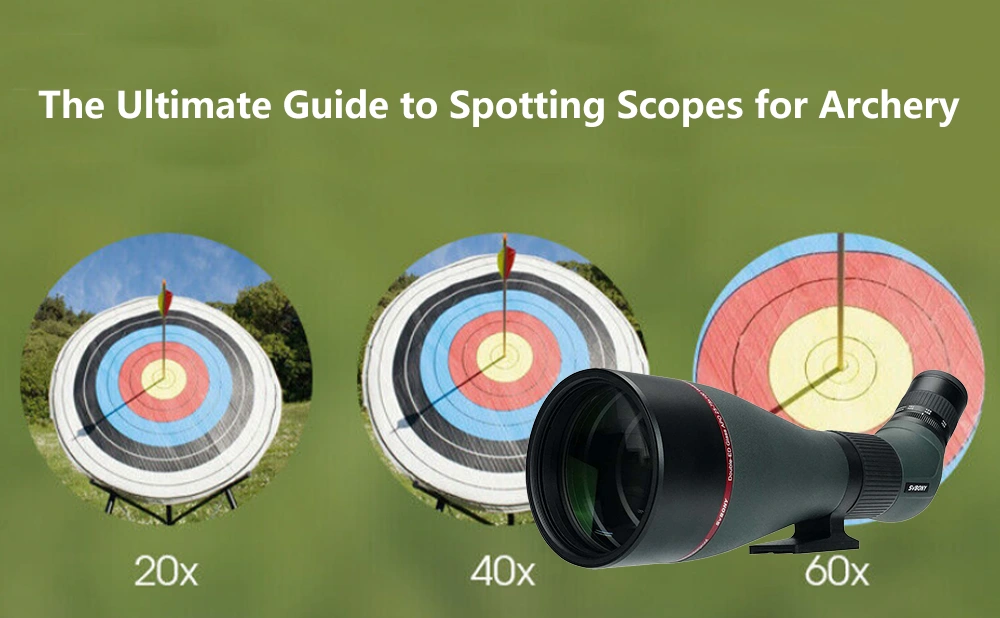
The Ultimate Guide to Spotting Scopes for Archery
Every archer is familiar with this moment: you release the string, hear a “snap,” and then... squint. At 30 meters, you might still make out where the arrow landed; at 50 meters, it’s mostly a guess; at 70 meters-the Olympic competition distance-the target turns into a blur of color, and those tiny X-ring marks are almost impossible to see.
That’s why, on any archery competition line, sighting scopes and binoculars stand side by side with bows and arrows. They aren’t just for show; they’re essential tools that help archers get critical feedback after every shot.
A quick glance through the sight tells you exactly where the arrow landed: too high? Off to the left? Right on the line? This information guides your next adjustment-whether it’s fine-tuning your sight, refining your form, or simply trusting that you hit the mark.
Do You Need a Spotting Scope? Distance Decides
Before diving into specs, ask yourself: How far do you shoot, and what do you need to see?
18-30 Meters: The Gray Area
At indoor or beginner distances, alternatives exist:
- Good eyesight might suffice for seeing general groups
- Quality 8× or 10× binoculars can reveal arrow holes
- Even a monocular-compact and pocketable-can work
Verdict: A spotting scope is convenient but not essential. Your budget might be better spent on arrows or lessons.
50-70 Meters: Where Scopes Become Essential
This is Olympic recurve and competitive compound territory. At 70 meters, the target face is small enough that seeing individual arrow holes-especially in the X-ring-requires serious magnification .
Verdict: Highly recommended. The feedback loop of "shoot, spot, adjust" becomes practical only with good optics.
90+ Meters and Field Archery
At extreme distances or in variable terrain (3D courses, field archery), conditions get even tougher. You're dealing with inconsistent lighting, wooded shadows, and targets at unknown ranges .
Verdict: Essential. A good spotting scope or high-performance binoculars become your eyes in challenging environments.
Spotting Scopes vs. Binoculars: Which Is Right for You?
Archers have options. Here's how to choose:
| Feature | Spotting Scope | Binoculars |
| Best For | Target archery, fixed positions | 3D courses, field archery, moving between targets |
| Magnification | 20-60× typical-zooms for detail | 8× or 10× fixed-easier to stabilize |
| Stability | Requires tripod | Can be handheld, but heavier models benefit from support |
| Portability | Bulky, needs setup | Compact, quick to grab |
| Sharing | Easy-angled eyepieces work for groups | Awkward for multiple users |
The Spotting Scope: The Target Archer's Workhorse
At long distance, a spotting scope allows quick, detailed observation. Once set up on its tripod, one glance tells you everything about your shot .
Key criteria:
- Zoom 20-60×-the most common and versatile range
- Objective lens 60mm minimum, ideally 70-80mm for brightness
- Stable tripod-essential for high-magnification clarity
On the tournament line, scopes must be placed on the equipment line and secured at a specific height. Archers pre-focus on their target before shooting begins, then check after each arrow in a steady ritual .
Binoculars: Compact and Course-Ready
Lightweight and easy to carry, binoculars shine in 3D and field archery, where terrain and lighting change throughout the day . They're also perfect for following competition from the stands .
How to choose:
- 8× magnification: Good visibility, easy to stabilize
- 10× magnification: More power, but more sensitive to movement
- 32mm objective: Sufficient for standard use
- 42mm objective: Better brightness, useful in wooded shade
Heads-up: Wider objectives mean heavier, bulkier binoculars . For roving courses, weight matters.
Key Specifications: What the Numbers Mean
When you see "20-60×80" on a spotting scope, here's what it tells you:
Magnification (20-60×)
The first numbers indicate zoom range-how many times closer objects appear.
- 20× : Wider field of view, easier to locate your target
- 60× : Extreme close-up for seeing arrow holes and scoring rings
For archery: The zoom is invaluable. Use low power to find your target, then zoom in to inspect your arrows.
Trade-off: Higher magnification means:
- Narrower field of view
- More sensitivity to movement (tripod required)
- Greater effect from mirage/heat waves on hot days
Objective Lens Diameter (80mm)
The number after the "×" is the objective lens size in millimeters. Larger objectives gather more light, creating brighter images-critical in overcast conditions or late-afternoon shoots.
- 60mm: Entry-level, lighter, more portable
- 70-80mm: Brighter, better resolution, heavier
- 85mm+: Maximum light transmission, premium performance, significant weight
Rule of thumb: For serious target archery at 50-70 meters, aim for at least 60mm. If you shoot in variable light or want the clearest view, 80mm is worth the weight.
Exit Pupil: The Brightness Factor
Exit pupil = objective diameter ÷ magnification. It's the little disk of light your eye sees through the eyepiece.
- 2-3mm: Fine in bright daylight
- 4-7mm: Brighter, easier viewing in low light
Example: A 60mm scope at 20× gives a 3mm exit pupil. At 60×, it drops to 1mm-much dimmer. That's normal; just don't expect high-magnification brightness to match low power.
Eye Relief: For Eyeglass Wearers
If you wear glasses, eye relief matters-the distance you can hold your eye from the eyepiece while still seeing the full image. Look for scopes with generous eye relief (15mm+) and twist-up eyecups for comfort.
Waterproofing and Fog-Proofing
Spring weather changes fast. Rain, humidity, and temperature swings can fog interior lenses if your scope isn't sealed. Look for:
- Nitrogen or argon purging: Prevents internal fogging
- Rubber armor: Protects against bumps and provides grip in wet conditions
Bottom line: "Waterproof" isn't optional for serious outdoor archers-it's essential.
Angled vs. Straight Eyepiece: Which Is Better for Archery?
This choice affects how you use your scope all day.
Angled Eyepieces (45°)
Strongly recommended for target archery. Why?
- Comfortable viewing: You maintain a natural head position while seated or standing
- Sharing-friendly: Multiple archers can easily look through without adjusting the scope
- Lower tripod height: You don't need to elevate the scope as high, improving stability
On a tournament line, where scopes are fixed in place and shared between teammates, angled is the standard for good reason .
Straight Eyepieces
Advantages:
- Faster target acquisition-point and look
- Intuitive for beginners
Disadvantages:
- Awkward for bench or seated use-you crane your neck
- Harder to share
- Requires taller tripod setup
Verdict: Unless you're primarily shooting from elevated positions or need quick scanning, choose angled for archery.
The Tripod
Here's a truth that surprises many new scope owners: Even the best optics become useless on a wobbly tripod . At 60x magnification, even the slightest vibration-the sound of wind or footsteps-will cause the image to shake.
Tripod Buying Tips
- Stability first: Get a tripod rated for at least twice your scope's weight
- Head type: Fluid or video heads allow smooth panning and tilting
- Height: Should reach your eye level without extending the center column fully (columns reduce stability)
- Budget split: Plan to spend about 3:1 on scope vs. tripod. A $500 scope deserves a $150+ tripod and head.
Field Tip: Secure Your Setup
On windy days or crowded shooting lines, accidents happen. Some archers secure their scopes to railings or benches with straps-one less thing to worry about.
Practical Tips for Range Day
Setup Position: Find Your Rhythm
On the shooting line, archers typically:
- Set up their scope on the equipment line at regulation height
- Pre-focus on their target before shooting begins
- After each arrow, glance through to see the result
- Repeat-a ritual that builds consistency
Focusing Technique: Low to High
- Start at low magnification (20-25×) to locate your target face
- Rough focus to make scoring rings visible
- Zoom in to high power (40-60×) to see individual arrows
- Fine-focus on the arrow holes
Dealing with Mirage
On hot days, heat waves distort the image-especially at high magnification. This isn't your scope's fault; it's physics. Options:
- Shoot early morning or late afternoon when mirage is minimal
- Accept lower magnification on hot afternoons
- Learn to read mirage as wind indicator (advanced skill)
Protecting Your Investment
- Cover when not in use: Dust and rain are enemies
- Clean carefully: Use a blower first, then lens brush or microfiber-never wipe with a shirt
- Transport securely: Padded cases prevent bumps
Quick Comparison: Scenarios and Recommendations
| Your Shooting Style | Recommended Setup | Why |
| Target archery, 50-70m, fixed position | 20-60×80 angled spotting scope + sturdy tripod | Maximum detail, comfortable viewing, competition-ready |
| 3D/field archery, moving between targets | 10×42 binoculars (waterproof) | Lightweight, quick to deploy, good in variable light |
| Backyard practice, 18-30m | 8×42 binoculars or 20-60×60 scope | Both work; choose based on budget and whether you want zoom |
| Tournament shooter sharing with teammates | Angled scope (any quality) with wide exit pupil | Easy sharing, comfortable for all |
| Archer who wears glasses | Long eye relief (15mm+), twist-up eyecups | Full field of view without squishing glasses against lens |
FAQ
Q1:Can I use a spotting scope meant for rifle shooting?
A:Absolutely. Spotting scopes are optics-they don't care what launched the projectile. The same 20-60×80 that works for benchrest shooting serves beautifully for archery. In fact, many top archery scopes evolved from rifle spotters.
Q2:What magnification do I need to see arrow holes?
A:At 50 meters, 40-60× makes arrow holes clearly visible, especially with good lighting. At 30 meters, 20-30× often suffices.
Q3:Can I use my phone to capture what I see?
A:Yes! Digiscoping (photographing through the eyepiece) is popular. Phone adapters clamp your phone to the eyepiece, letting you capture images and video.Some archers even set up dedicated camera systems with Wi-Fi viewing, though battery life becomes an issue.
Q4:Are vintage military scopes good for archery?
A:Generally not recommended. Older scopes have simpler coatings (often yellow-tinted), smaller exit pupils, and uncomfortable eyepieces. Modern mid-range scopes outperform vintage glass in every practical way.
Q5:Do I need a spotting scope if I have a high-end compound bow sight with magnification?
A:Bow-mounted magnifiers (like clarifiers) help you see the target while aiming, but they don't help you see where your arrow landed. They serve different purposes. A spotting scope is for feedback after the shot; your sight is for aiming during it.
Summary
Archery is a sport of infinitesimal adjustments. A millimeter at the arrow rest becomes centimeters at the target. Without seeing those results, you're guessing at what to fix.
A good spotting scope removes the guesswork. It shows you the truth of each shot-the good, the bad, and the "how did that happen?"-and turns every arrow into a learning opportunity.
What distances do you shoot? What spotting gear works for you? Share your experience in the comments!
 Google
 Amazon
There are no customer reviews yet . Leave a Reply !