

Table of Contents
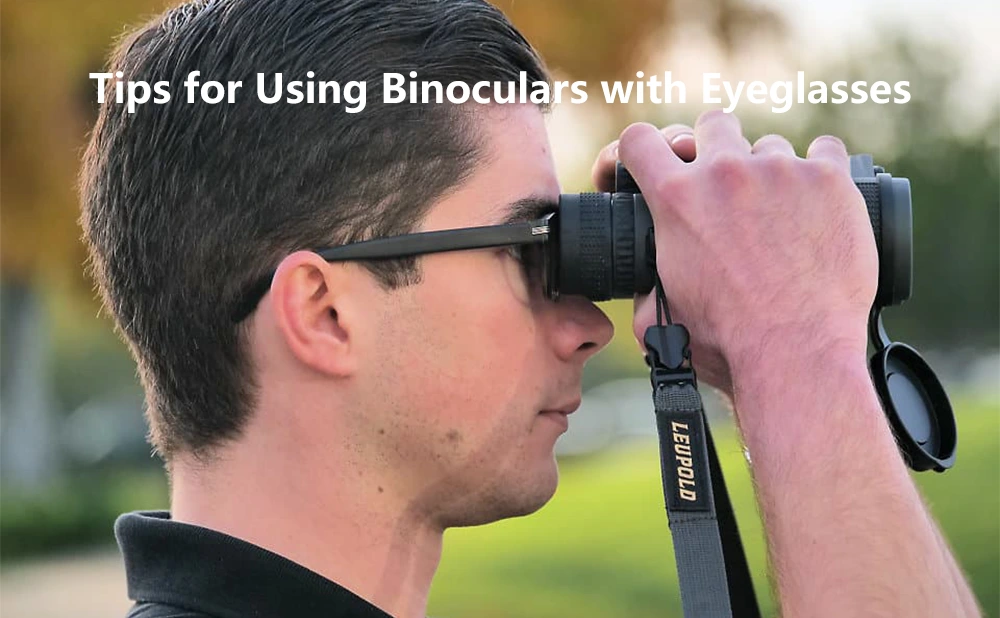
Tips for Using Binoculars with Eyeglasses
Throughout our lives, we have the opportunity to appreciate countless animals, birds, and majestic mountain ranges. But to truly experience their charm and observe them in greater detail-understanding the stories behind them-is an invaluable pursuit. This is why a good pair of binoculars can open up a whole new world of observation.
If you wear glasses and have been wondering whether you can use binoculars while wearing them, keep reading this article, which will tell you everything you need to know about using binoculars if you wear glasses.
Interpupillary Distance (IPD)
The interpupillary distance refers to the distance between the two barrels that house the eyepieces and objective lenses. Most binoculars consist of two barrels connected by a hinge. This allows you to bend the binoculars at the hinge, bringing the barrels closer together or farther apart to align the eyepieces with your eyes.
To adjust the IPD, follow these simple steps:
- Hold the binoculars comfortably with both hands.
- Locate the hinge (or in some cases, a lever or knob) that allows adjustment.
- Bring the binoculars up to your face and look through the eyepieces while gradually adjusting the distance between the barrels until the eyepieces sit comfortably against your face. The goal is to match the distance between the eyepieces to that of your eyes.
- Continue adjusting until you see a single, merged image without any overlap or double vision.
- Once you’ve found the correct IPD, some binoculars have a lock to prevent accidental changes, though not all models include this feature, so you may need to adjust it each time you use them.
How to Adjust Binocular Eyecups
Generally, manufacturers design binocular eyepieces so that the optimal eye relief corresponds to either the fully extended or fully folded position of the eyecups. This means that if you don’t wear glasses, you should usually keep the eyecups fully extended for the best field of view without dark rings at the edges. For eyeglass wearers, the opposite is typically true-you’ll want to fully retract or fold down the eyecups to make room for your glasses.
However, everyone’s vision is slightly different, and glasses vary in thickness and how they sit on the face, so you may find you need the eyecups almost fully retracted, but not quite.
Adjusting Fold-Down Eyecups
Fold-down eyecups have only two positions: folded down or extended outward.For most models, you simply find the softer rubber portion of the eyecup and fold it toward your eyes or down toward the binoculars to adjust the eye relief.
As mentioned, since these eyecups offer only two settings, it can be difficult to achieve your specific eye relief needs. For example, you may need longer eye relief because you wear glasses, but with the eyecups folded down, the eye relief might be too long, and with them extended, it might be too short. Unfortunately, these designs make it hard to find a middle ground. Therefore, we always recommend choosing twist-up eyecups whenever possible.
Adjusting Twist-Up Eyecups
- Twist-up eyecups generally allow for finer adjustments, as they can be set at various distances.
- Start by fully retracting the eyecups, twisting them as far down toward the binocular body as possible.
- Put on your glasses and look through the binoculars to see if there are dark rings at the edges of the image. If you don’t see any, the eyecups are set correctly for your eyes.
- If you see dark rings, twist the eyecups out one click or turn and check again.
- Repeat this process until you can comfortably view through the binoculars without any dark rings.
Diopter Adjustment While Wearing Glasses
- Bring the binoculars up to your eyes and adjust the interpupillary distance (IPD) to match the distance between your eyes.
- Close the eye opposite the diopter adjustment ring (usually the right eyepiece), and use the central focus wheel to bring the image into sharp focus for the open eye.
- Open the eye behind the diopter adjustment eyepiece and close the other eye. Rotate the diopter adjustment mechanism until the image for the eye you’re using is sharply focused.
- Open both eyes and look through the binoculars to ensure the image is equally sharp for both. Make any minor adjustments as needed for the best clarity.
- Once both eyes are properly focused, lock the diopter adjustment mechanism if available to prevent accidental changes.
Conclusion
We hope this article has provided you with useful information on how to use binoculars while wearing glasses and how to adjust them for optimal performance. The most important considerations are eye relief and eyecup design. We strive to include information on these features in all our product details to make it as easy as possible for you to select the right binoculars for your needs.
 Google
 Amazon
There are no customer reviews yet . Leave a Reply !