

Table of Contents
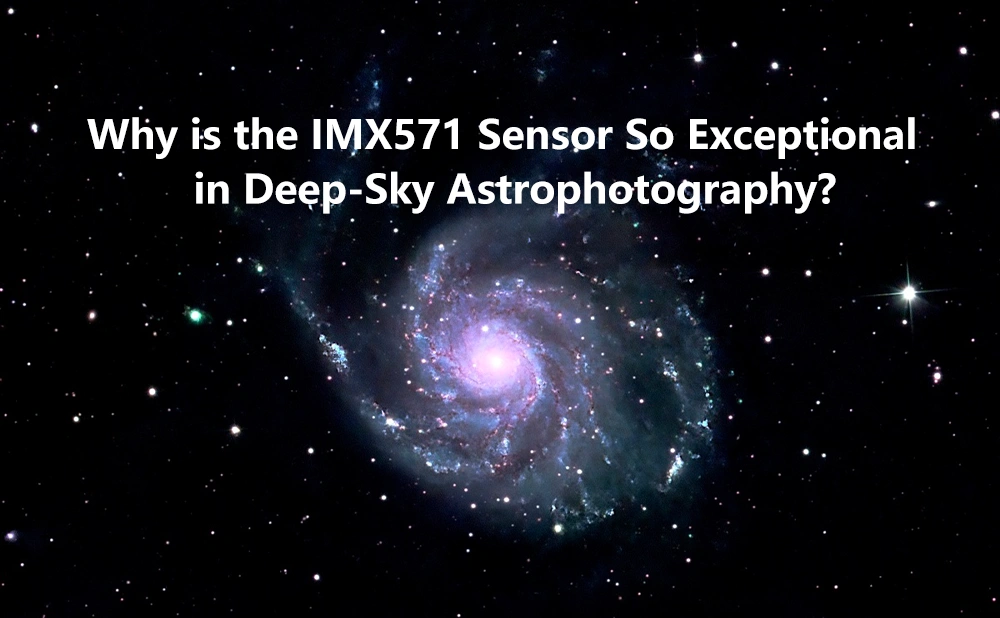
Why is the IMX571 Sensor So Exceptional in Deep-Sky Astrophotography?
In the world of deep-sky astrophotography, there is one sensor that has maintained remarkable popularity over the years, adopted by numerous astronomical camera brands – Sony's IMX571 APS-C format back-illuminated CMOS sensor. Since its debut in 2018, this 26-megapixel "heart" has become a benchmark product in the field thanks to its outstanding comprehensive performance.
The IMX571 Sensor – The Gold Standard for Deep-Sky Photography
Technical Background
The IMX571 is an APS-C format back-illuminated CMOS sensor manufactured by Sony Semiconductor, originally used in high-end mirrorless cameras like the Fujifilm X-T3. As a world-leading sensor manufacturer, Sony's products have always been renowned for their high sensitivity, excellent noise control, and wide dynamic range - qualities that laid the foundation for the IMX571's success in deep-sky photography.
Core Specifications
|
Parameter |
Value |
|
Resolution |
26 megapixels (6224 × 4168) |
|
Sensor Size |
APS-C (23.4mm × 15.7mm) |
|
Pixel Size |
3.76μm × 3.76μm |
|
ADC Bit Depth |
Native 16-bit |
|
Peak Quantum Efficiency |
>80% |
|
Read Noise |
As low as 1.14e⁻ (depending on gain) |
|
Dynamic Range |
Over 14 stops |
Four Core Advantages
Back-Illuminated Design, Ultra-High Quantum Efficiency
The back-illuminated structure gives the IMX571 a peak quantum efficiency exceeding 80%, meaning it converts more photons into electrical signals. For capturing faint deep-sky objects (such as the Horsehead Nebula, Veil Nebula, and other Hα regions), high quantum efficiency is often the deciding factor between success and failure. Even in light-polluted urban environments, this sensor delivers surprisingly capable performance.
Native Zero Amp Glow, Pristine Image Quality
"Amp Glow" is a common problem with traditional CMOS sensors during long exposures – bright areas appearing in the corners of the frame, severely interfering with image quality. The IMX571 achieves native zero amp glow through advanced circuit design. This means you can confidently take 10-minute, 20-minute, or even longer single exposures without worrying about abnormal brightness in the corners, and post-processing becomes much simpler.
The Perfect Balance of Low Read Noise and High Dynamic Range
The IMX571 achieves an excellent balance between read noise and dynamic range. With the camera's dual-gain design (HCG/LCG modes), users can flexibly adjust based on their target:
- Lower gain settings suit bright galaxies and star clusters
- Higher gain settings better reveal details in faint nebulae
This flexibility allows the IMX571 to handle both faint emission nebulae and bright reflection nebulae, truly serving multiple purposes.
APS-C Format: The Perfect Match for Telescopes
Compared to full-frame, APS-C avoids the problematic edge aberrations common in many telescopes, making it easier to achieve sharp stars and uniform illumination across the frame. Compared to smaller formats, it offers a wider field of view. The 3.76μm pixel size is also ideal – small enough to capture detail, yet large enough to ensure sensitivity, pairing well with common focal ratios (f/4-f/8).
Technical Implementation of the IMX571 Sensor – Taking SVBONY SC571CC as an Example
Based on the IMX571 sensor, different camera brands offer diverse options through varying design philosophies and technical approaches. As SVBONY's latest cooled camera, the SC571CC fully inherits the IMX571's core advantages while making clear value-based choices in product design.
Core Features of SVBONY SC571CC
Two-Stage TEC Cooling, Stable and Reliable
The SC571CC features a two-stage TEC cooling system that can lower the sensor temperature up to 35°C below ambient. This effectively reduces dark current and sensor noise, providing a stable and reliable foundation for long-exposure deep-sky photography.
512MB DDR3 Cache, Worry-Free Data Transfer
The large cache, combined with a USB 3.0 Type-C interface, ensures stable data transmission during extended continuous shooting sessions, effectively reducing frame drops or interruptions – ideal for all-night imaging sequences.
16-bit ADC Output, Rich Image Gradation
The native 16-bit analog-to-digital converter delivers over 14 stops of dynamic range, ensuring that details from faint nebulae to bright galaxies are fully recorded, with smooth tonal transitions.
Wide Software Compatibility
The SC571CC is compatible with Windows, Mac, Linux, and Raspberry Pi systems, supporting mainstream astronomical software including NINA, SharpCap, and PHD2. Through ASCOM drivers, it seamlessly integrates into existing astronomical control ecosystems.
Clear Product Positioning:Focus on Core Performance
Compared to other IMX571-based cameras, the SC571CC's product strategy is very clear - concentrate resources on core imaging performance, offering IMX571's exceptional image quality at a more competitive price.
The SC571CC does not include a built-in USB hub. This trade-off allows users to allocate their budget toward more flexible external device configurations. In practical setups, many experienced users actually prefer this approach, as it allows them to choose different specifications of USB hubs or power management devices according to their needs, making cabling solutions more flexible.
Testing by well-known astro blogger naztronomy shows that under identical shooting conditions, the actual image quality of the SC571CC is virtually indistinguishable from other mainstream IMX571 cameras. Whether shooting broadband targets or using dual-narrowband filters, star shapes, background noise, and color reproduction all show remarkable consistency.
This means that when you choose the SC571CC, you get all the image quality potential the IMX571 sensor has to offer, while the budget you save can be used to upgrade other components.
How to Choose the Right IMX571 Camera for You?
Faced with multiple IMX571-based cameras on the market, how do you make the best choice for yourself?
Clarify Your Core Needs
If you're on a budget and prioritize core image quality
If your primary concern is the IMX571 sensor's imaging performance, and you don't have strong needs for附加 features like built-in hubs, then focusing your budget on the sensor itself is a wise choice. SVBONY SC571CC is designed precisely for such users, offering uncompromising image quality at an accessible price.
If you want to simplify your equipment connections
If you prefer to reduce cable clutter and keep your setup clean, choosing a model with a built-in hub would be more suitable. Such products integrate multi-device connection functionality within the camera, reducing external connection points.
Consider System Compatibility and Future Expansion
Regardless of which camera you choose, ensure it works well with your existing or planned accessories:
- Back Focus Calculation: The camera body's back focus distance affects the overall optical path design. The SC571CC has a body back focus of 17.5mm, which can be paired with accessories like the SVBONY SV226P adapter ring and SV238 off-axis guider to easily achieve the standard 55mm back focus.
- Software Control: The SC571CC is fully compatible with the ASCOM platform, seamlessly integrating with mainstream software like NINA, SharpCap, and PHD2 – whether for autofocus, auto-guiding, or sequence shooting.
Real User Feedback
Real user feedback often best reflects a product's actual performance:
"From my point of view, the SC571CC is positioned at the same level as other cameras using the IMX571 sensor, but with a more competitive price. It achieves this by reducing certain features such as an integrated USB hub. By offering the camera at a lower price point, users can allocate part of the savings to an external hub, which in many real-world setups ends up being a more flexible and scalable solution. From this perspective, I think the strategy makes a lot of sense."– Carlos, SC571CC User
Why Has the IMX571 Become an "Evergreen"?
Looking back at the IMX571 sensor's development since its 2018 release, the fundamental reason for its enduring vitality is that it strikes a near-perfect balance:
- Ideal Format: APS-C pairs perfectly with mainstream telescopes, balancing field of view and edge aberration control
- Optimal Pixel Size: 3.76μm balances detail capture and sensitivity, adapting to optical systems with different focal ratios
- Balanced Performance: High quantum efficiency, low read noise, native zero amp glow, wide dynamic range
For deep-sky photography enthusiasts, choosing the IMX571 camera means choosing a reliable path with extremely high potential for advancement. Regardless of which product you ultimately choose, this sensor will open the door to new realms of deep-sky photography.
Conclusion
Whether you're a beginner just entering deep-sky photography or an experienced enthusiast seeking an upgrade, the IMX571 sensor deserves your serious consideration.
Which IMX571 camera are you using? Feel free to share your photos and experiences in the comments!
Comments (0 )
Leave a Reply
 Google
 Amazon
There are no customer reviews yet . Leave a Reply !