
Table of Contents
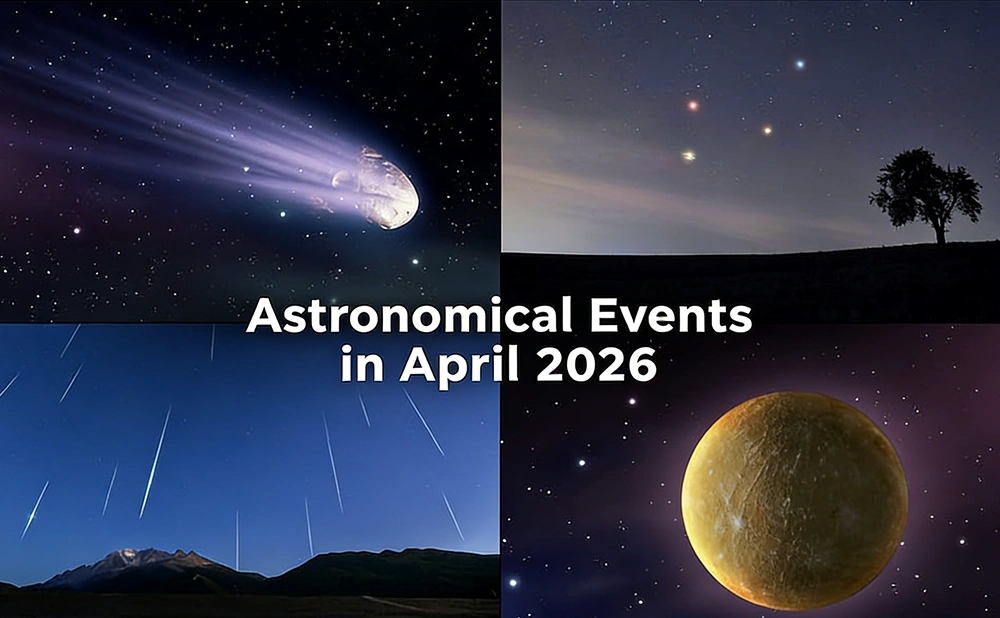
Astronomical Events in April 2026
April 2026 promises to be a thrilling month for stargazers, with the night sky hosting a rare planetary alignment, a reliable meteor shower, and a potentially naked-eye comet. Whether you're an experienced astronomer or a casual observer, this guide will help you plan your observations for the most notable celestial events.
Key Astronomical Events in April 2026
April 18: Four-Planet Alignment
Around April 18, Saturn, Mars, Mercury, and Neptune will gather in a remarkably tight patch of sky, spanning only about 4°.
- Observation Challenge: This alignment will be difficult to observe as the planets sit very close to the Sun in the morning sky.
- Best Time & Direction: Look low above the eastern horizon roughly one hour before sunrise.
- Hemisphere Advantage: Observers in the Southern Hemisphere will have the best chance, as the planets will appear slightly higher in a darker sky before dawn.
- Visibility: Saturn, Mars, and Mercury should be visible to the naked eye. Neptune, typically requiring a telescope, will likely be too faint to spot in the bright twilight.
April 22: Lyrid Meteor Shower Peak
The annual Lyrid meteor shower will reach its maximum activity.
- Peak Date: April 22.
- Meteors per Hour: Up to 18.
- Moon Conditions: Excellent! A waxing crescent Moon (38% illuminated) will set early, providing dark skies for optimal viewing.
- Best Viewing Time: Start observing after about 22:30 local time in mid-northern latitudes. For those in the mid-southern hemisphere, the best viewing is after midnight.
- Radiant Point: The meteors will appear to emanate from the constellation Lyra. The higher it is above your horizon, the more meteors you are likely to see.
- Viewing Tip: No special equipment needed. Find a dark spot, allow your eyes to adjust for 20-30 minutes, and enjoy the show.
April 25: Comet C/2025 R3 Reaches Maximum Brightness
Comet C/2025 R3 (PANSTARRS) is predicted to reach its peak brightness.
- Estimated Brightness: Approximately magnitude 7.7, making it a binocular target. Some forecasts suggest it could brighten dramatically to magnitude 3.7, potentially becoming visible to the naked eye!
- Visibility by Hemisphere:
- Northern Hemisphere: Look for the comet in the morning sky in late April.
- Southern Hemisphere: Better positioned to see it in the evening sky in early May.
More Celestial Events in April 2026
Beyond the headline events, April's sky offers many other beautiful conjunctions and phases:
- April 2: Full Moon (The Pink Moon), which also determines the date of Easter in 2026. Located in the constellation Virgo.
- April 3: The nearly full Moon passes close to the bright star Spica in Virgo. Also, Mercury reaches its greatest western elongation, offering the best morning visibility of the year.
- April 6: The Moon passes very close to the red star Antares in Scorpius, with a lunar occultation visible from parts of the southern Indian Ocean.
- April 15: A thin crescent Moon appears near Mercury in the morning sky.
- April 19: A busy day in the sky! The crescent Moon is close to Venus, then later near the Pleiades star cluster and the planet Uranus. Also, Mars and Saturn have a close conjunction.
- April 20: Mercury has a very close encounter with Saturn (only 0.27° apart) and another with Mars.
- April 22-24: The waxing Moon visits Jupiter and the star Pollux in Gemini, then passes near the Beehive Cluster in Cancer.
- April 24: Brilliant Venus passes close to the beautiful Pleiades star cluster in Taurus.
Stargazing Preparation Tips for April 2026
Location is Key
Seek out the darkest possible site with a wide, unobstructed view of the horizon, especially for the morning planetary alignment.
Dress for Success
April nights can still be chilly. Dress in warm layers and consider bringing a hot drink, a comfortable chair, and a blanket for extended observing sessions.
Essential Tools
- Your Eyes: Perfect for enjoying meteor showers, bright conjunctions, and the Full Moon.
- Binoculars (8x42 or 10x42): Highly recommended for viewing the comet, the Pleiades, the Beehive Cluster, and to enhance details during planetary alignments.
- Small Telescope: Useful for trying to spot Neptune during the alignment and for getting detailed views of the Moon and planets.
Happy stargazing! We hope this guide helps you make the most of April's spectacular celestial offerings.
 Google
 Amazon
There are no customer reviews yet . Leave a Reply !