

Table of Contents
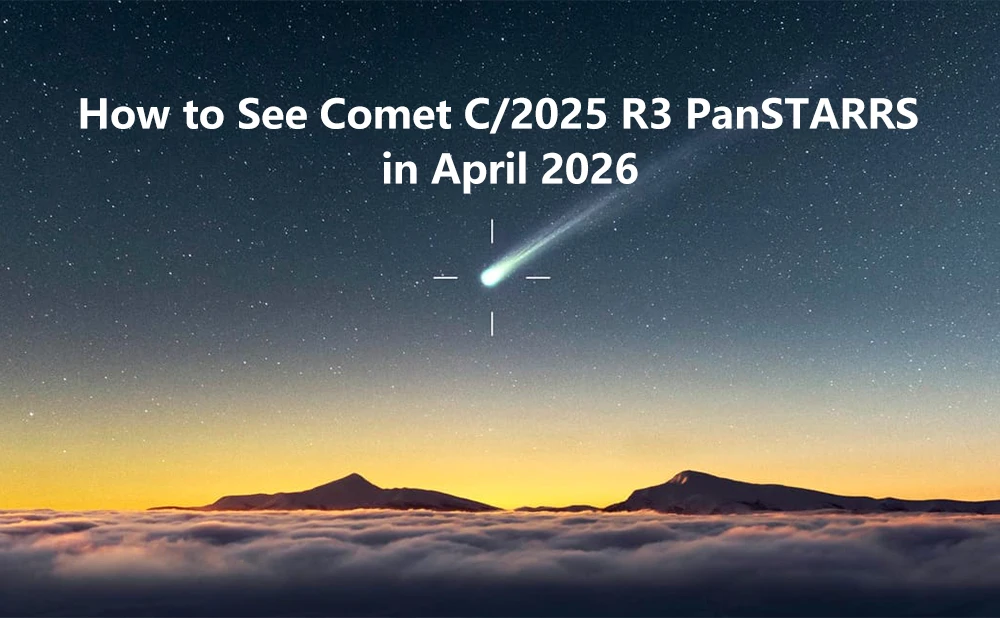
How to See Comet C/2025 R3 PanSTARRS in April 2026
A highly anticipated comet is about to shine. In April 2026, comet C/2025 R3 (PanSTARRS) may be so bright that it will be visible to the naked eye, even rivaling the brightness of planets! This article will tell you when, where, and how to observe this comet.
Key Information on C/2025 R3 (PanSTARRS)
Type
Non-periodic comet. Its orbit is highly inclined and may be hyperbolic, meaning this could be humanity's only chance to see it.
Peak Brightness (Predicted)
Around magnitude 2.8 (baseline). Under optimal conditions with forward scattering, it could reach magnitude -1.0.
Key Dates
- Perihelion (closest to Sun): April 19, 2026.
- Closest to Earth: April 26, 2026.
Where to See Comet C/2025 R3
The where to see comet C/2025 R3 depends heavily on your location and the date.
Northern Hemisphere
- March to mid-April 2026: Best chance to see it. It will be a morning object, visible in the east before sunrise.
- Late April 2026: The comet sinks into the Sun's glare and becomes very difficult or impossible to see from the north.
Southern Hemisphere
Late April to May 2026: The best viewing shifts south. The comet will become an evening object in the western sky after sunset.
How to See Comet C/2025 R3
Follow these steps for the best chance on how to see comet C/2025 R3.
Timing is Everything
- Best Window: Aim for the week around the New Moon on April 17, 2026, for the darkest skies.
- Avoid: Full Moons (e.g., April 2, May 1) when moonlight washes out the comet.
- Time of Day: For the Northern Hemisphere, look before sunrise in early April. For the Southern Hemisphere, look after sunset in late April/early May.
Find a Dark Sky
Get away from city lights. The darker your location, the better your chance of seeing it, especially if it only reaches moderate brightness.
Use Tools to Locate It
- Use an App: The comet's position changes nightly. Use a sky guide app to pinpoint its real-time location in constellations like Pegasus, Pisces, Cetus, and Taurus.
- Start with Optics: Even at its predicted peak, binoculars or a small telescope will greatly enhance your view, revealing its diffuse coma and tail.
Know What to Look For
The comet will appear as a fuzzy, diffuse patch of light (not a sharp star-like point). Patience and dark-adapted eyes are key.
Why Are the Predictions Different?
Some predictions for how to see comet C/2025 R3 show it much brighter due to forward scattering. This optical effect, dependent on the geometry between the Sun, comet, and Earth, could temporarily boost its brightness by up to 100 times. Its actual peak brightness remains uncertain until closer to the date.
Summary
Schedule your observations during the mid-April dark and moonless window, find a dark viewing spot, and use a stargazing app to locate it. This may be your only chance to witness this visitor from the distant Oort cloud.
 Google
 Amazon
There are no customer reviews yet . Leave a Reply !