
Table of Contents
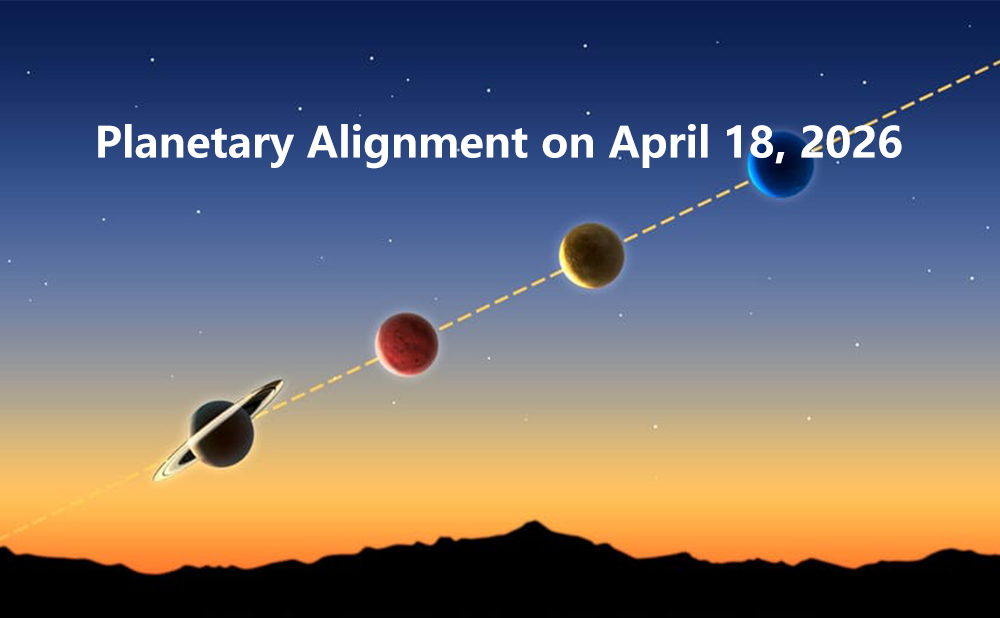
Planetary Alignment on April 18, 2026
When you gaze at the night sky, have you ever wondered about the spectacular sight of all planets lining up? Or, more practically, when you can next see multiple planets gathered together? This blog will quickly explain the truth about "planetary alignments" and focus on an upcoming celestial event.
What Exactly is a "Planetary Alignment"?
First, let's clarify a common misconception. A "planetary alignment" or "planet parade" does not mean all planets form a perfect straight line in space (an extremely rare occurrence). In observational astronomy, it usually refers to the visual phenomenon where, from Earth's viewpoint, several planets cluster in the same region of the sky, forming a noticeable line or tight grouping along the ecliptic-the Sun's apparent path across our sky.
When Was the Last Time "All Planets" Aligned?
According to astronomical definitions, all eight solar system planets (Mercury, Venus, Earth, Mars, Jupiter, Saturn, Uranus, Neptune) forming an absolutely precise straight line in space has likely never occurred in human history and is virtually impossible due to the vast differences in their orbital planes and periods.
The "planetary alignments" we typically talk about and can see with our eyes refer to multiple bright planets appearing close together in the night sky. A notable multi-planet gathering last occurred in April 2026, when Mercury, Venus, Jupiter, Saturn, Uranus, and Neptune lined up in the pre-dawn sky. The next noteworthy event is just ahead.
The Next Celestial Feast: A Four-Planet Align in April 2026
If you're searching for "when will four planets align," the answer is set: mid-April 2026.
Key Details at a Glance
- Peak Date: April 18, 2026 (visible for several mornings around this date)
- Planets Involved: Mercury, Mars, Saturn, Neptune
- Best Time to Look: ~30 minutes before local sunrise (Northern Hemisphere) or 60–90 minutes before sunrise (Southern Hemisphere)
- Where to Look: Low in the east
- Visible to Naked Eye: Mercury, Mars, Saturn
- Telescope Target: Neptune
Why is This "Planet Alignment" Notable?
This alignment is special due to the hemispheric disparity in viewing conditions, which directly answers the question "Is this alignment visible everywhere?"
- A Boon for Southern Hemisphere Viewers: For observers in Australia, South Africa, South America, and similar latitudes, this is an excellent opportunity. The planets will rise at a steeper angle, reaching a higher position in a darker sky, offering a longer and easier viewing window.
- A Challenge for Northern Hemisphere Observers: For locations above ~30°N (like North America, Europe, northern Asia), observing is very difficult. The planets will hug the brightening eastern horizon, with a very short viewing window requiring exceptionally clear air and a completely unobstructed view.
How to Successfully Observe This "Four Planets Align"
- Flex Your Dates: Don't focus solely on April 18. The planetary formation remains similar for several days, giving you a viewing window of about a week around the peak date.
- Safety First: This is critical! This alignment happens close to the rising Sun. Never point binoculars or a telescope near the eastern horizon around sunrise. The Sun can unexpectedly enter the field of view, causing instant, permanent eye damage. Stop using optical devices several minutes before sunrise.
Conclusion
A "planetary alignment" isn't a once-in-a-millennium myth but a periodic celestial drama. The four-planet gathering in April 2026 offers a pre-dawn feast for Southern Hemisphere stargazers and a challenging opportunity for their Northern Hemisphere counterparts.
No matter where you are on Earth, the keys to unlocking this sky show are planning ahead, leveraging technology, finding an open location, and always prioritizing safety.
Happy stargazing, and clear skies!
 Google
 Amazon
There are no customer reviews yet . Leave a Reply !