
Table of Contents
Moon-Venus Conjunction 2026: What It Is and How to See It
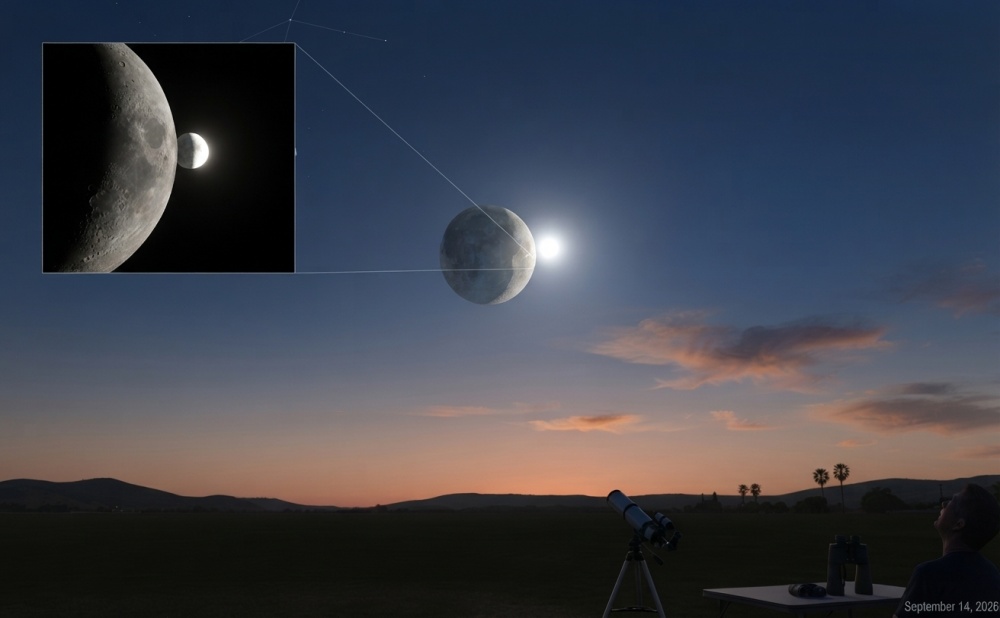
On September 14, 2026, the Moon and Venus will appear remarkably close together in the evening sky, creating one of the notable September astronomical events 2026. This moon and Venus conjunction 2026 will bring a thin waxing crescent Moon and brilliant Venus together in a striking celestial pairing.
The event will be easy to enjoy with the naked eye, while binoculars and telescopes can provide a closer view. It also offers good opportunities for night-sky photography. From parts of Africa, Asia, Europe, and western Russia, observers may also have the chance to see a lunar occultation of Venus, when the Moon passes in front of the planet from our point of view. The exact view and timing will depend on your location.
Whether you are new to astronomy or already enjoy photographing the night sky, this close pairing is a simple event to add to your observing calendar.
What Is a Venus-Moon Conjunction?
A conjunction of Venus and the Moon occurs when Venus and the Moon appear close together in the sky as seen from Earth. It is an apparent alignment, not an indication that the two objects are physically close to each other in space.
The Moon moves relatively quickly across the sky as it orbits Earth, so it regularly passes near bright planets. Venus is particularly easy to notice because it can become one of the brightest objects in the sky after the Sun and Moon.
This makes Venus next to the moon an attractive sight for both beginners and experienced observers. The bright planet and thin lunar crescent create a strong visual contrast, especially during twilight.
A conjunction can also be a useful learning opportunity. By following the Moon as it moves through the sky, beginners can start to recognize planets, constellations, and the changing position of celestial objects from night to night.
It is important to remember that the apparent distance between the Moon and Venus is measured as an angle on the sky. Their actual distance from Earth and from each other is vastly greater than the separation seen in the sky.
September 14, 2026: A Close Moon-Venus Pairing
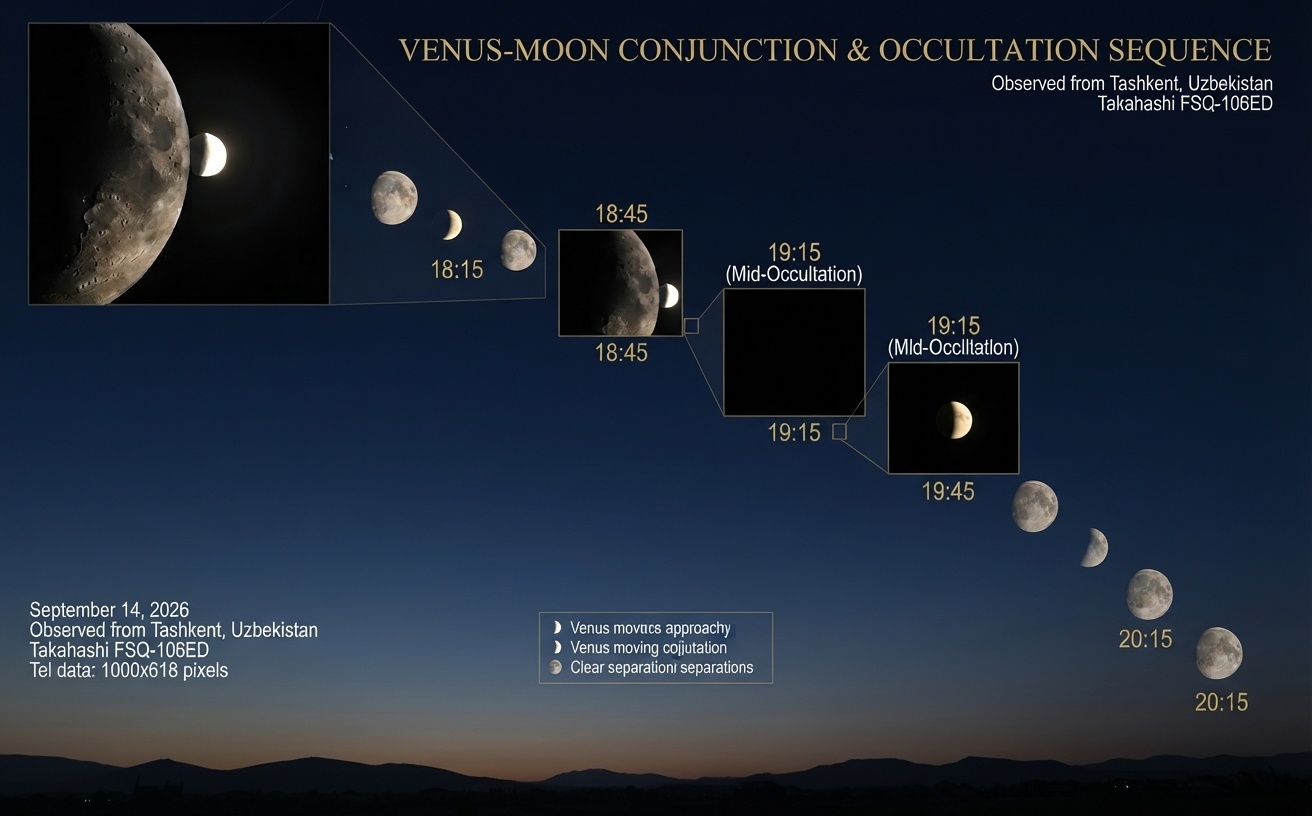
The main Venus-Moon conjunction will occur on September 14, 2026. At their closest apparent approach, the Moon and Venus will pass within about 28.8 arcminutes, or 0.48 degrees, of each other. The conjunction itself occurs at a separation of roughly 31 arcminutes, with the close approach following shortly afterward.
The Moon will appear as a thin waxing crescent, with about 15% of its surface illuminated. Venus will appear much brighter nearby, creating a noticeable contrast between the narrow lunar crescent and the brilliant planet.
For many observers, the pair will be relatively low in the evening sky. The exact altitude, viewing direction, and time of visibility depend on your location. In general, look toward the western or southwestern sky after sunset, then use a local astronomy app or sky chart to confirm the Moon and Venus's exact position.
A clear horizon will be especially important. Trees, buildings, hills, and haze can easily block objects that are low in the sky.
The two objects will also be in the constellation Virgo around the time of the close approach.
Could You See Venus Disappear Behind the Moon?
For some observers, September 14 offers more than a close conjunction. The Moon will pass directly in front of Venus from certain locations, producing a lunar occultation of Venus.
A lunar occultation happens when the Moon moves across the line of sight between Earth and another celestial object. Because the Moon is relatively close to Earth, its apparent position changes noticeably depending on where you are on the planet. As a result, an occultation can be visible from one region while observers only a short distance away see a close conjunction instead.
NASA lists the September 14 occultation as visible from parts of Asia, Africa, Europe, and western Russia. The actual occultation path is much narrower than those broad regions, so observers should check a local occultation map or astronomy app before planning a dedicated observation.
If you are outside the occultation path, there is still plenty to see. The close Moon-Venus pairing will be visible over a much wider area.
Why Is the Venus-Moon Conjunction Worth Watching?
One of the best things about this event is its accessibility. You do not need a large telescope, specialized camera, or dark-sky location to enjoy it.
The Moon is easy to find, and Venus is bright enough to stand out during twilight. This makes the conjunction a useful introduction to skywatching for beginners. Once you locate the Moon, Venus can help you practice identifying planets and learning how celestial objects move across the evening sky.
The pairing is also visually attractive. The Moon will appear as a narrow crescent, while Venus will look like a bright point of light to the naked eye. As the sky becomes darker, the contrast between the two objects can become even more noticeable.
For experienced observers, the event provides an opportunity to compare different observing methods.
You can start with the naked eye, switch to binoculars for a closer look, and then use a telescope to examine the Moon and Venus in greater detail.
Photographers have another reason to watch. Because the objects appear close together, they can often be captured in a single frame along with a landscape, building, mountain, or other foreground subject.
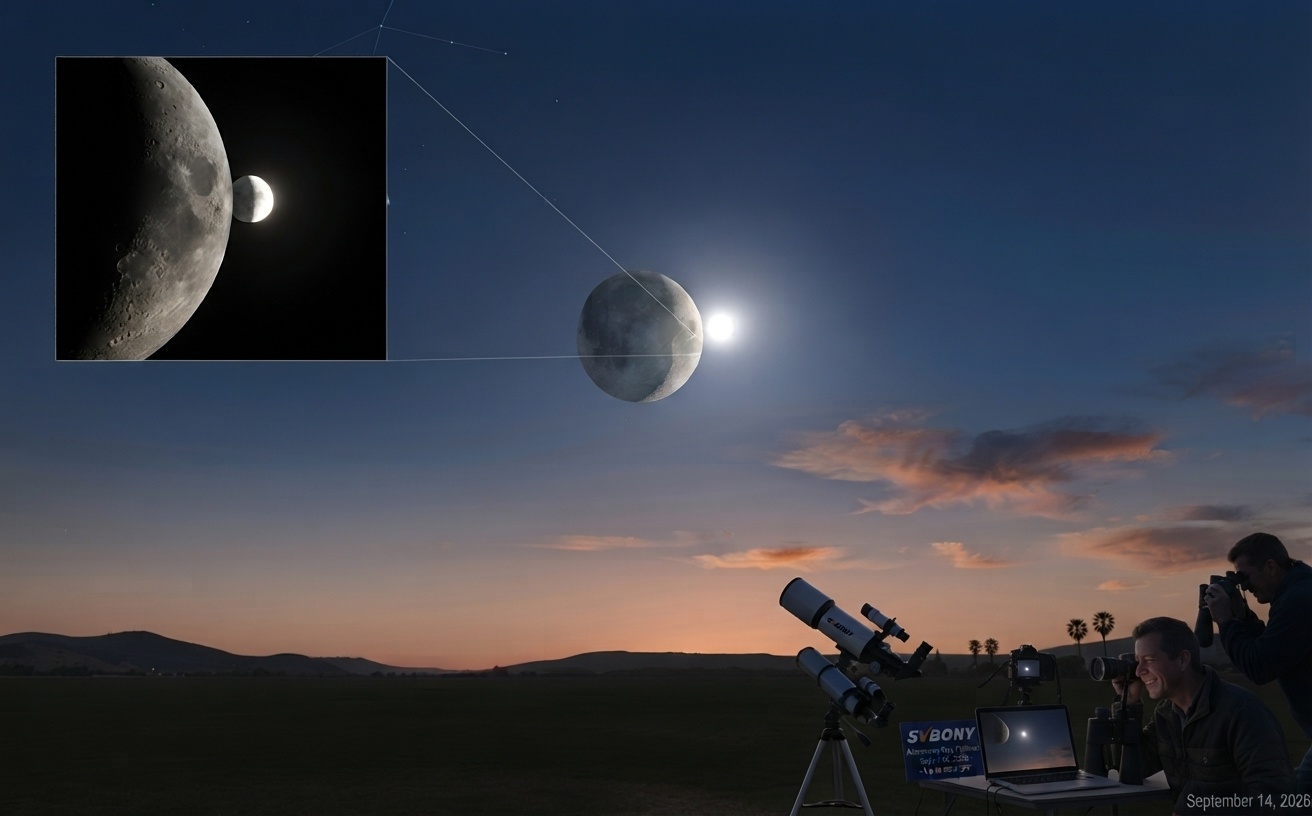
How to Observe the Moon and Venus?
Naked-Eye Observation
The simplest way to observe the September 14 event is with your eyes.
Choose a location with an unobstructed view toward the western or southwestern sky. Before sunset, check a local sky chart so you know approximately where to look. Once the sky begins to darken, find the thin crescent Moon first. Venus should be the exceptionally bright object nearby.
Do not wait too long after sunset if the pair is low above the horizon. Their altitude will decrease as the evening progresses, and local buildings or trees may quickly block the view.
Light pollution should not be a major problem. The Moon and Venus are both bright enough to remain visible from many suburban and urban locations.
If you are observing with children or beginners, this is also a good event for a simple first astronomy session. Start by locating the Moon, then identify Venus, and finally compare their brightness and apparent size.
Observing With Binoculars
Binoculars offer a closer view while maintaining a relatively wide field of view. This makes them particularly useful for a close Moon-Venus pairing.
A pair of binoculars can make the thin lunar crescent easier to examine while keeping Venus nearby in the same field. Because binoculars are easier to move and aim than a telescope, they are also convenient for beginners.
Try to keep the binoculars steady. Resting your arms on a stable surface or using a tripod adapter can make the view more comfortable.
Binoculars are also useful if you want to photograph the scene indirectly by first studying the composition. Once you know how the Moon and Venus are positioned, you can decide whether a wide-angle camera lens or a telescope will better suit your image.
As always, use optical equipment carefully around sunset. Never point binoculars or a telescope toward the Sun. Wait until the Sun is safely below the horizon before beginning your observation.
Observing With a Telescope
A telescope can reveal more detail on the Moon and show Venus as a small planetary disk.
If you want to see both objects in the same field, start with a low-power, wide-field eyepiece. Because the Moon and Venus are close together on September 14, a sufficiently wide field may allow both to remain visible at the same time.
Once you have found the pair, you can increase magnification if you want to examine the Moon more closely. However, increasing magnification reduces the field of view, so Venus may move outside the frame.
Atmospheric conditions are another consideration. When an object is low above the horizon, you are looking through more of Earth's atmosphere. Turbulence and haze can soften fine lunar detail and make Venus appear less stable.
For this reason, a larger telescope is not always the most important factor. A clear horizon, stable air, accurate focus, and suitable magnification can make a significant difference.
If you are using a computerized mount, enter the Moon or Venus as your initial target and then adjust the framing manually. If you are using a manual mount, the bright Moon provides an easy starting point for locating the pair.
Planning Your Equipment
You do not need to build a complicated observing setup for this event.
For simple visual observing, the naked eye or binoculars may be enough. A compact telescope is useful if you want a closer look at the Moon, while a wider-field telescope setup can be better for viewing both objects together.
For astrophotography, consider your desired composition before choosing your focal length. A long focal length provides a larger image of the Moon but makes it harder to include Venus and a landscape in the same frame. A shorter focal length provides more context and is usually easier for wide-field conjunction photography.
If you are planning to observe or photograph the event, SVBONY's Astronomy Day Festival runs from September 7–22, 2026, with up to 45% off storewide on telescopes, astrophotography cameras such as the SC571CC,and other astronomy gear. Visit the official promotion page for full details.
How to Photograph the Moon and Venus?
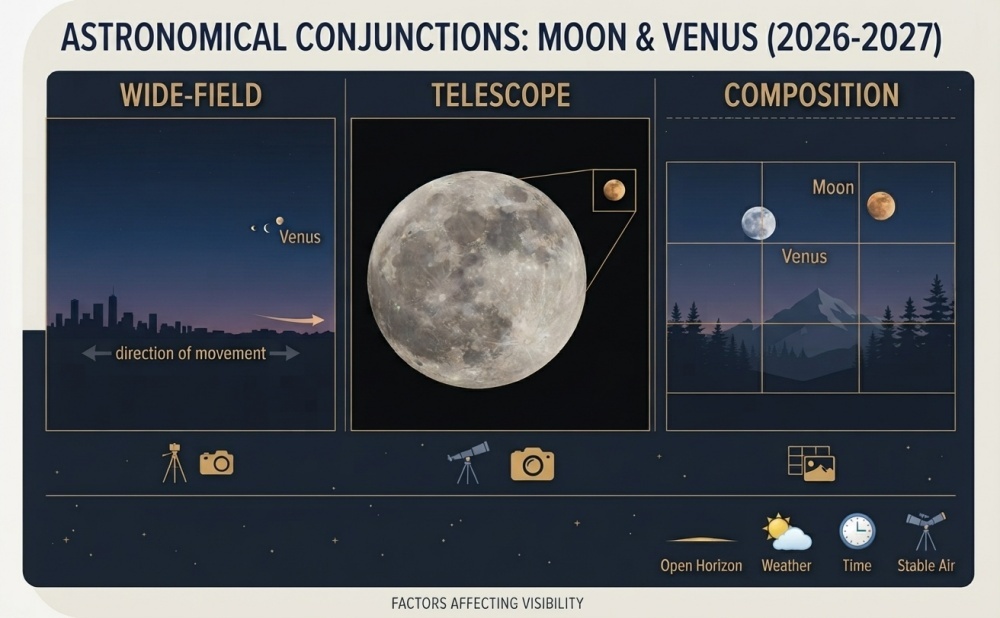
Wide-Field Photography
A standard or wide-angle lens is one of the easiest ways to photograph the conjunction.
Use a tripod to keep the camera steady and begin with a relatively short exposure. The Moon and Venus are both bright, so a long exposure can easily overexpose the lunar crescent.
As twilight changes, adjust your shutter speed, aperture, and ISO. Manual exposure gives you more control when the brightness of the sky changes quickly.
A wide composition can be especially effective. Instead of photographing only the two objects, include something in the foreground, such as:
A building or city skyline
A mountain or hill
Trees or a natural horizon
An observatory or telescope
A recognizable architectural feature
A foreground gives the image a sense of scale and shows how the conjunction appeared from Earth.
You can also take several photographs over 20–30 minutes as the sky becomes darker. The changing color of twilight can create very different results without changing your location.
Telescope Photography
A telescope can provide a closer view, but field of view becomes especially important.
At high magnification, the Moon may fill much of the frame while Venus disappears outside the image. If your goal is to capture both objects together, start with a wider field and check your framing before increasing magnification.
For detailed lunar photography, you can photograph the Moon separately. This lets you use exposure settings that preserve lunar surface detail without trying to balance the much smaller and brighter Venus in the same image.
Planetary imaging can also benefit from video capture and frame selection. However, the low altitude of the pair may introduce atmospheric turbulence, so a clear and stable evening is more valuable than simply increasing image scale.
Composition Tips
The Moon and Venus do not need to be centered in the frame.
Try placing the pair slightly to one side and leaving open sky in the direction of their movement. This can make the photograph feel more natural and give the image a stronger sense of space.
For a landscape photograph, shoot during twilight rather than waiting for a completely dark sky. The remaining blue light can reveal details in the foreground while keeping Venus and the crescent Moon clearly visible.
If you want a more dramatic image, plan your location before the event. Check where the western or southwestern horizon is and identify any buildings, trees, or other foreground elements that could work well in the composition.
Best Conditions for Observation and Photography
A few simple preparations can improve your experience of the night sky September 2026 has to offer.
Find an open horizon.
The Moon and Venus will be relatively low for many observers, so a clear western or southwestern horizon is valuable.
Check the weather.
Clouds, haze, and humidity near the horizon can hide the pair even when the rest of the sky appears clear.
Check local timing.
The exact visibility window varies with location. Use a reliable astronomy app or sky chart to check when the Moon and Venus will be above your horizon.
Look for stable air.
If you plan to use a telescope, atmospheric stability can affect image sharpness, especially when the objects are low.
Prepare your equipment early.
Set up your tripod, camera, telescope, or binoculars before the pair becomes difficult to see. This gives you more time to focus and frame the scene.
Plan your photo location.
If you want to include a landscape, choose the location in advance and check the direction of the sky before September 14.
You do not need a remote dark-sky location. The Moon and Venus are bright enough to be seen from many urban and suburban areas, provided you have a reasonably clear view of the horizon.
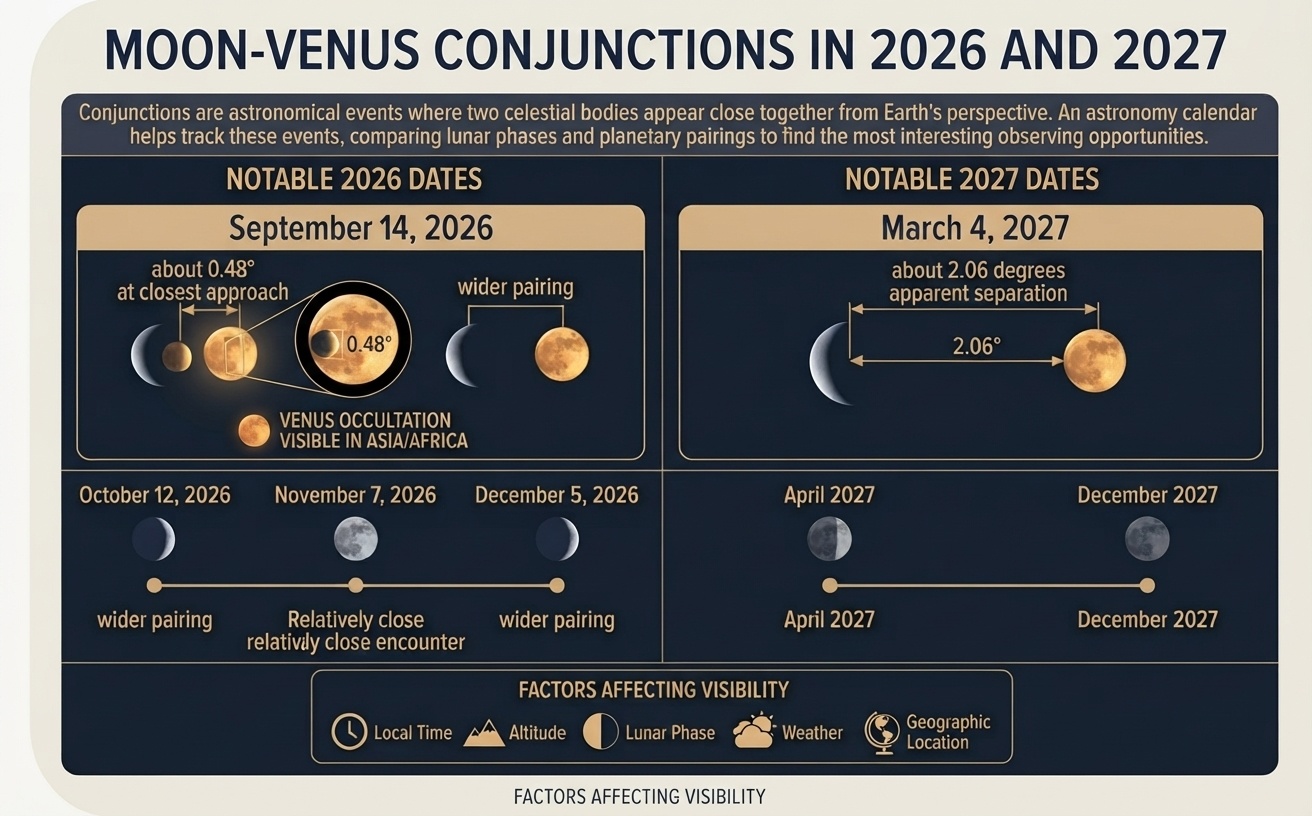
Moon-Venus Conjunctions in 2026 and 2027
The Moon passes near Venus regularly, but the apparent separation changes from one event to another. Some pairings are relatively wide, while others produce much closer encounters.
This is why a single conjunction does not represent the only opportunity to observe Venus near the Moon. If you enjoy tracking the evening sky, keeping a simple astronomy calendar can help you compare different lunar phases and planetary pairings.
Notable 2026 Dates
Several Moon-Venus encounters occur during 2026, but the September 14 event stands out because of its particularly close apparent separation.
September 14, 2026 — about 0.48° at closest approach
October 12, 2026 — a wider pairing
November 7, 2026 — another relatively close encounter
December 5, 2026 — a wider Moon-Venus pairing
The September event is especially interesting because it combines a close apparent pairing with a thin waxing crescent Moon. NASA also identifies September 14 as one of the three Venus occultations occurring in 2026.
Notable 2027 Dates
Moon-Venus conjunctions continue into 2027. For example, the Moon and Venus will have another conjunction on March 4, 2027, with an apparent separation of about 2.06 degrees, considerably wider than the September 2026 event.
The 2027 calendar includes additional Moon-Venus conjunctions throughout the year, including dates in April and December.
The exact separation is only one part of the observing experience. Local time, altitude, lunar phase, weather, and geographic location all affect how impressive a conjunction will appear from the ground.
A Celestial Event to Add to Your Calendar
The September 14, 2026 Moon and Venus conjunction will be an accessible event for beginners, experienced observers, and astrophotographers. The Moon and Venus will appear less than half a degree apart at their closest, while observers in parts of the occultation path may have the opportunity to see Venus pass behind the Moon.
You can enjoy the event with your eyes, binoculars, or a telescope. A wide-angle camera lens can capture the pair with a landscape, while a telescope can provide a closer view of the lunar crescent and Venus.
The event is also a good reminder that interesting astronomy does not always require advanced equipment. A clear horizon, a little planning, and a basic understanding of where to look can be enough to turn an ordinary evening into a rewarding observing session.
If you are planning your September 2026 night sky observations, mark September 14, 2026 on your calendar. This close moon and Venus conjunction 2026 offers a simple way to enjoy the evening sky, practice your observing skills, and capture a memorable celestial pairing.
 Google
 Amazon
There are no customer reviews yet . Leave a Reply !