

Table of Contents
Why Petzval APO? SV580 Optical Design, Zemax Analysis & Imaging
For astrophotographers shooting wide-field deep-sky targets, choosing a telescope is about more than aperture and focal length.The optical design determines how well a telescope controls field curvature, chromatic aberration, and off-axis image quality—especially when using a large camera sensor.
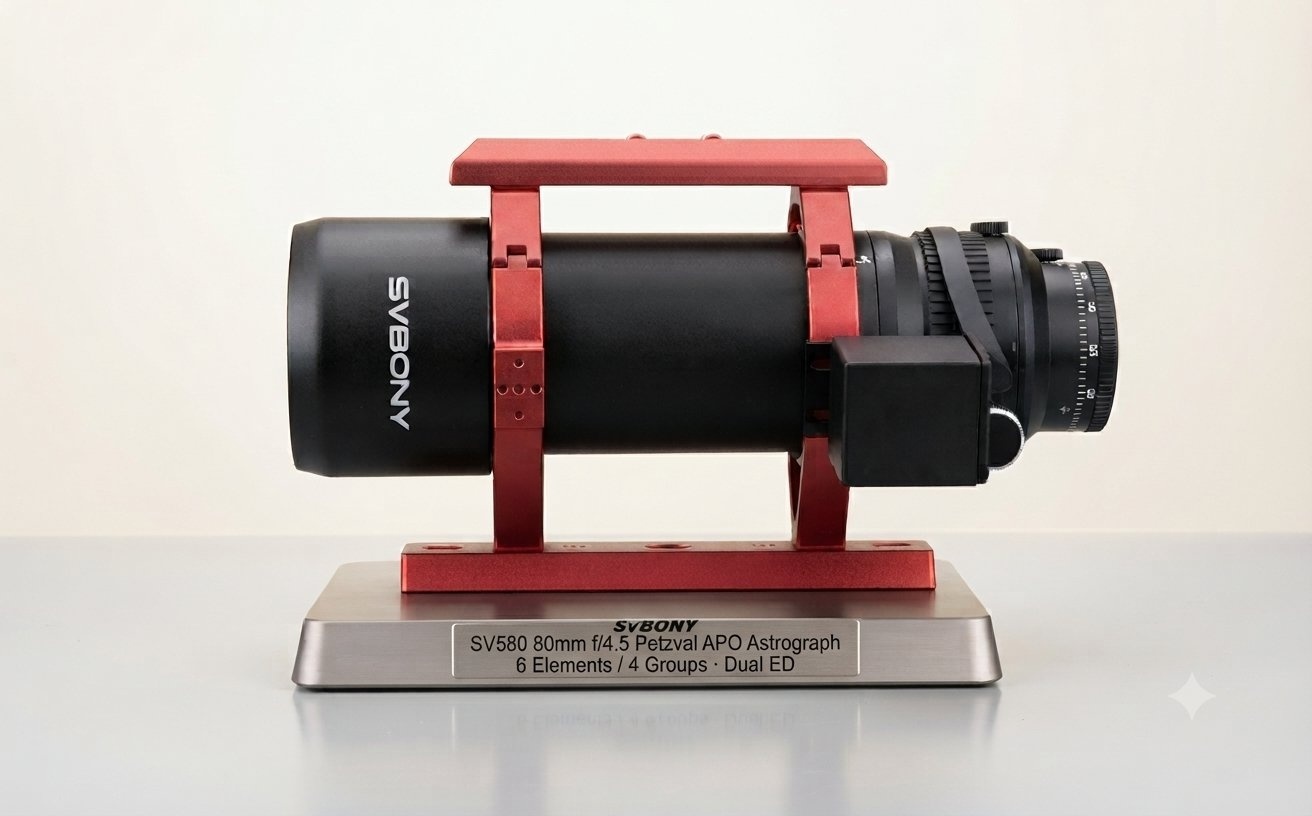
The SVBONY SV580 is an 80mm f/4.5 Petzval APO astrograph designed for fast, wide-field, full-frame deep-sky astrophotography. Its Petzval APO optical system integrates field correction and chromatic correction into a compact optical configuration, with a specified 44mm image circle for full-frame imaging.
In practical terms, the design addresses three common needs in deep-sky imaging: maintaining controlled image quality across a large sensor, simplifying the optical configuration, and improving imaging efficiency with a fast focal ratio.
This article examines how the SV580's Petzval APO optical design works, what its Zemax analysis shows, how the prototype was refined, and how the telescope performs in real-world imaging.
Why Choose a Petzval APO for Deep-Sky Astrophotography?
Wide-field deep-sky imaging places demanding requirements on an optical system. Stars near the edge of a camera sensor can become larger or less well corrected, different wavelengths may focus at slightly different positions, and external field-correction components can add complexity to the imaging train.
The SV580 approaches these challenges through its Petzval APO optical design, integrated field correction, dual ED elements, fast f/4.5 focal ratio, and 44mm image circle.
Key Design Advantages for Deep-Sky Imaging
These design choices work together around three practical concerns: edge-of-field image quality, imaging-train simplicity, and capture efficiency.
How Does the Petzval APO Optical Design Work?
A traditional refractor can produce field curvature and off-axis aberrations as the image moves farther from the optical axis. For astrophotographers using larger sensors, this may become visible as stars near the edge of the frame appear less consistent with those at the center.
A Petzval optical system uses additional lens groups to provide field correction within the telescope itself. This approach helps manage field curvature and off-axis aberrations, making the configuration well suited to wide-field astrophotography.
The SV580 combines this Petzval configuration with APO correction using dual ED elements. Rather than treating field correction and chromatic correction as separate accessories or adjustments, both are incorporated into the telescope's optical system.
The result is an optical architecture designed around the requirements of wide-field deep-sky imaging, where image quality needs to remain controlled across a large sensor.
Optical Layout
The SV580 uses a six-element, four-group Petzval APO optical system with two ED elements and integrated field correction.
The optical configuration combines Petzval field correction with APO chromatic correction in a single optical system. The ED elements contribute to controlling wavelength-dependent aberrations, while the Petzval configuration incorporates field correction into the telescope's optical path.
By integrating field correction into the optical design, the SV580 does not require a separate field flattener in its basic optical configuration. This keeps the core optical system more straightforward for astrophotography setups.
The optical structure is particularly relevant when imaging stars across a large camera sensor. Performance therefore needs to be evaluated not only near the optical axis, but also toward the outer field.
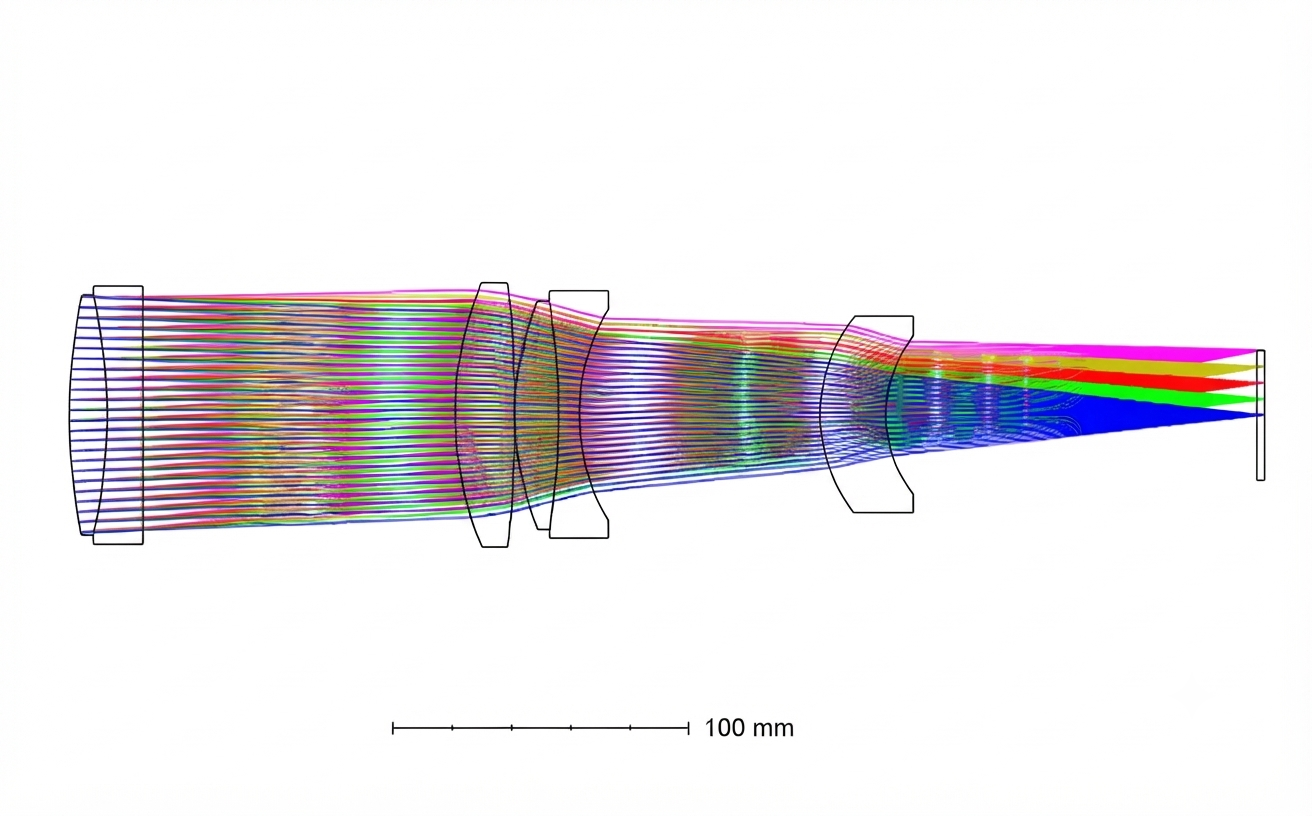 The following analysis examines the resulting optical performance across different wavelengths and field positions.
SV580 Optical Performance Analysis
The analysis examines several parameters relevant to deep-sky astrophotography, including chromatic behavior, point-source imaging, contrast transfer, and ray transmission across the image field.
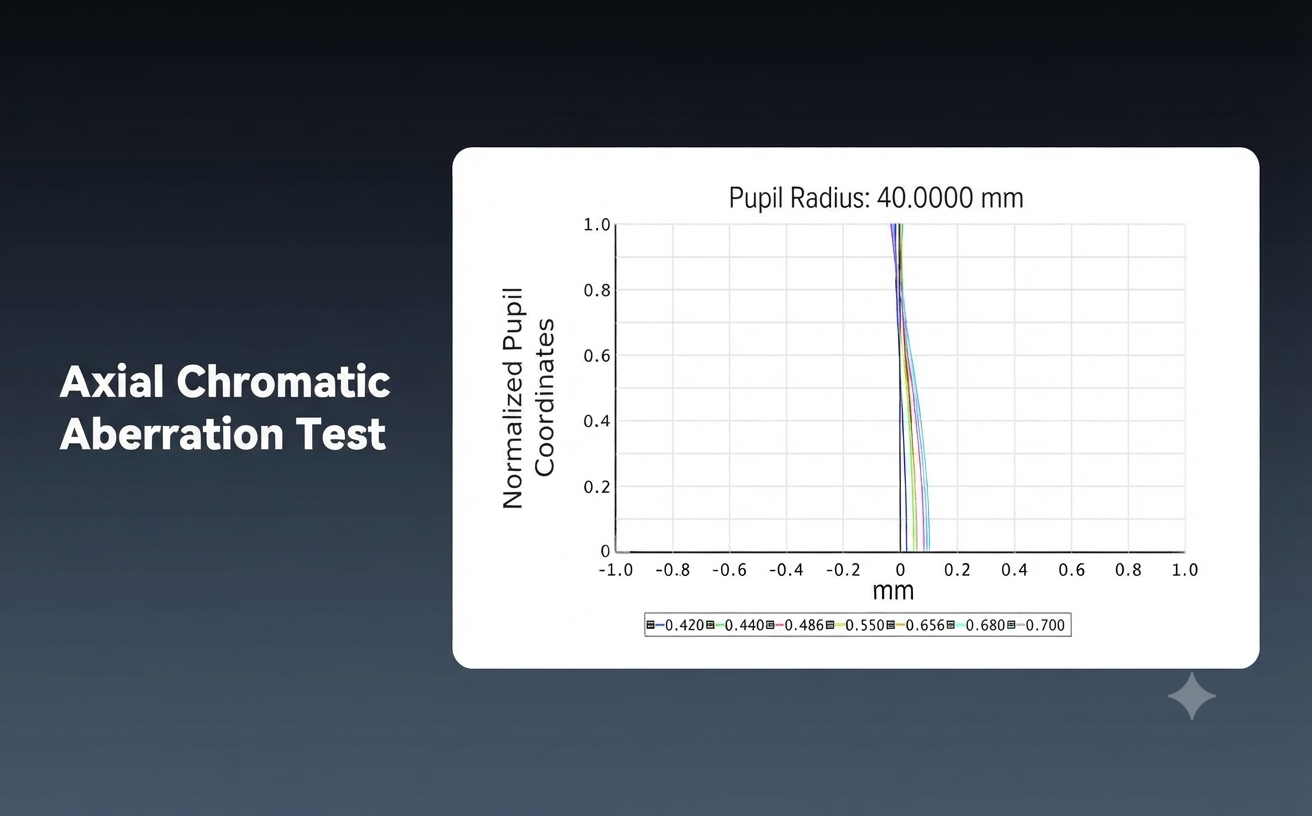
Axial Aberration
Different wavelengths can focus at slightly different positions along the optical axis. If this difference is not well controlled, it can contribute to chromatic blur or color fringing around stars.
The SV580 axial aberration analysis covers wavelengths from 0.420 μm to 0.700 μm. The wavelength curves remain relatively close, indicating controlled wavelength-dependent focus behavior across the analyzed spectrum.
The dual ED elements in the APO optical system contribute to this chromatic correction.
For astrophotography, better control of wavelength-dependent focus differences can support cleaner star rendering and reduce the risk of visible color fringing.
Spot Diagram
A spot diagram provides a direct view of how a point source is reproduced at different positions across the image field. This is particularly relevant to astrophotography, where stars act as natural point sources.
The SV580 spot diagram evaluates field positions from the optical axis to approximately 22 mm off-axis.
The RMS spot radius ranges from 1.625 μm to 2.700 μm, while the GEO spot radius ranges from 3.266 μm to 6.008 μm.
The spot size increases gradually toward the outer field, with relatively compact spots through the central and inner field.
For astrophotography, this center-to-edge behavior is important because stars are distributed across the entire sensor. Controlled spot growth helps maintain more consistent star rendering as the image moves away from the optical axis.
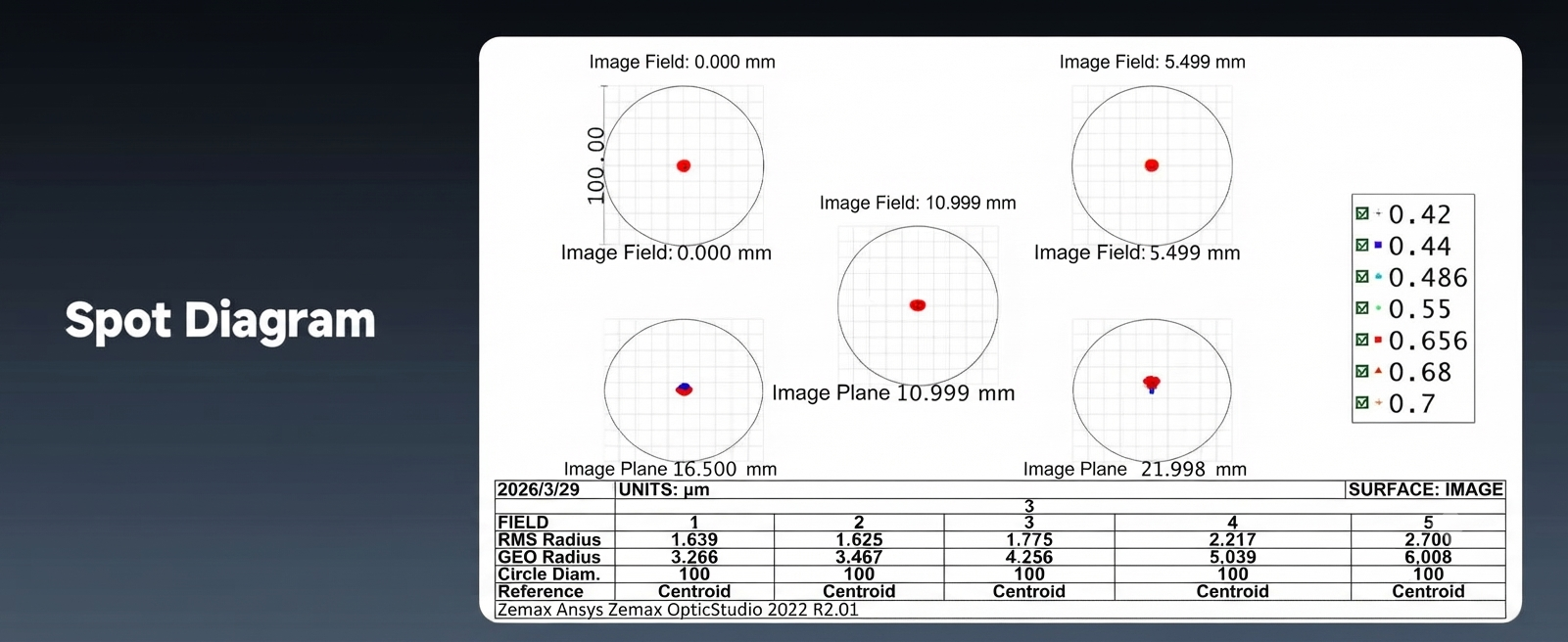
The spot diagram should be considered together with the other optical analyses rather than as a standalone measurement of real-world image sharpness.
FFT MTF vs. Field
Spot size is not the only factor affecting image quality. An optical system also needs to transfer contrast and fine detail effectively across the image field.
Modulation Transfer Function (MTF) describes how well an optical system transfers contrast at different spatial frequencies.
The SV580 FFT MTF analysis evaluates both tangential (T) and sagittal (S) performance at 10 cycles/mm and 30 cycles/mm.
Based on the provided analysis, MTF remains relatively stable across the analyzed field, with values above 0.8 at 10 cycles/mm and above 0.7 at 30 cycles/mm.
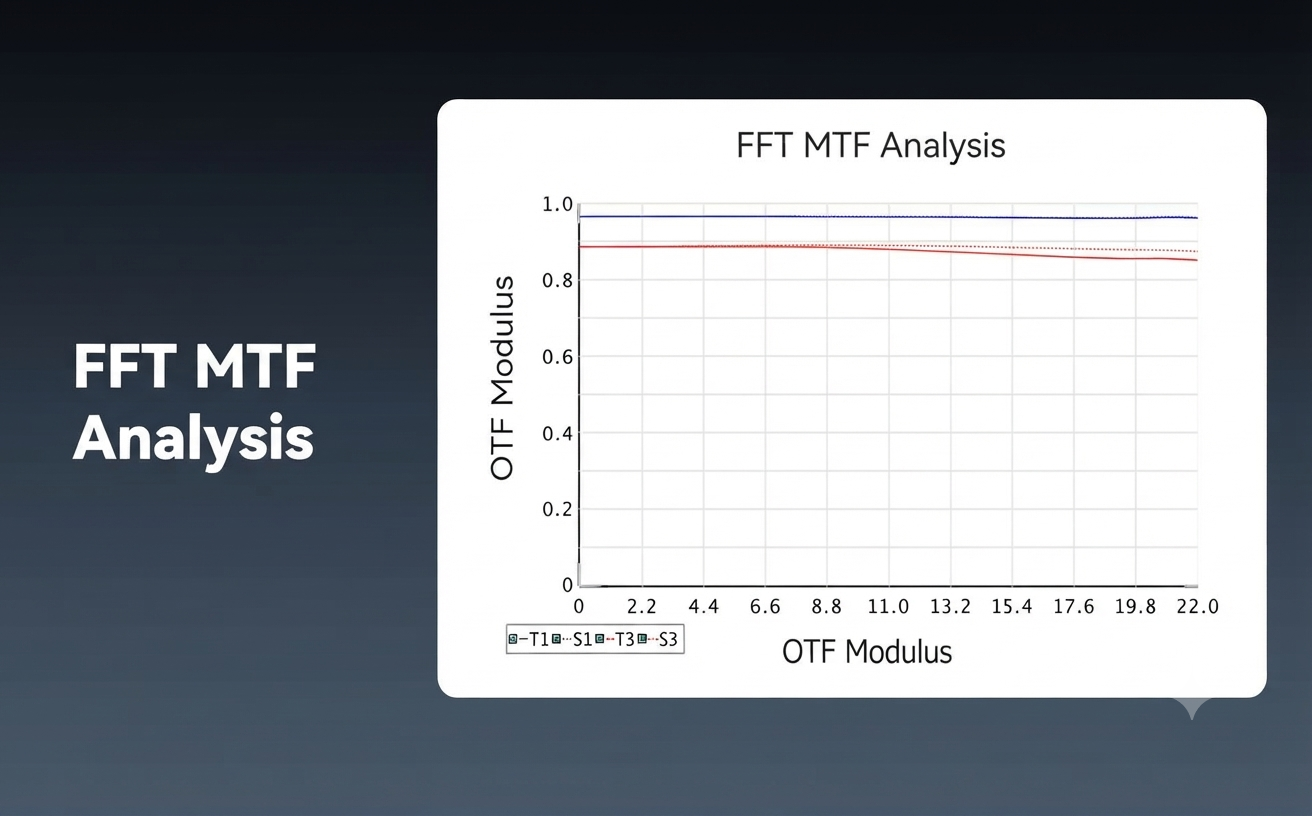
For deep-sky astrophotography, stable contrast transfer across the field is relevant to preserving subtle structures and fine detail in nebulae and other extended targets.
Ray Transmission Across the Image Circle
Large camera sensors can introduce another optical concern: vignetting toward the outer field.
The ray-transmission analysis evaluates the fraction of unvignetted rays across the image field. The curve remains close to 1.0 out to approximately 22 mm from the optical axis, indicating a high fraction of unvignetted rays across the analyzed field.
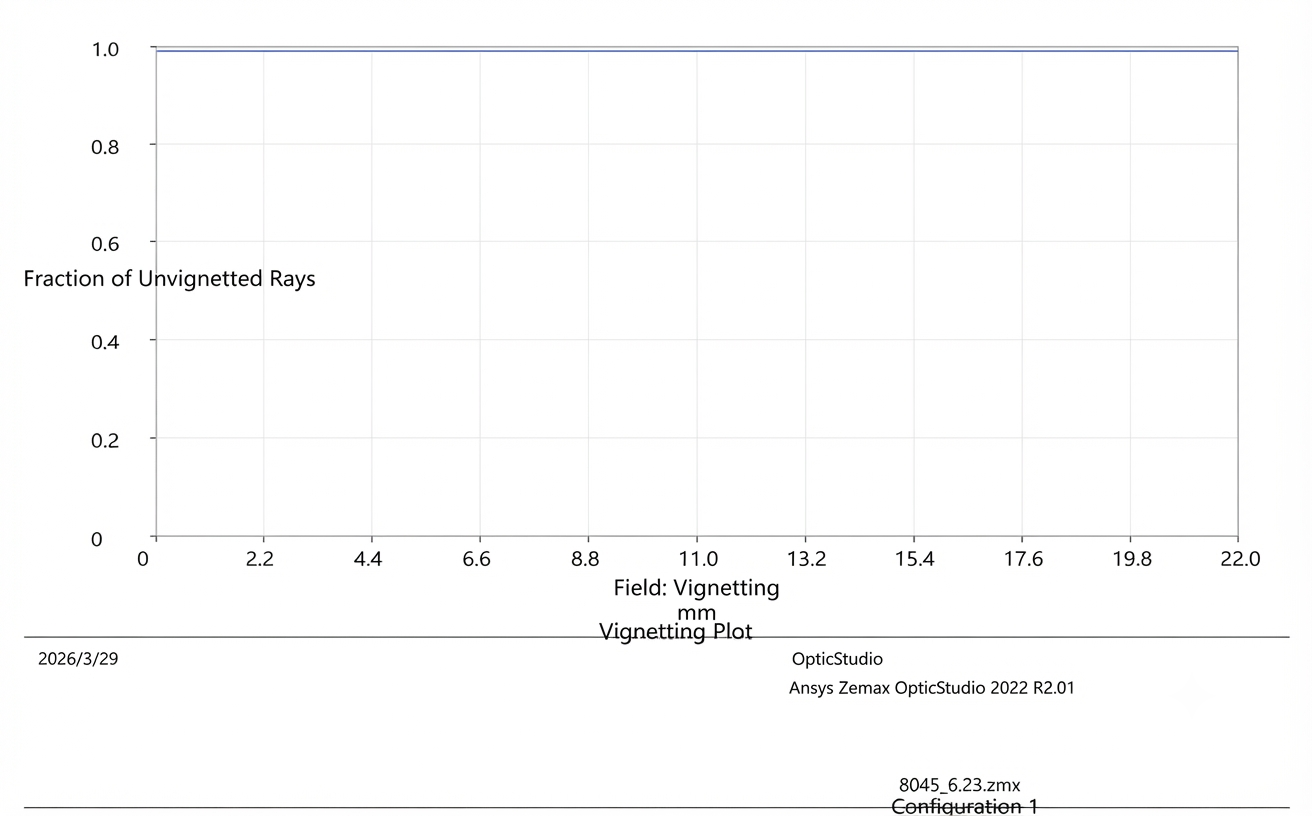
For astrophotographers, effective ray transmission across the field helps reduce the risk of severe mechanical or optical vignetting and supports useful image coverage across a large sensor.
This analysis describes unvignetted ray transmission rather than relative illumination. A separate relative-illumination analysis would be required to quantify brightness uniformity across the sensor.
Prototype Refinements: From EP1 to F9395B
Optical performance is only part of developing an astrophotography telescope. Mechanical usability and integration also influence the overall imaging experience.
During prototype development, feedback from the earlier EP1 sample was incorporated into the updated F9395B sample.
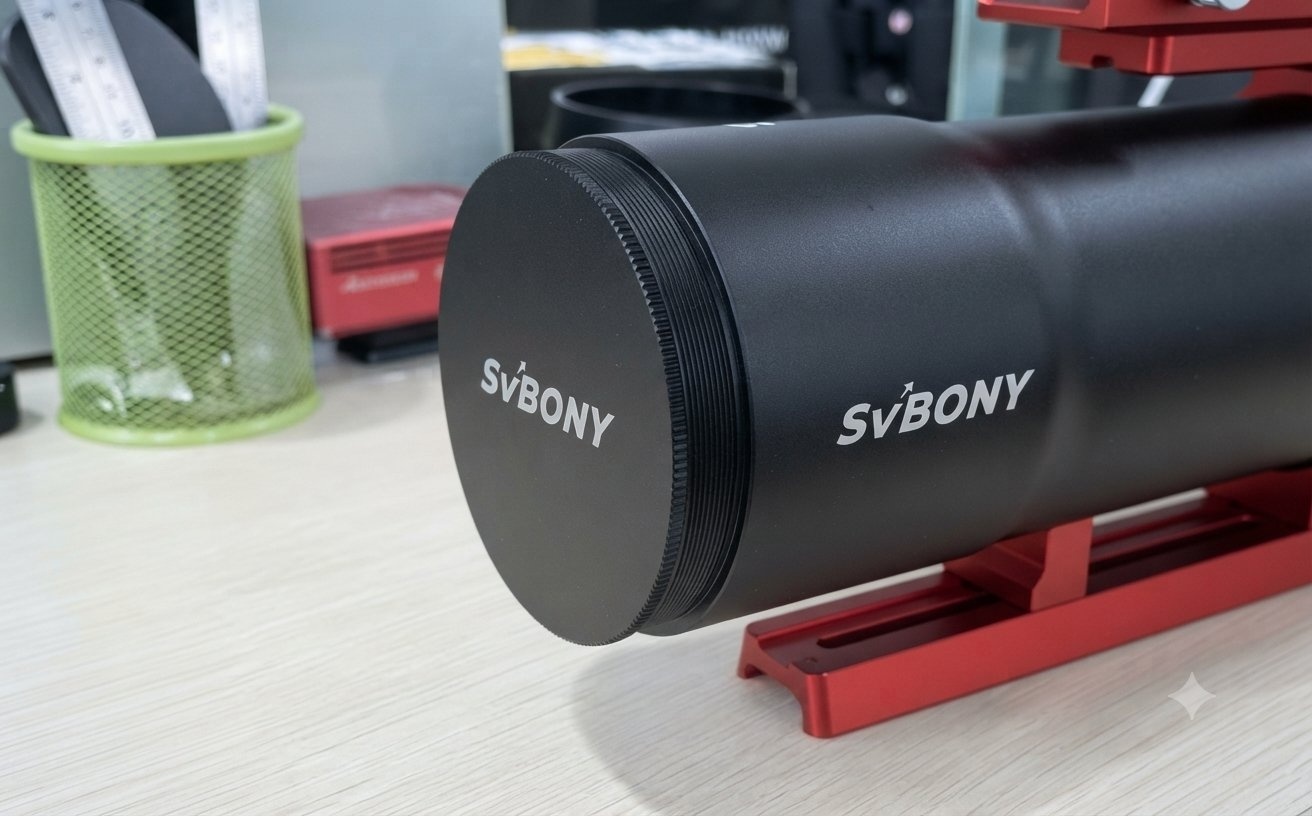
Several mechanical details were refined. The lens cap was changed to a conventional push-on design, while the dew shield was updated from a reverse-threaded attachment to a conventional retractable structure.
The transitions between the dew shield, objective group, main tube, and focuser were also reviewed. Further attention was given to tube proportions and the spacing available between the two tube rings.
The outer edge of the focuser brake was also refined for a more integrated mechanical appearance.
In testing, the F9395B sample showed improved star quality and aberration control compared with the earlier EP1 prototype. These observations contributed to the continued refinement of the SV580's optical and mechanical design.
SV580 Astrophotography Setup
Optical simulations provide controlled performance data, while real-world astrophotography shows how the telescope integrates into an actual imaging system.
The SV580 was evaluated with the following setup:
This configuration combines the SV580 with electronic focusing, guiding, power management, and a dedicated astronomy camera for deep-sky imaging.
Because the ASI2600MC uses an APS-C sensor, the real-world images demonstrate the telescope in an APS-C imaging configuration. The telescope's specified 44mm image circle and optical analysis address the broader field intended for full-frame imaging.
From Zemax Analysis to Real-World Imaging
The optical analysis provides controlled measurements of the SV580's performance. Real astrophotography provides another perspective: how the optical system renders actual deep-sky targets.
one target were used for real-world imaging: NGC 1499, the California Nebula.
NGC 1499, the California Nebula, is a large, extended emission nebula. Its apparent size makes it well suited to a wide-field imaging setup, allowing the 360mm focal length to capture a substantial region of the target.
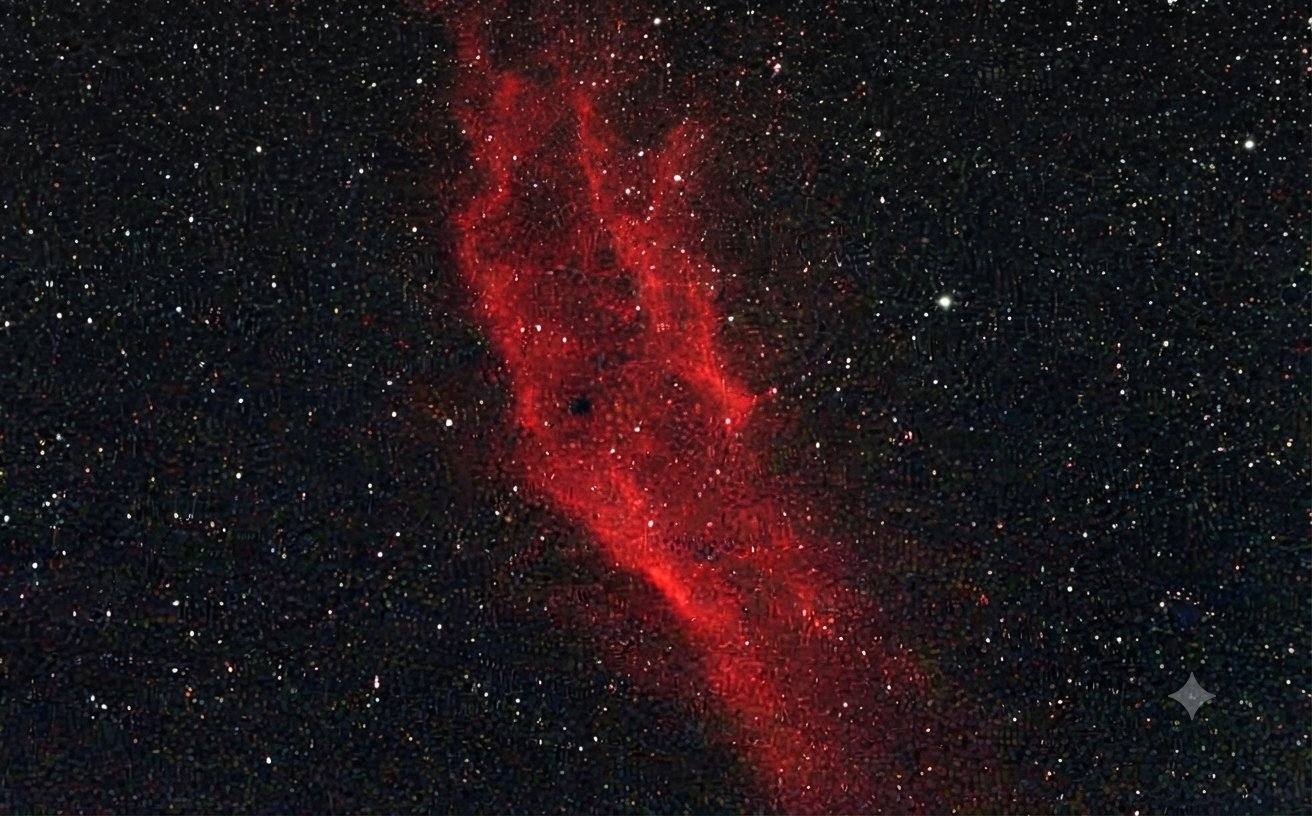
The real images complement the Zemax analysis by connecting the modeled optical performance with actual deep-sky imaging.
From Optical Design to Imaging Performance
The SV580 brings its optical design, performance analysis, and practical imaging experience together in a single astrograph.
The Petzval APO optical system integrates field correction and chromatic correction into the telescope, while the f/4.5 focal ratio and 360mm focal length provide a fast, wide-field configuration for deep-sky imaging. The specified 44mm image circle supports full-frame imaging, and the integrated field correction simplifies the basic optical configuration.
The Zemax analysis, prototype refinement, and real-world imaging provide complementary perspectives on the SV580's development—from optical design and modeled performance to practical astrophotography.
 Google
 Amazon
There are no customer reviews yet . Leave a Reply !